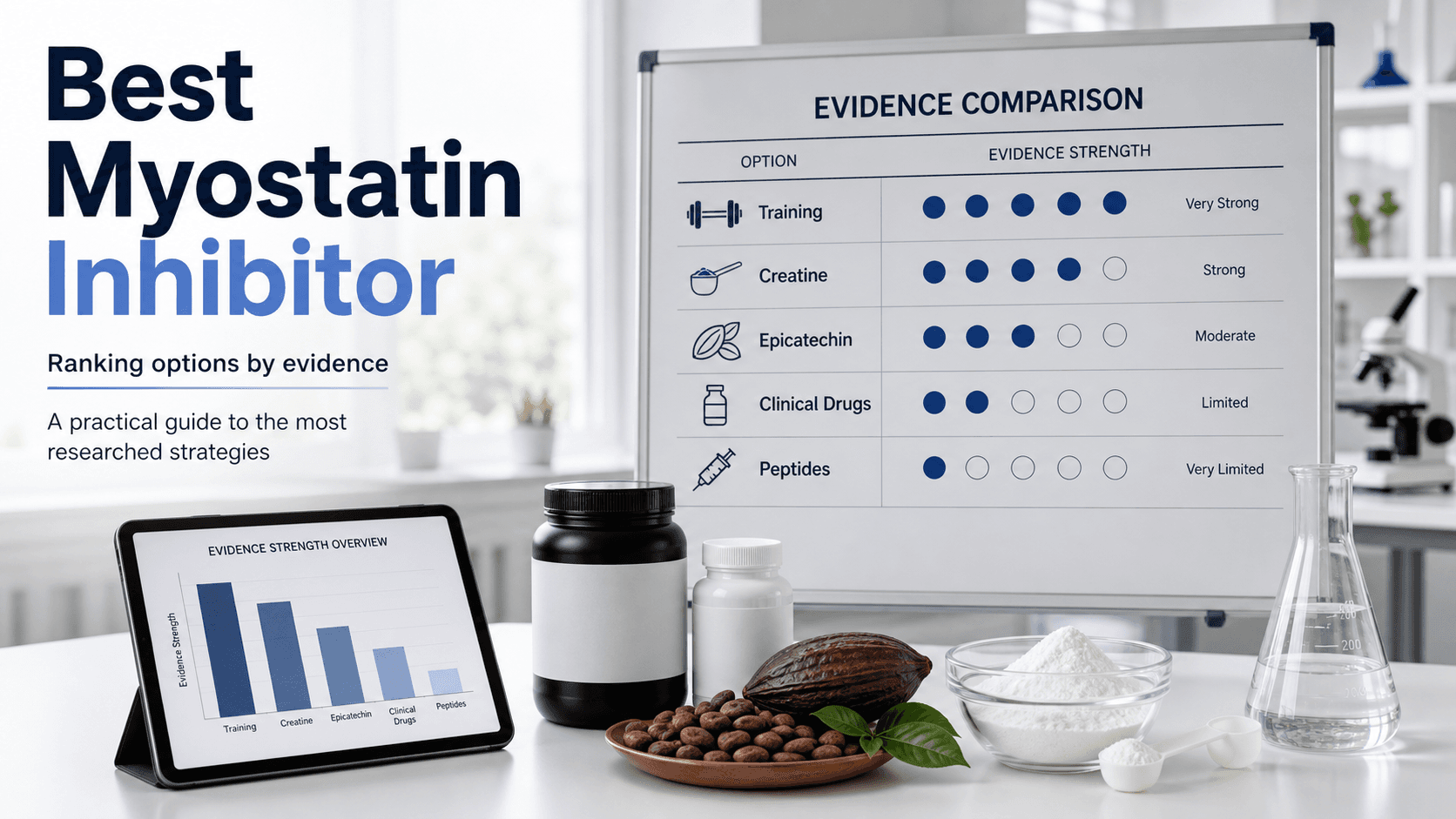
The honest answer is frustrating. The best myostatin inhibitor depends on whether you mean a safe training strategy, a supplement, a clinical drug, or a risky online shortcut.
Key takeaways
- For most readers, the best practical option is not a direct blocker. It is progressive training, enough protein, sleep, and creatine if appropriate.
- Epicatechin is the most common natural myostatin pick in ranking pages, but the human evidence is still too thin for big claims.
- Clinical drugs have the strongest pathway logic, but they belong to medical trials and defined diseases, not casual muscle gain.
- Peptides, YK11, and gray-market injections should not be ranked like normal supplements.
Best myostatin inhibitor ranking table
Rank by real outcomes. A useful ranking should separate muscle-building basics from pathway-targeting drugs and marketing claims.
| Rank | Option | Best fit | Evidence read | Bottom line |
|---|---|---|---|---|
| 1 | Progressive resistance training plus adequate protein | Most healthy lifters | Strong for strength and hypertrophy | Best practical foundation, even if it is not a direct drug-like blocker |
| 2 | Creatine monohydrate | Lifters who tolerate it well | Strong for performance support; mixed for myostatin-specific effects | Best supplement starting point |
| 3 | Clinically supervised myostatin-pathway drugs | Defined medical indications | Strongest pathway targeting, but indication-specific | Most powerful category, not a consumer product |
| 4 | Epicatechin / cocoa flavanol supplements | Curious supplement users | Early human signals, inconsistent practical outcomes | Interesting, but easy to overhype |
| 5 | HMB, vitamin D, protein powders, nutrient correction | Specific gaps or diets | Useful in context, not direct blockers | Fix the gap, not the buzzword |
| 6 | Follistatin-style peptides, ACE-031 claims, YK11 | High-risk online searches | Unreliable sourcing and safety concerns | Poor choice for normal buyers |
That ranking may look less exciting than the SERP. It is also more useful. If a page ranks a supplement above training, protein, and creatine without showing better human outcomes, the ranking is probably built for clicks.
Why ranking pages get messy
Search intent is commercial. The top results for "best myostatin inhibitor" are full of product lists, epicatechin capsules, HMB products, egg-derived supplements, peptide claims, and comparison pages.
Some pages also mix unrelated categories. A cocoa extract, a prescription-stage antibody, a receptor blocker, YK11, and a training program are not the same kind of option.
That category mixing is where bad decisions start. A reader arrives looking for the strongest option, then gets pushed toward the easiest thing to buy.
The safer question is different: what has the best evidence for the goal you actually care about?
Best overall: training and protein
The foundation still wins. Progressive resistance training, appropriate calories, enough protein, and recovery habits are the most reliable way to build or keep useful muscle.
That answer can feel unsatisfying because it does not sound like a blocker. But the outcome matters more than the label.
Training changes the whole muscle-growth environment. Protein gives the body material to repair and build tissue. Sleep and recovery control whether the work becomes adaptation or just fatigue.
If those basics are weak, a niche myostatin product is usually an expensive distraction.
Best supplement starting point: creatine
Creatine earns first consideration. It is not best because it is the strongest myostatin blocker; it is best because it has a strong practical evidence base for training output and lean-mass support.
Some myostatin articles mention creatine because training studies have reported changes in myostatin-related signaling. That is interesting, but it should not be the main reason to use it.
The cleaner reason is simple. Creatine helps many people train harder, recover between high-effort sets, and support lean mass over time.
For a supplement buyer, that is a stronger case than a label promising a pathway shortcut.
For ingredient-by-ingredient details, see the myostatin inhibitor supplement review.
Best natural candidate: epicatechin
Epicatechin gets the spotlight. It appears in cocoa, dark chocolate, green tea, and many myostatin supplement pages.
The best argument is that epicatechin may influence the follistatin-to-myostatin environment. The problem is scale. Small marker changes or short studies do not prove visible muscle gain in trained people.
That makes epicatechin a "maybe," not a winner. It can be a reasonable curiosity if the product is transparent, tested, and not priced like a miracle.
Watch the label. Many products hide doses, stack stimulants, or borrow drug-level language to sell a food-derived ingredient.
Strongest category: clinical drugs
Drugs are the direct path. Antibodies and receptor blockers can target myostatin or related activin signaling more forcefully than supplements.
That does not make them the best choice for healthy readers. It makes them medical interventions that must be judged by indication, endpoint, safety, and supervision.
Bimagrumab, trevogrumab, apitegromab, and taldefgrobep alfa show where the serious field is moving. Obesity trials now ask whether these agents can improve body composition during GLP-1 therapy, while SMA programs ask whether muscle responsiveness can add benefit beyond motor-neuron treatment.
For that clinical side, read the myostatin inhibitor drug pipeline.
What not to rank as best
Some options need separation. Follistatin-style injections, ACE-031-style claims, and YK11 should not be placed beside creatine and epicatechin as if they are normal shelf supplements.
The issue is not just legality or branding. It is product identity, sterility, dose uncertainty, systemic biology, and unknown long-term risk.
YK11 is especially misleading in supplement-style lists. It is not a normal cocoa extract or sports nutrition ingredient. If a ranking page treats it casually, trust the page less.
The same applies to any vendor that uses clinical trial language to sell an online vial without explaining the safety gap.
Best for different goals
Match the goal first. "Best" changes when the reader changes.
| Goal | Best practical direction | Why |
|---|---|---|
| Building muscle as a healthy lifter | Training, protein, calories, creatine | Strongest real-world payoff with the least category confusion |
| Preserving muscle during weight loss | High-protein diet, resistance training, medical obesity care when needed | Lean mass depends on diet, training, rate of loss, and treatment context |
| Exploring natural options | Epicatechin only as a cautious add-on | Interesting pathway signal, but not a proven transformation tool |
| Understanding medical candidates | Follow drug trials and regulatory updates | Strongest mechanisms are being tested for specific indications |
| Avoiding bad purchases | Demand dose, testing, human outcomes, and warnings | Most bad products fail one of those checks |
That is the ranking most search pages skip. They rank what can be sold, not what should be trusted.
Buyer-safe checklist
Use a simple filter. Before buying anything labeled as a myostatin inhibitor, ask these questions.
- Does the label show exact ingredient amounts?
- Does the brand provide third-party testing?
- Does the evidence measure human outcomes, not only pathway language?
- Does the product avoid hormone-like or peptide claims?
- Does the page admit that myostatin is only one part of muscle growth?
- Does the cost make sense compared with creatine, food quality, coaching, or recovery?
If the answer is no, keep your money.
What the best choice looks like
The best choice is boring. It makes your next month of training more consistent, measurable, and recoverable.
For most readers, that means a structured lifting plan, enough protein, a calorie target that matches the goal, creatine if appropriate, and fewer purchases based on pathway buzzwords.
For patients in medical care, the best option is different. It depends on diagnosis, trial eligibility, medication history, body-composition goals, and clinician oversight.
Those worlds should not be blurred. When they are, the article is usually selling harder than it is explaining.
Sources and notes
- The Effects of Dietary Supplements, Nutraceutical Agents, and Physical Exercise on Myostatin Levels
- The 2 Best Myostatin Supplements - Muscle and Brawn
- Top 5 Myostatin Inhibitor Supplement Choices - Strong Supplement Shop
- Best Myostatin Inhibitor Supplements - Neurogan Health
- Bimagrumab plus semaglutide randomized phase 2 trial - Nature Medicine
- Regeneron Phase 2 COURAGE results
Frequently Asked Questions
What is the best myostatin inhibitor?
For most healthy readers, the best practical option is resistance training, adequate protein, recovery, and creatine if appropriate. Direct myostatin-pathway drugs are medical tools for defined settings.
Is epicatechin the best natural myostatin inhibitor?
It is the most common natural candidate in search results, but the evidence is not strong enough to promise major muscle gain. Treat it as an optional add-on, not the foundation.
Are myostatin inhibitor peptides better than supplements?
They may sound stronger, but they carry much higher safety, sourcing, and oversight problems. They should not be handled like normal sports supplements.
What should I buy first?
Most people should spend first on food quality, protein consistency, creatine, coaching, or recovery support before paying for a niche myostatin-labeled product.
This article is for educational purposes only and is not medical advice. Talk with a qualified healthcare professional before using supplements, peptides, hormone-like products, or medications promoted for muscle growth or myostatin inhibition.