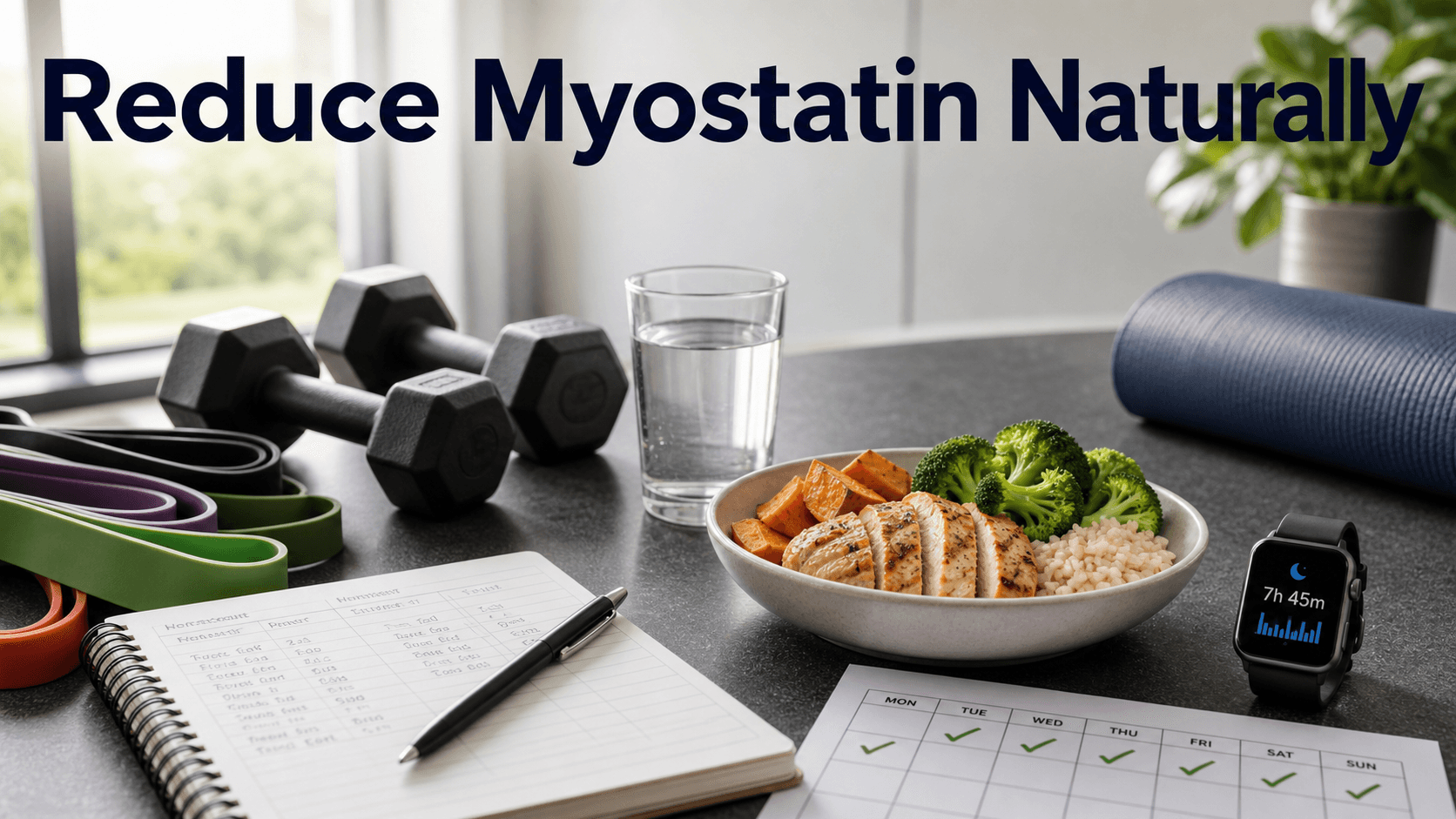
You reduce the brake indirectly. To reduce myostatin naturally, start with the levers that reliably improve muscle outcomes: progressive training, adequate protein, enough recovery, and smart supplement basics.
Key takeaways
- The practical answer is a 30-day execution plan, not a single food or pill.
- Resistance training has the strongest connection to useful muscle adaptation and myostatin-related signaling.
- Protein and creatine support the training response better than most myostatin-labeled products.
- Cocoa, green tea, and epicatechin are interesting, but they should not replace training basics.
- Avoid shortcuts that present peptides, SARMs, or drug candidates as natural wellness tools.
How to reduce myostatin naturally: action plan
Use a simple order. The goal is not to micromanage one protein in isolation. The goal is to create the environment where muscle can respond.
| Step | Action | Target | Why it helps |
|---|---|---|---|
| 1 | Lift with progression | 3 to 4 sessions weekly | Repeated loading is the main natural signal for strength and hypertrophy |
| 2 | Eat enough protein | Often 1.6 to 2.2 g/kg/day for active adults | Supports repair and adaptation from training |
| 3 | Consider creatine | 3 to 5 g/day if appropriate | Helps many people train harder and support lean mass |
| 4 | Sleep consistently | 7 to 9 hours for most adults | Keeps recovery from becoming the bottleneck |
| 5 | Add food-based compounds | Cocoa, green tea, cruciferous vegetables, berries | Supports diet quality without miracle claims |
| 6 | Check vitamin D if risk is present | Blood test and clinician-guided correction | Corrects a common muscle-health gap when low |
| 7 | Avoid risky shortcuts | Skip peptide and SARM-style products | Prevents category mistakes and safety problems |
That is the evidence-led path. If a page says one capsule can reduce myostatin naturally without the training and recovery part, it is overselling.
For the ingredient overview, read natural myostatin inhibitor options. For the broader science, start with what myostatin does.
Week 1: make training measurable
Track the work first. You cannot improve a signal you never measure.
Pick a plan you can repeat for four weeks. Three full-body sessions or four upper/lower sessions both work if the plan covers squats or leg presses, hip hinges, presses, pulls, and loaded carries or core work.
Do not chase soreness. Chase progression.
Use one of these progress markers:
- Add one rep with the same load.
- Add a small amount of weight.
- Add one set to a key movement.
- Improve form at the same workload.
The point is consistency. Myostatin is part of a larger adaptation system, and the body needs repeated reasons to adapt.
Week 2: fix protein and calories
Food sets the ceiling. If protein and calories are mismatched to the goal, the training signal has less to work with.
Start with protein. Many active adults land in the 1.6 to 2.2 g/kg/day range, but medical history, kidney disease, appetite, digestion, body size, and weight-loss goals can change the right target.
Spread protein across meals. It is easier to repeat and usually easier on digestion.
Calories matter too. A steep deficit can make muscle gain harder. A surplus can help gaining phases but may not fit fat-loss goals. During weight loss, resistance training and protein are especially important because the body needs a reason to keep lean tissue.
That is why "reduce myostatin naturally" should never mean "ignore the diet."
Week 3: add creatine if it fits
Creatine is the simple add. It is not a magic myostatin switch, but it is one of the most useful sports nutrition tools for repeated high-effort training.
A common approach is 3 to 5 grams per day. Loading is optional. Consistency matters more than timing for most people.
Skip it or ask a clinician first if you have kidney disease, a complex medical history, or medication concerns.
Why include it here? Because improving training output is more useful than chasing a fragile pathway claim. If creatine helps you complete better sessions for months, that is a real advantage.
Week 4: protect recovery
Adaptation needs margin. Sleep, stress, and deloads are not glamorous, but poor recovery can make a good plan look ineffective.
Aim for a sleep window you can actually keep. Most adults do best around 7 to 9 hours, but the key is repeatability.
Watch these warning signs:
- Strength drops across multiple sessions.
- Motivation collapses despite a good plan.
- Sleep gets worse as training rises.
- Joint soreness lingers longer than usual.
- Appetite and mood swing hard.
If those appear, reduce volume before adding products. Better recovery often beats a new supplement.
Foods that may help
Choose foods first. The best food strategy is not a secret ingredient list. It is a diet pattern that supports training, body composition, and health.
Still, several food-derived compounds show up in myostatin discussions:
| Food group | Main compound angle | Practical use |
|---|---|---|
| Cocoa and dark chocolate | Epicatechin and flavanols | Use modestly within calories; avoid sugar-heavy framing |
| Green tea | Catechins, including epicatechin-related compounds | Useful beverage option, not a blocker |
| Broccoli sprouts and crucifers | Sulforaphane | Good diet quality; pathway claims need restraint |
| Berries and colorful plants | Polyphenols such as quercetin | Supports overall diet pattern |
| Protein foods | Amino acids for repair | More important than most niche compounds |
This is where the hype needs control. Foods can support the system. They do not override the system.
Supplements to treat carefully
Labels can mislead. A product can be natural-sounding and still make claims that are too strong.
Use this filter before buying:
- Does the label show exact doses?
- Is the ingredient backed by human outcome data?
- Is third-party testing available?
- Does the product avoid hormone-like or peptide language?
- Is it priced fairly compared with creatine and food basics?
Epicatechin can be reasonable to explore, but it should not be the first move. HMB may fit some contexts, especially lower training experience or higher muscle-loss risk, but it is not a universal shortcut.
For a fuller product-by-product breakdown, read the myostatin inhibitor supplement review.
What not to do
Avoid the category trap. Peptides, SARMs, clinical antibodies, and receptor blockers are not natural lifestyle tools.
They also do not belong in a casual "foods that reduce myostatin" list. The sourcing, dose, sterility, side-effect, sports-rule, and medical-oversight issues are different.
If a site jumps from green tea to YK11 or injection claims without slowing down, leave the page.
For current clinical candidates, use the myostatin inhibitor drug pipeline. For overall ranking across categories, see best myostatin inhibitor options.
A realistic 30-day checklist
Make the month visible. The fastest way to improve the plan is to remove guesswork.
| Day range | Focus | Done when |
|---|---|---|
| Days 1 to 7 | Choose repeatable training plan | All sessions are scheduled and logged |
| Days 8 to 14 | Hit protein target | Four or more days meet the planned range |
| Days 15 to 21 | Add creatine if appropriate | Daily habit is set and tolerated |
| Days 22 to 30 | Tighten sleep and recovery | Training quality improves or stabilizes |
At the end, review the log. If lifts, reps, form, sleep, or consistency improved, the plan is working even if you never measured a blood marker.
That is the practical goal. Reduce friction, train better, recover better, and let the biology follow.
Sources and notes
- The Effects of Dietary Supplements, Nutraceutical Agents, and Physical Exercise on Myostatin Levels
- How to Lower Myostatin Levels - wikiHow
- How to Block Myostatin - wikiHow
- How to Lower Myostatin Naturally - Wellbeing Port
- The 2 Best Myostatin Supplements - Muscle and Brawn
- Best Myostatin Inhibitor Supplements - Neurogan Health
- Myostatin Inhibitors Definition, List and Application - BOC Sciences
Frequently Asked Questions
Can you reduce myostatin naturally?
You can support a lower-myostatin muscle environment indirectly through resistance training, protein, recovery, and some supplements. That is different from directly blocking myostatin like a drug.
What exercise reduces myostatin?
Progressive resistance training is the best practical starting point. High-effort lifting with enough recovery matters more than a single perfect exercise.
What foods reduce myostatin?
No food has been proven to reliably reduce myostatin in a drug-like way. Cocoa, green tea, cruciferous vegetables, berries, and protein-rich foods may support the broader muscle-building environment.
How long does it take to reduce myostatin naturally?
Do not think in days. Use a 30-day training, protein, creatine, and recovery block, then judge progress by strength, reps, consistency, sleep, and body-composition trends.
This article is for educational purposes only and is not medical advice. Talk with a qualified healthcare professional before changing supplements, using products promoted for muscle growth, or training through illness, injury, or a diagnosed medical condition.