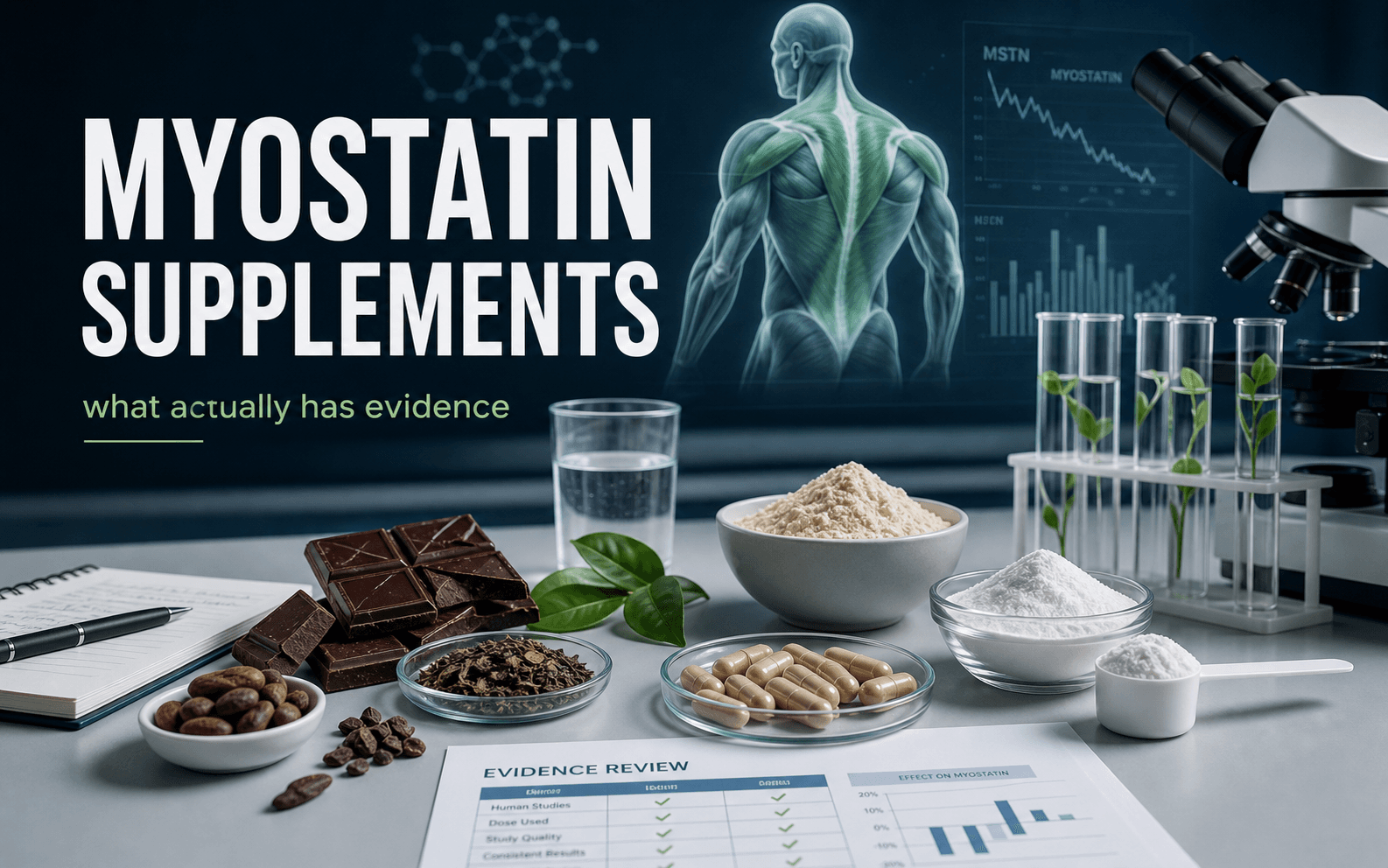
Shopping intent needs more skepticism. A myostatin inhibitor supplement can sound like a shortcut, but the human evidence is much thinner than the marketing language suggests.
Key takeaways
- No over-the-counter supplement has proved it can reliably produce drug-like myostatin inhibition in healthy lifters.
- Creatine, protein, and training are still more useful than chasing myostatin-only claims.
- Epicatechin, egg-derived products, HMB, vitamin D, and green tea appear often in SERPs, but the evidence is mixed.
- The safest buyer move is to grade ingredients by outcomes, not by “blocker” wording.
Myostatin inhibitor supplement evidence table
Start with the receipts. The strongest supplement question is not “can this change a marker?” but “does this help a person build or keep useful muscle?”
| Supplement or ingredient | What marketers claim | Evidence grade | Practical verdict |
|---|---|---|---|
| Creatine monohydrate | May reduce myostatin while improving training output | Strong for strength support, mixed for pathway claims | Useful for many lifters, but not a myostatin shortcut |
| Protein and essential amino acids | Supports muscle protein synthesis and may affect myostatin | Strong for muscle support, inconsistent for myostatin | Fix intake before chasing niche products |
| Epicatechin | May raise follistatin and lower myostatin | Early and inconsistent | Interesting, not a proven muscle-gain engine |
| Egg-derived products | Often sold as follistatin or myostatin-control products | Mixed and hard to separate from protein/calories | Needs skepticism and label scrutiny |
| HMB | May affect muscle loss settings | Conditional | More relevant for specific populations than advanced lifters |
| Vitamin D | May matter when status is low | Conditional | Correct deficiency; do not expect a growth switch |
| Green tea, cocoa, dark chocolate | Flavanol or antioxidant claims | Indirect | Food quality matters more than blocker hype |
For the broader category, read our myostatin blocker breakdown. For the drug and clinical side, see the myostatin inhibitor hub.
What the SERP gets right
The top results know the hook. They explain that myostatin limits muscle growth, then frame supplements as a way to reduce the brake.
That framing is partly true. Myostatin is real, and some nutrients or supplements may influence the muscle-growth environment.
The leap is the problem. Changing a pathway marker is not the same as adding visible lean mass, improving strength, or recovering faster in a way you can measure.
That is why this page grades supplements by practical outcomes first.
Creatine is useful, but not magic
Creatine earns its reputation. It is one of the best-supported supplements for training performance, strength output, and lean-mass support.
Some studies connect creatine with lower myostatin signaling during training programs, which is why it appears in myostatin supplement articles.
But the reason to use creatine is simpler. It helps many people train harder and accumulate better work. If myostatin shifts along the way, treat that as secondary.
That distinction keeps expectations clean.
Protein, eggs, and amino acids
Protein solves a basic problem. If total intake is low, muscle growth stalls no matter how many pathway claims appear on a label.
Eggs, whey, essential amino acids, and leucine-rich foods all show up in this conversation because they support muscle protein synthesis. Some trials report myostatin changes, while others do not.
The 2022 Metabolites review is useful here because it found non-uniform effects across supplements and training contexts. In plain terms, the marker can go down, up, or nowhere.
So the practical advice stays boring: reach an appropriate protein target, then judge any special myostatin supplement against that foundation.
Epicatechin and cocoa claims
Epicatechin gets attention. It is a flavanol found in foods such as cocoa, dark chocolate, and green tea, and many supplement lists rank it as the natural myostatin ingredient.
The issue is scale. A small or short-term signal is not enough to promise major muscle gain.
If you use an epicatechin product, treat it as experimental support, not the center of your plan. Check the dose, third-party testing, stimulant additions, and whether the brand cites human outcomes instead of mechanism-only claims.
A supplement can be interesting and still not deserve top billing.
YK-11 does not belong in a normal supplement basket
This one needs separation. Several ranking pages mention YK-11 beside epicatechin and natural products.
That creates a category problem. YK-11 is not a standard food-derived supplement. It belongs in a higher-risk, hormone-adjacent conversation and should not be handled like creatine or cocoa extract.
If a product page casually blends YK-11 with everyday supplements, treat that as a trust warning.
How to buy without getting played
Use a buyer-safe filter. You do not need to know every pathway detail to avoid bad purchases.
Before buying, ask:
- Does the product list exact ingredient amounts?
- Does it show third-party testing or contaminant screening?
- Does the evidence measure humans, not just pathway theory?
- Does it explain who should avoid it?
- Does it admit the limitation that myostatin is only one growth signal?
If the page only shows hype, rankings, and transformation language, close it.
What actually deserves your money first
Prioritize the foundation. Most people will get more from fixing training, sleep, calories, protein, and creatine consistency than from chasing a niche blocker product.
That does not mean every myostatin supplement is useless. It means the burden of proof is higher than the sales page suggests.
For advanced lifters, the honest question is opportunity cost. If a product costs more than creatine, protein, coaching, food quality, or recovery support, it needs better evidence than a pathway story.
That is the buyer-safe standard.
Sources and notes
- The Effects of Dietary Supplements, Nutraceutical Agents, and Physical Exercise on Myostatin Levels
- Evidence Based Muscle: Myostatin inhibitor supplements
- Poison Control: What are myostatin inhibitors?
- Neurogan Health: Best Myostatin Inhibitor Supplements
- Strong Supplement Shop: Top 5 Myostatin Inhibitor Supplement Choices
- JISSN abstract on a commercial myostatin inhibitor
Frequently Asked Questions
Do myostatin inhibitor supplements work?
Some supplements may influence myostatin-related markers, but current human evidence does not show reliable drug-like muscle growth from over-the-counter myostatin supplement products.
What supplement is most worth considering first?
Creatine monohydrate is usually the best first choice because it has strong evidence for training performance and lean-mass support, even though it should not be treated as a direct blocker shortcut.
Is epicatechin a real myostatin inhibitor?
Epicatechin is an interesting ingredient with some pathway-related signals, but the evidence is not strong enough to promise major muscle gain or replace training basics.
Should I buy a product labeled myostatin blocker?
Only after checking the label, dose, testing, human evidence, and safety warnings. If the proof is mostly marketing language, skip it.
This article is for educational purposes only and is not medical advice. Talk with a qualified healthcare professional before using supplements, peptides, hormone-like products, or medications promoted for muscle growth or myostatin inhibition.