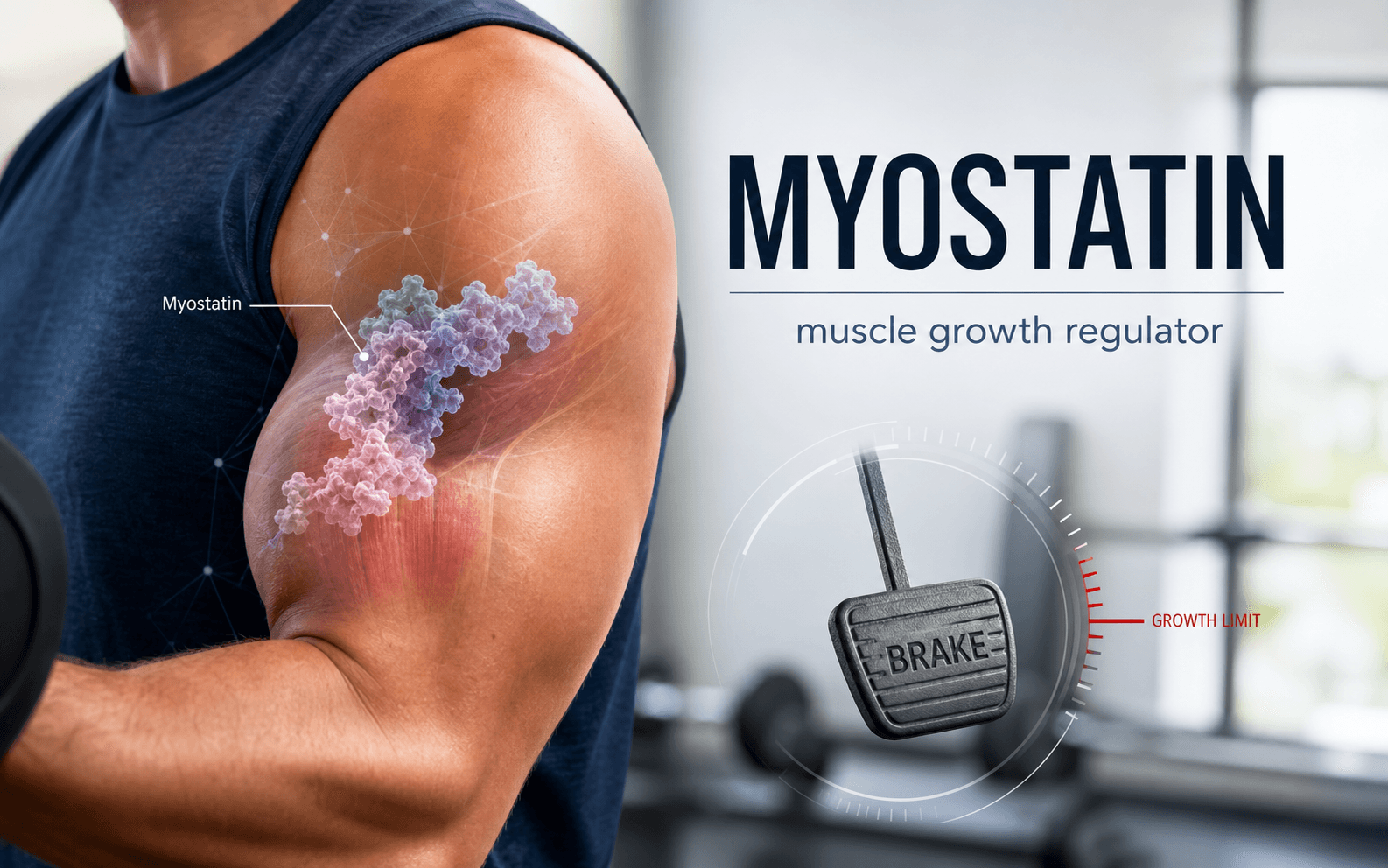
Myostatin is your muscle-growth brake. Myostatin is a protein your body uses to keep muscle growth from running without limits, which is why lifters, patients, and drug developers all pay attention to it.
Key takeaways
- Myostatin, also called GDF-8, is a signaling protein that helps limit skeletal muscle size.
- Rare low-myostatin genetics show why the protein matters, but they do not prove that blocking it is simple or safe.
- Training, nutrition, age, disease state, and recovery can all change how myostatin behaves.
- The biggest mistake is treating myostatin as an enemy instead of a control system.
Myostatin: the quick answer
Start with the brake. Myostatin is part of the transforming growth factor beta family, and its best-known job is to restrain skeletal muscle growth.
That restraint matters. Muscle is metabolically expensive tissue, and your body does not build unlimited amounts of it just because more size sounds useful in the gym.
In plain English, myostatin helps decide how high the ceiling sits. When the signal is unusually low, the ceiling can move upward. When the signal is high or paired with illness, inactivity, poor intake, or aging, keeping muscle can become harder.
| Term | What it means |
|---|---|
| Myostatin | The common name for the muscle-growth regulating protein |
| GDF-8 | Growth differentiation factor 8, another name for myostatin |
| MSTN | The gene that carries the instructions for making myostatin |
| Activin receptors | Receptor pathways myostatin can use to send its signal |
| Follistatin | A binding protein that can reduce activity from myostatin and related signals |
What myostatin does inside muscle
Muscle growth needs permission. Myostatin sends a stop signal that pushes muscle cells away from unchecked growth and toward controlled maintenance.
The simplified pathway looks like this: muscle tissue produces myostatin, myostatin interacts with activin-type receptors, and downstream signaling changes the activity of genes involved in growth, repair, and protein turnover.
That sounds abstract until you translate it. More myostatin activity can make it harder to add or keep lean mass. Less activity can remove part of the restraint, but the rest of the growth system still needs training stimulus, amino acids, calories, hormones, sleep, and time.
This is why myostatin is interesting but incomplete. It is one lever in a bigger system, not a magic switch.
Myostatin and muscle growth
Training still runs the show. Resistance training gives muscle the reason to adapt; food and recovery provide the materials; myostatin helps control how far that adaptation can go.
That relationship explains why the topic attracts athletes. If your gains have stalled despite better programming and nutrition, the idea of removing a biological brake feels obvious.
But the clinical story is more complicated. Several drug candidates have increased lean mass or muscle volume in specific settings, yet increased size has not always translated into better walking, strength, function, or quality of life.
Useful muscle is not just bigger tissue. It needs tendons, nerves, joints, bones, cardiovascular capacity, and movement skill to adapt with it.
Low myostatin in humans
Rare cases prove the concept. People with loss-of-function changes in MSTN can show unusually high muscle mass from early life.
Those cases are important because they confirm that the myostatin pathway matters in humans, not just in theory. They also explain why supplement sellers and biotech companies keep returning to the target.
The limit is just as important. Being born with unusually low signaling is different from trying to suppress the pathway later with a drug, peptide, supplement, or lifestyle change.
A lifetime genetic state is not the same as a temporary intervention. That difference is where many online claims fall apart.
Why blocking myostatin is controversial
The promise is obvious. If myostatin limits muscle growth, then reducing its activity could help people dealing with muscle loss, frailty, neuromuscular disease, obesity-related lean-mass loss, or hard strength plateaus.
The risk is also obvious. Muscle can grow faster than connective tissue adapts, and the pathway overlaps with bone, tendon, metabolic, and cardiovascular biology.
That is why the strongest medical interest is not "more muscle at any cost." It is better function: standing, climbing stairs, keeping lean mass during weight loss, preserving independence, or improving disease-specific outcomes.
For healthy lifters, the bar should be higher. A claim is weak if it only promises bigger muscles while ignoring strength, injury risk, long-term safety, and whether the product actually changes myostatin in people.
How myostatin changes with training, age, and disease
Context changes the signal. Myostatin does not behave the same way in every person or every situation.
Resistance training can shift the muscle-growth environment toward adaptation, often alongside changes in related proteins such as follistatin. Creatine, protein intake, sleep, and recovery can support the training response, but they should not be treated as direct myostatin blockers by default.
Age and disease add more noise. Some studies link myostatin with muscle loss, while others show mixed patterns depending on sex, health status, activity, and measurement method.
That is why a single blood value or supplement claim rarely tells the whole story. The useful question is not "Is myostatin high or low?" It is "What problem is the person trying to solve, and does changing this pathway improve real function?"
What to watch for in claims
Most claims skip the hard part. They mention myostatin, then jump straight to dramatic muscle growth.
Use this filter before trusting any claim:
- Does it show human data, or only mechanism talk?
- Does it measure function, not just lean mass?
- Does it separate drugs, supplements, food, and training?
- Does it explain safety without burying it?
- Does it admit when the evidence is early, mixed, or indirect?
If the answer is no, slow down. Myostatin is real biology, but real biology is exactly why simplistic claims deserve more skepticism.
Sources and notes
- Myostatin: A Skeletal Muscle Chalone
- Myostatin and its Regulation
- Antimyostatin Treatment in Health and Disease
- Myostatin overview from ScienceDirect
- MSTN gene information from MedlinePlus
Frequently Asked Questions
Is myostatin bad?
No. Myostatin limits muscle growth, but that does not make it useless. It is part of a control system that helps balance muscle size with the rest of the body.
Does lowering myostatin build muscle automatically?
No. Lower activity may remove part of the growth restraint, but muscle still needs training, nutrition, recovery, and healthy connective tissue adaptation.
Can you test myostatin levels?
Some labs can measure circulating myostatin, but a single value is hard to interpret without medical context, symptoms, training history, and body-composition data.
Why do bodybuilders talk about myostatin?
Because the pathway is tied to the ceiling on muscle growth. The problem is that many bodybuilding claims outrun the human evidence.
This article is for educational purposes only and is not medical advice. Talk with a qualified healthcare professional before making decisions about medications, peptides, supplements, testing, or treatment for muscle loss.