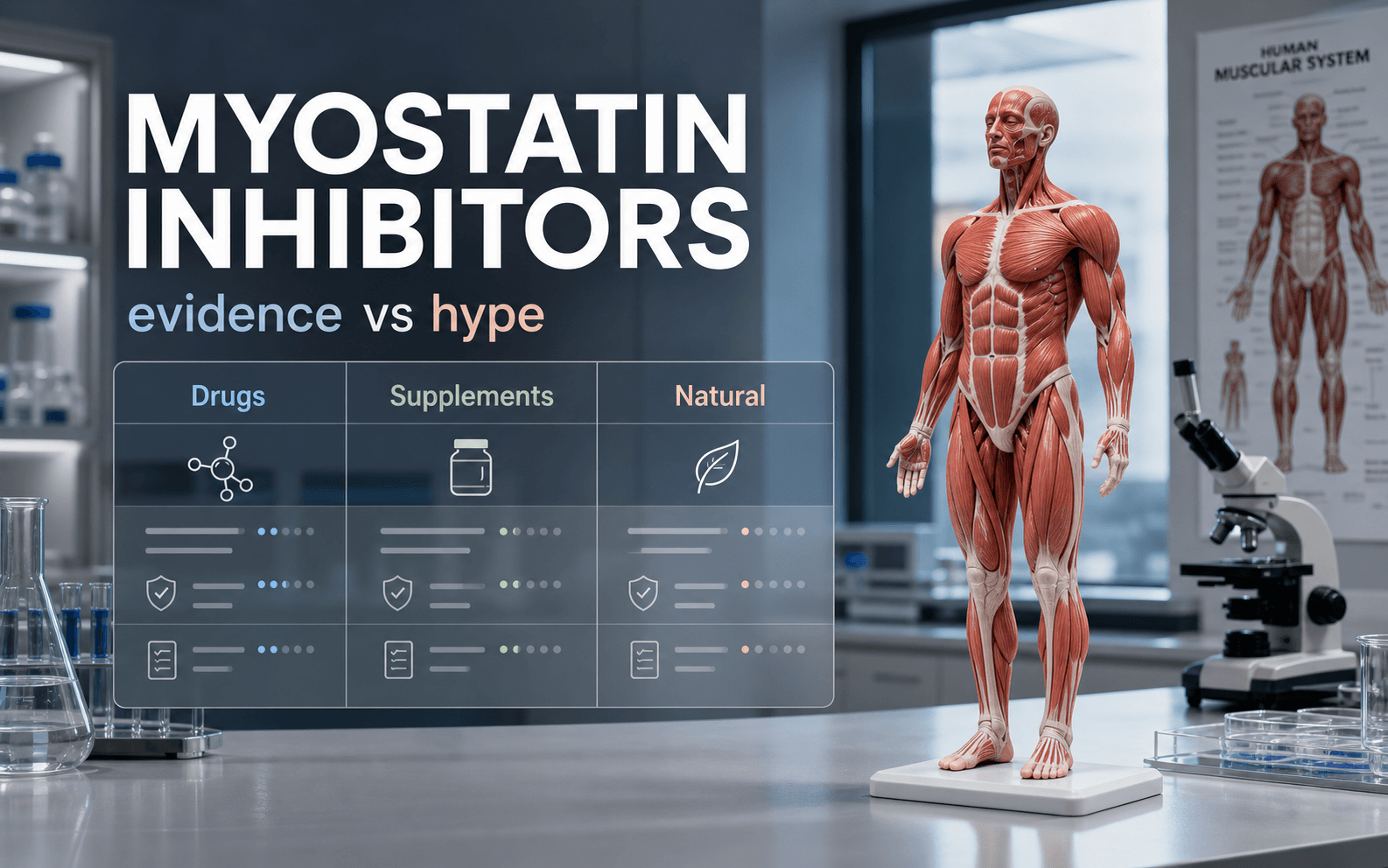
The category is messy. A myostatin inhibitor can mean a clinical antibody, a receptor blocker, a peptide claim, a supplement ingredient, or a training strategy, and those options do not carry the same evidence or risk.
Key takeaways
- Drug candidates have the strongest evidence, but they are condition-specific and still need functional outcomes.
- Supplements often borrow the language of clinical myostatin inhibition without proving the same effect in people.
- Online peptide injections carry real safety and quality-control problems.
- The best question is not which blocker is strongest; it is which option has human evidence for the goal you care about.
Myostatin inhibitor options compared
Start with the category. The phrase myostatin inhibitor describes anything meant to reduce myostatin signaling or blunt its effect on muscle.
That broad definition creates confusion. A monoclonal antibody in a clinical trial is not the same thing as epicatechin, creatine, broccoli sprout extract, or a gray-market follistatin vial.
| Option | What it targets | Evidence strength | Main caution |
|---|---|---|---|
| Clinical antibodies and receptor blockers | Myostatin, activin receptors, or related pathway signals | Strongest, but indication-specific | Size gains must translate into function and safety |
| Follistatin-style peptides | Binding proteins that can affect myostatin and related ligands | Unreliable outside supervised medicine | Product identity, contamination, eye, fluid, and systemic risks |
| Supplements and foods | Indirect signaling, training support, or nutrient status | Mixed to indirect | Claims often exceed human data |
| Resistance training | Whole-muscle adaptation environment | Strong for strength and hypertrophy | Does not work by a single myostatin switch |
| Weight-loss combination drugs | Lean-mass preservation during GLP-1 therapy | Emerging quickly | Still being tested for outcomes that matter |
Drug candidates and clinical evidence
Drugs are moving fastest now. The most serious myostatin inhibitor work is happening in clinical programs for neuromuscular disease, obesity, cachexia, and lean-mass preservation during modern weight-loss therapy.
As of May 1, 2026, no myostatin-pathway drug has U.S. approval for bodybuilding, general muscle gain, or obesity. That matters because the buyer intent around this keyword often looks commercial, while the evidence base is still medical and condition-specific.
Several names come up often:
- Apitegromab targets latent myostatin and has been developed for spinal muscular atrophy.
- Bimagrumab targets activin type II receptors and is being studied for body composition, including obesity programs.
- Trevogrumab is being tested with semaglutide-based obesity treatment, including lean-mass preservation endpoints.
- Taldefgrobep alfa is Biohaven's myostatin/activin-pathway candidate in obesity and body-composition development.
- MYO-029, ACE-031, domagrozumab, and LY2495655 are older names that explain why the field has both promise and disappointment.
The pattern is consistent. Some agents can move lean mass, fat mass, or muscle volume. The harder test is whether people move, function, feel, and stay safer in ways that justify treatment.
What the 2026 obesity trials changed
The goal is shifting. Myostatin inhibitors are no longer only framed around rare muscle diseases or bodybuilding claims.
The new commercial question is body composition during weight loss. GLP-1 and dual-incretin drugs can produce major fat loss, but some lost weight can include lean mass. That created a market for drugs that may preserve or improve lean tissue while fat mass falls.
Recent trial reporting makes this category more concrete. In a phase 2 bimagrumab study with semaglutide, published in 2026, the high-dose combination group showed large total weight and fat-mass reductions while losing less lean mass than semaglutide alone.
Regeneron's COURAGE program has also reported lean-mass preservation signals when trevogrumab was combined with semaglutide, though tolerability and discontinuation details still matter.
Biohaven's taldefgrobep program is pursuing a different angle: better body composition without needing the highest possible scale-weight drop. That is an important distinction because the strongest obesity drug is not always the one that protects the most muscle.
Supplements and natural blockers
Supplement claims need grading. Natural myostatin inhibitor content usually mentions epicatechin, creatine, vitamin D, sulforaphane, resistance training, protein, and sometimes green tea or cacao.
Some of those are useful. That does not mean they are proven myostatin blockers in the same way a clinical antibody is.
| Ingredient or strategy | Best practical read | Evidence grade |
|---|---|---|
| Resistance training | Best-supported foundation for strength and hypertrophy | Strong for outcomes, not a single-pathway blocker |
| Creatine | Supports training output and lean-mass gain; myostatin data is secondary | Strong supplement, mixed myostatin-specific evidence |
| Epicatechin | Interesting small human signals around strength and pathway markers | Early and not enough for big claims |
| Vitamin D | Worth correcting if low; not a muscle-growth shortcut | Conditional |
| Sulforaphane | Mechanistically interesting, mostly indirect for lifters | Early |
| Protein adequacy | Necessary for muscle gain and retention | Strong for muscle support, not an inhibitor claim |
The safe takeaway is simple. Use supplements to support training and nutrition first. Treat myostatin-specific marketing as a claim that must be proven, not assumed.
Peptides and online injections
This is the risk zone. Follistatin-style injections and unlabeled peptide vials often appear in myostatin inhibitor searches because they promise a direct shortcut.
That shortcut has problems. Product identity can be unclear, sterility can be unknown, and the biology can reach beyond skeletal muscle. Poison Control highlights concerns such as tendon weakness, bone effects, muscle spasm, bleeding issues, vascular effects, and cardiac effects. It also describes eye-related fluid problems after high-dose follistatin-344 exposure.
None of that belongs in a casual muscle-gain plan. If someone is in a legitimate trial, they should follow the trial team's adverse-event instructions. If someone reacts badly to an online product, they need medical help, not another forum protocol.
Strongest myostatin inhibitor?
Strongest is not safest. The strongest pathway suppression may also create the most uncertainty.
For medical development, the strongest option is the one that improves the endpoint: walking, stair climbing, lean-mass preservation, fatigue, function, or disease-specific measures.
For healthy lifters, the best-supported path is less exciting but more reliable: progressive training, enough protein and calories for the goal, creatine if appropriate, sleep, and injury management.
That approach will not sound like a shortcut. It also has the largest real-world evidence base.
How to evaluate any claim
Use three filters. First, ask whether the claim is about human outcomes or only pathway language.
Second, ask whether the source separates drugs from supplements. If an article uses clinical drug data to sell a supplement, that is a trust problem.
Third, ask whether the article discusses function and safety. Lean mass without strength, mobility, or durability is not enough.
A strong myostatin inhibitor article should make the next decision clearer. It should not push a reader from curiosity into risky buying behavior.
Sources and notes
- Antimyostatin Treatment in Health and Disease
- Therapeutic applications and challenges in myostatin inhibition
- Poison Control: What are myostatin inhibitors?
- Bimagrumab plus semaglutide phase 2 trial
- Myostatin inhibitors and the GLP-1 market
- Biohaven body-composition program update
Frequently Asked Questions
What is a myostatin inhibitor?
It is anything intended to reduce myostatin signaling or its effect on muscle. The term can refer to drugs, biologics, peptides, supplements, or lifestyle strategies.
Are myostatin inhibitor supplements the same as drugs?
No. Supplements usually have indirect or mixed evidence. Clinical drug candidates are designed to target the pathway more directly and are tested under medical oversight.
What is the safest myostatin inhibitor?
For most healthy people, the safest practical route is training, nutrition, sleep, and standard evidence-based supplements. Direct pathway blockers should be treated as medical interventions.
Do myostatin inhibitors work for bodybuilding?
There is no clean evidence that consumer myostatin blockers reliably produce bodybuilding-style results. Many claims borrow from clinical science without proving the same outcome.
This article is for educational purposes only and is not medical advice. Myostatin-pathway drugs, peptide injections, and body-composition treatments can carry serious risks and should be discussed with a qualified healthcare professional.