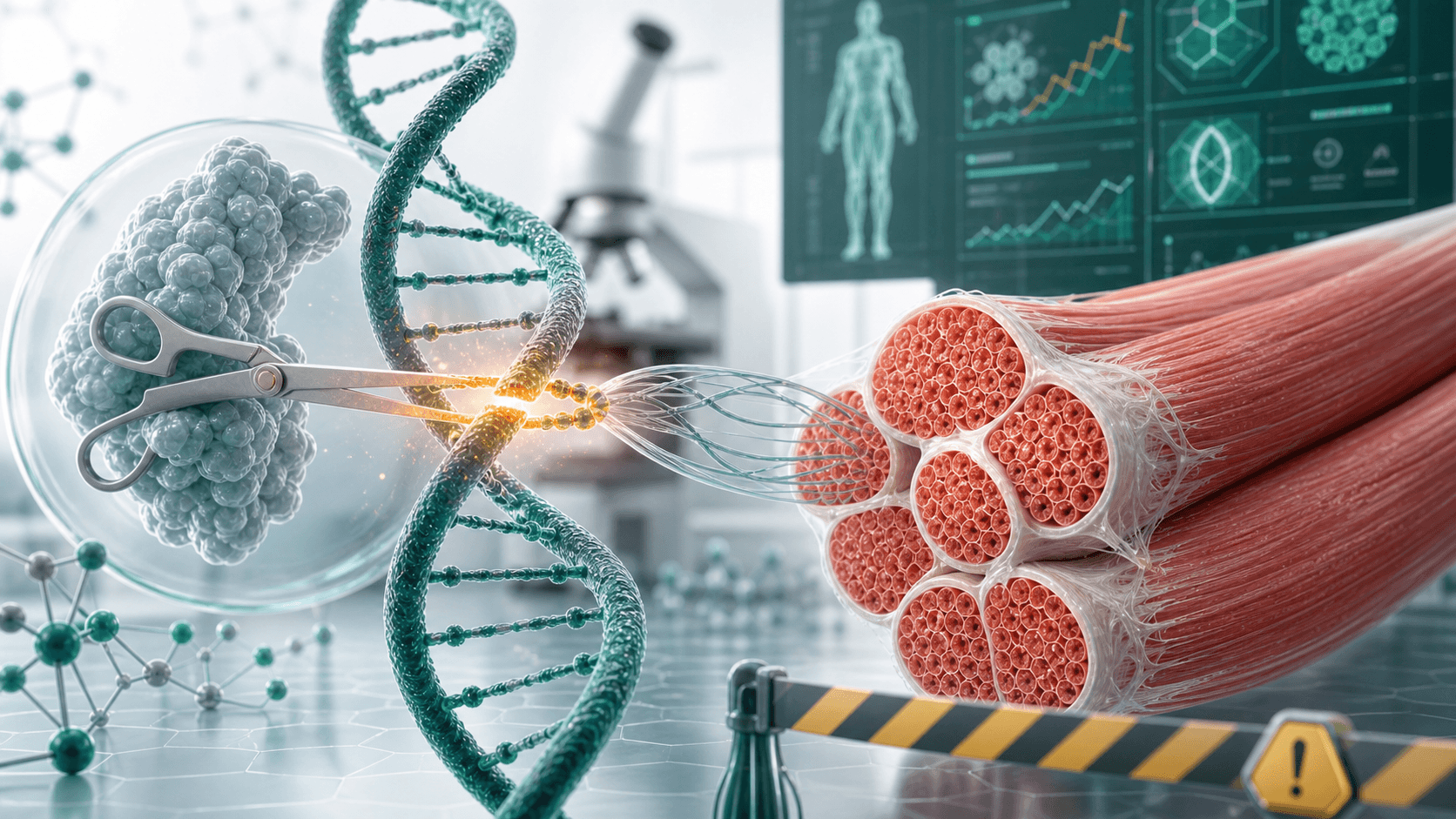
CRISPR can edit myostatin in research settings. That does not mean CRISPR myostatin biohacking is safe, legal, ethical, or ready for bodybuilding.
Key takeaways
- CRISPR/Cas9 can disrupt MSTN, the gene that encodes myostatin, in research models.
- Most CRISPR myostatin work is in cells, livestock, fish, embryos, or disease models, not elective human bodybuilding.
- Editing myostatin after birth is not the same as being born with a rare MSTN variant.
- Delivery, off-target edits, mosaicism, immune response, tissue targeting, and long-term safety remain central problems.
- Do not treat CRISPR myostatin editing as a personal enhancement tool.
Quick answer
CRISPR myostatin editing usually means using CRISPR/Cas9 or related systems to disrupt the MSTN gene so cells make less functional myostatin. Because myostatin limits muscle growth, researchers have studied MSTN knockout in animals, cell models, and muscle-wasting contexts.
The concept is real. The consumer leap is not.
| Context | What has been studied | What it does not prove |
|---|---|---|
| Cell culture | Editing MSTN in muscle cells | Safe whole-body human enhancement |
| Livestock and aquaculture | Increased muscle or growth traits | Appropriate human use |
| Embryos | Proof of editing feasibility | Ethical or legal enhancement |
| Mouse muscle-wasting models | Local or experimental protection from wasting | Ready therapy for healthy adults |
| Biohacking claims | Self-experiment stories | Controlled safety or efficacy |
For background, read myostatin protein and low myostatin.
How CRISPR targets myostatin
CRISPR/Cas9 uses a guide RNA to direct a cutting enzyme to a specific DNA sequence. If the target is MSTN, the goal is often to disrupt the gene so functional myostatin is reduced.
In simple terms:
- Choose an MSTN sequence.
- Deliver CRISPR machinery to cells or embryos.
- Create a DNA break.
- Let cellular repair introduce a disruptive change.
- Test whether myostatin function is reduced.
Each step can fail or create unwanted outcomes. Editing a dish of cells is very different from editing enough muscle tissue in a living adult.
Why researchers study MSTN knockout
The reason is straightforward: loss of myostatin can increase muscle mass. This has been seen in animals and rare human genetics. CRISPR gives researchers a way to test the same target with modern gene-editing tools.
Applications include:
- livestock and aquaculture productivity
- basic muscle biology
- disease models of muscle wasting
- embryo and developmental research
- delivery-system testing
- potential future therapies
Those are research goals, not consumer instructions.
Animal studies are not bodybuilding proof
SERPs for "CRISPR myostatin" are heavy with animal and cell studies: sheep, fish, horses, prawns, mice, and muscle-derived cells.
Animal results can be scientifically useful, but they do not answer the human enhancement question. Species differ. Editing embryos differs from editing adults. A farm-animal productivity goal differs from a medical safety standard.
Even when muscle mass increases, quality and function still matter. Large muscle is not automatically well-coordinated, injury-resistant, or metabolically healthy.
Human genetics versus adult editing
Rare people with reduced functional myostatin from MSTN variants can have unusual muscularity from early life. That does not mean adult CRISPR editing would recreate the same result.
Developmental timing matters. Muscle fiber number, tendons, connective tissue, motor learning, metabolism, and growth history all develop over years.
Adult editing would also have to reach enough target tissue. A local injection, systemic vector, or ex vivo strategy would each create different risks.
Safety questions
Any serious CRISPR myostatin discussion has to include risk.
| Risk | Why it matters |
|---|---|
| Off-target editing | DNA changes outside MSTN could have unknown effects |
| Mosaic editing | Not all cells get the same edit |
| Delivery failure | Muscle tissue is large and distributed |
| Immune response | Viral vectors or editing machinery can trigger reactions |
| Overgrowth imbalance | Muscle, tendon, and connective tissue may not adapt together |
| Germline ethics | Embryo edits affect future individuals and raise major ethical issues |
| Long-term uncertainty | Permanent edits are harder to reverse than drugs |
These are not theoretical details. They are the center of whether gene editing can be responsibly developed.
Legal and sport context
CRISPR myostatin editing is not a legal bodybuilding shortcut. In medicine, gene editing belongs in regulated research and approved therapeutic contexts. In sport, gene and cell manipulation and performance-enhancing pathway manipulation create major anti-doping risk.
For the legal overview, read are myostatin inhibitors legal?.
If a vendor or forum implies that myostatin gene editing is a personal project, treat that as a serious safety warning.
What future therapy might look like
A responsible future therapy would not look like a gym biohack. It would need:
- A defined disease indication.
- Strong preclinical safety data.
- controlled delivery.
- dose and exposure monitoring.
- long-term follow-up.
- objective functional endpoints.
- regulatory review.
- clinician supervision.
That is a high bar, and it should be.
Bottom line
CRISPR myostatin editing is scientifically real and potentially important. It is also far from a consumer bodybuilding tool. The research belongs in the same evidence category as gene therapy and regulated medical development, not supplement stacks or online enhancement experiments.
The honest answer is simple: learn from the research, but do not try to copy it.
Sources and notes
- Prevention of muscle wasting by CRISPR/Cas9-mediated disruption of myostatin
- Efficient generation of myostatin knock-out sheep using CRISPR/Cas9
- Generation of myostatin-edited horse embryos using CRISPR/Cas9
- CRISPR/Cas9-targeted myostatin deletion in muscle-derived stem cells
- FDA information on human gene therapy
Frequently Asked Questions
Can CRISPR knock out myostatin?
Yes, CRISPR can disrupt MSTN in research models. That does not mean it is safe or approved for elective human muscle enhancement.
Would CRISPR myostatin editing build muscle?
Reducing myostatin can increase muscle mass in some models, but human adult editing would face delivery, safety, function, and regulatory barriers.
Is CRISPR myostatin biohacking legal?
Do not assume it is legal or safe. Human gene editing belongs in regulated medical research and therapy contexts, not self-experimentation.
Is low myostatin from genetics the same as CRISPR editing?
No. Being born with an MSTN variant is different from trying to edit muscle tissue in adulthood. Timing and tissue targeting matter.
This article is educational and is not medical advice. Do not attempt gene editing, injectable gene-transfer products, or unapproved myostatin interventions outside regulated medical care.