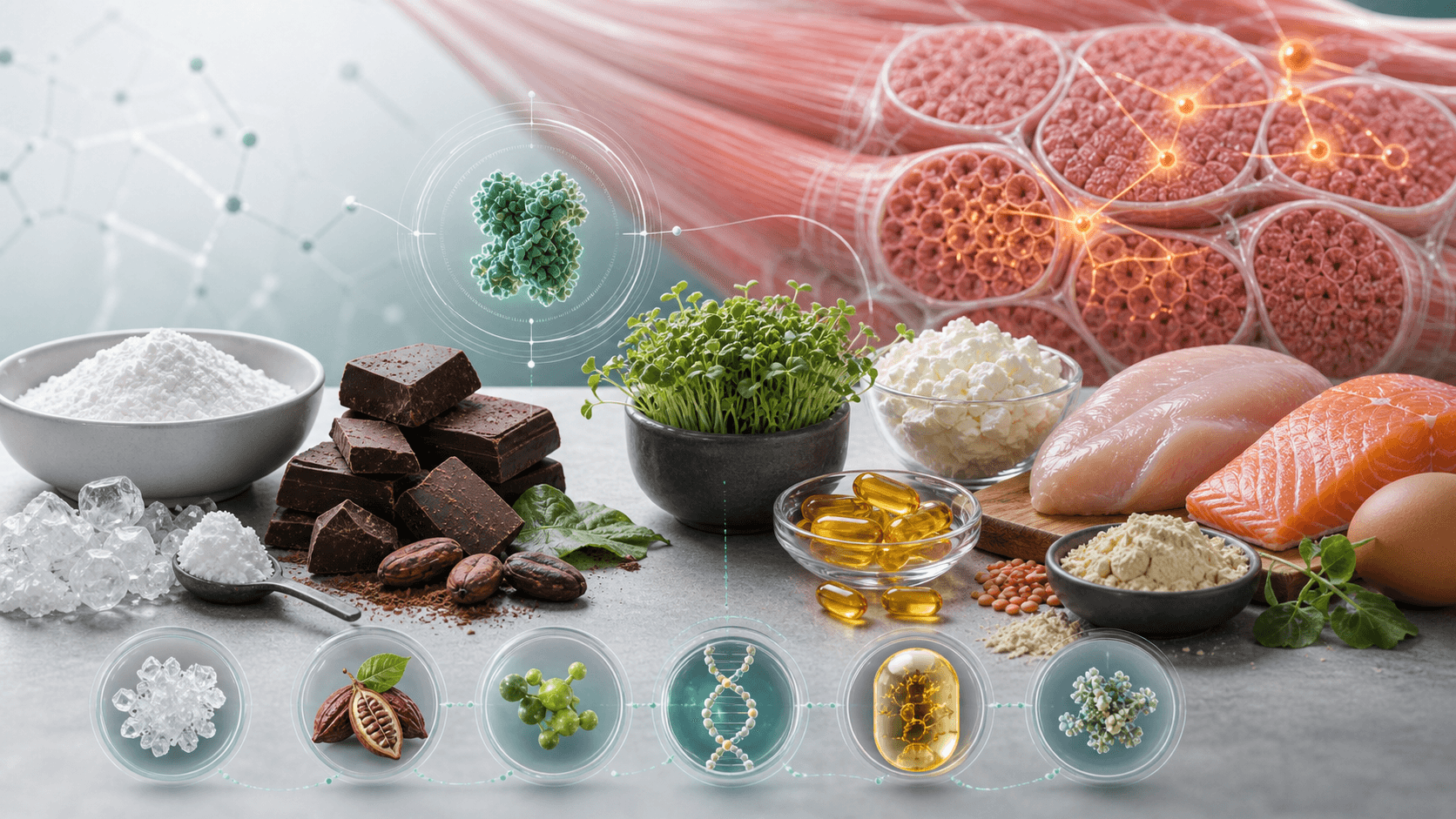
Nutrients can influence the muscle-growth environment, but that does not make every nutrient a true myostatin inhibitor. The practical question is which options have useful human evidence and which are mostly pathway marketing.
Key takeaways
- Creatine has the strongest practical supplement case, but not because it is a magic myostatin blocker.
- Vitamin D matters most when deficiency or poor muscle function is part of the picture.
- Epicatechin is the most common food-compound myostatin claim, but human outcome evidence remains limited.
- Sulforaphane, HMB, ecdysterone, green tea, and polyphenols are interesting but easy to overstate.
- Training, protein, energy balance, and recovery still matter more than chasing a single pathway.
Quick ranking
| Option | Evidence for muscle outcomes | Myostatin-specific evidence | Practical read |
|---|---|---|---|
| Resistance training plus protein | Strong | Indirect and context-dependent | Foundation |
| Creatine monohydrate | Strong for performance and lean mass support | Some human and animal pathway signals | Best first supplement for many lifters |
| Vitamin D correction | Useful when low | Mechanistic and condition-specific | Correct deficiency; do not megadose |
| Epicatechin/cocoa flavanols | Early and mixed | Small human marker signals | Interesting, not a transformation tool |
| HMB | Context-dependent | Some muscle-wasting pathway interest | More relevant for older, ill, or low-protein contexts |
| Sulforaphane | Early mechanistic | Mostly preclinical/indirect | Food-first, not a blocker |
| Ecdysterone | Unsettled | Not clean myostatin proof | High hype, unclear payoff |
For the broader natural category, read natural myostatin inhibitors and how to reduce myostatin naturally.
Creatine and myostatin
Creatine is the most defensible supplement in this discussion because it has strong practical evidence for training performance, strength work, and lean-mass support.
The myostatin angle comes from studies reporting changes in myostatin or related markers with creatine and resistance training. The best-known human framing is that creatine plus training may reduce circulating myostatin more than training alone in some conditions. Animal work also explores myostatin pathway changes.
But the clean reason to use creatine is simpler: it can help training output. Better training over time builds more muscle than a label claim about one pathway.
Do not buy creatine because it is marketed as a myostatin inhibitor. Use it because it is one of the better-supported sports supplements, if appropriate for you.
Vitamin D
Vitamin D is involved in muscle function, inflammation, and metabolic health. Low vitamin D status is common, and correction can matter for people who are deficient.
The myostatin connection is less direct. Research suggests vitamin D signaling may interact with muscle growth and atrophy pathways, including myostatin-related biology. That does not mean more vitamin D equals more muscle in people with normal levels.
Practical read: test and correct deficiency with clinician guidance. Do not use high-dose vitamin D as a self-directed myostatin-blocking strategy.
Epicatechin and cocoa
Epicatechin is the star ingredient in many myostatin supplement pages. It appears in cocoa, dark chocolate, and some plant foods.
The argument is that epicatechin may influence the follistatin-to-myostatin balance. Early human data and mechanistic work made the ingredient popular, but the outcome evidence is not strong enough to promise visible hypertrophy.
If you try cocoa flavanol foods, think of them as part of diet quality, not as a drug-like inhibitor. If you buy an epicatechin product, demand exact dosing, testing, and honest claims.
For the detailed review, see epicatechin and myostatin.
HMB
HMB is a leucine metabolite often discussed for muscle preservation, especially in older adults, clinical nutrition, or catabolic settings.
Its myostatin relevance is indirect. HMB may affect protein turnover, inflammation, and muscle-wasting pathways. That can be useful in certain contexts, but it does not make HMB a universal myostatin blocker.
For a well-fed lifter already training hard and eating enough protein, HMB is usually not the first priority.
Sulforaphane
Sulforaphane is a compound associated with cruciferous vegetables such as broccoli sprouts. It is discussed in oxidative stress, inflammation, and muscle-cell signaling research.
The myostatin claim is still early. Mechanistic plausibility does not prove human hypertrophy.
Practical read: eating cruciferous vegetables is sensible. Treat "sulforaphane lowers myostatin" supplement claims as preliminary unless the product shows human outcomes.
Ecdysterone, green tea, and other polyphenols
These ingredients often appear in myostatin-adjacent marketing:
| Ingredient | Better interpretation |
|---|---|
| Ecdysterone | Possible performance/hypertrophy interest, but not clean myostatin proof |
| Green tea catechins | General metabolic and polyphenol context, not a muscle-growth blocker |
| Pomegranate/berries | Diet-quality and antioxidant framing, not direct inhibitor proof |
| Protein powders | Useful if they help meet protein targets, not because they "block myostatin" |
| Broad bean products | Marketing is stronger than myostatin-specific human evidence |
If a product stacks several ingredients and calls the blend a myostatin inhibitor, ask which ingredient has human evidence for the exact outcome.
What matters more than the nutrient list
Before buying a myostatin-labeled product, fix the basics:
- Progressive resistance training.
- Enough total protein.
- Energy intake matched to the goal.
- Sleep and recovery.
- Creatine if appropriate.
- Deficiency correction when labs or diet suggest it.
- Consistent measurement of strength, body weight, and body composition.
Those levers have more real-world payoff than a proprietary "anti-myostatin matrix."
Bottom line
Nutrients may affect myostatin-related biology, but the evidence is uneven. Creatine is the best practical supplement for many lifters, vitamin D is important when low, epicatechin is interesting but overhyped, and most other nutrient claims remain indirect.
Use myostatin as one lens, not the whole decision.
Sources and notes
- Effects of creatine supplementation on the myostatin pathway
- The effects of dietary supplements, nutraceutical agents, and physical exercise on myostatin levels
- Creatine supplementation and resistance training myostatin study
- Vitamin D and skeletal muscle review
- Epicatechin and myostatin/follistatin human pilot context
Frequently Asked Questions
Does creatine lower myostatin?
Some studies suggest creatine combined with training may affect myostatin-related markers. The stronger reason to use creatine is its broader evidence for training performance and lean-mass support.
Does vitamin D lower myostatin?
Vitamin D may interact with muscle signaling, but correcting deficiency is the practical goal. More vitamin D is not automatically better for muscle growth.
Is sulforaphane a myostatin inhibitor?
It is better described as a mechanistically interesting compound, not a proven human myostatin inhibitor for muscle growth.
What nutrient should I start with?
Start with total protein and creatine if appropriate, then correct deficiencies. Do not start with proprietary myostatin blends.
This article is educational and is not medical advice. Talk with a qualified clinician before using supplements if you have kidney disease, take medications, are pregnant, or have a medical condition.