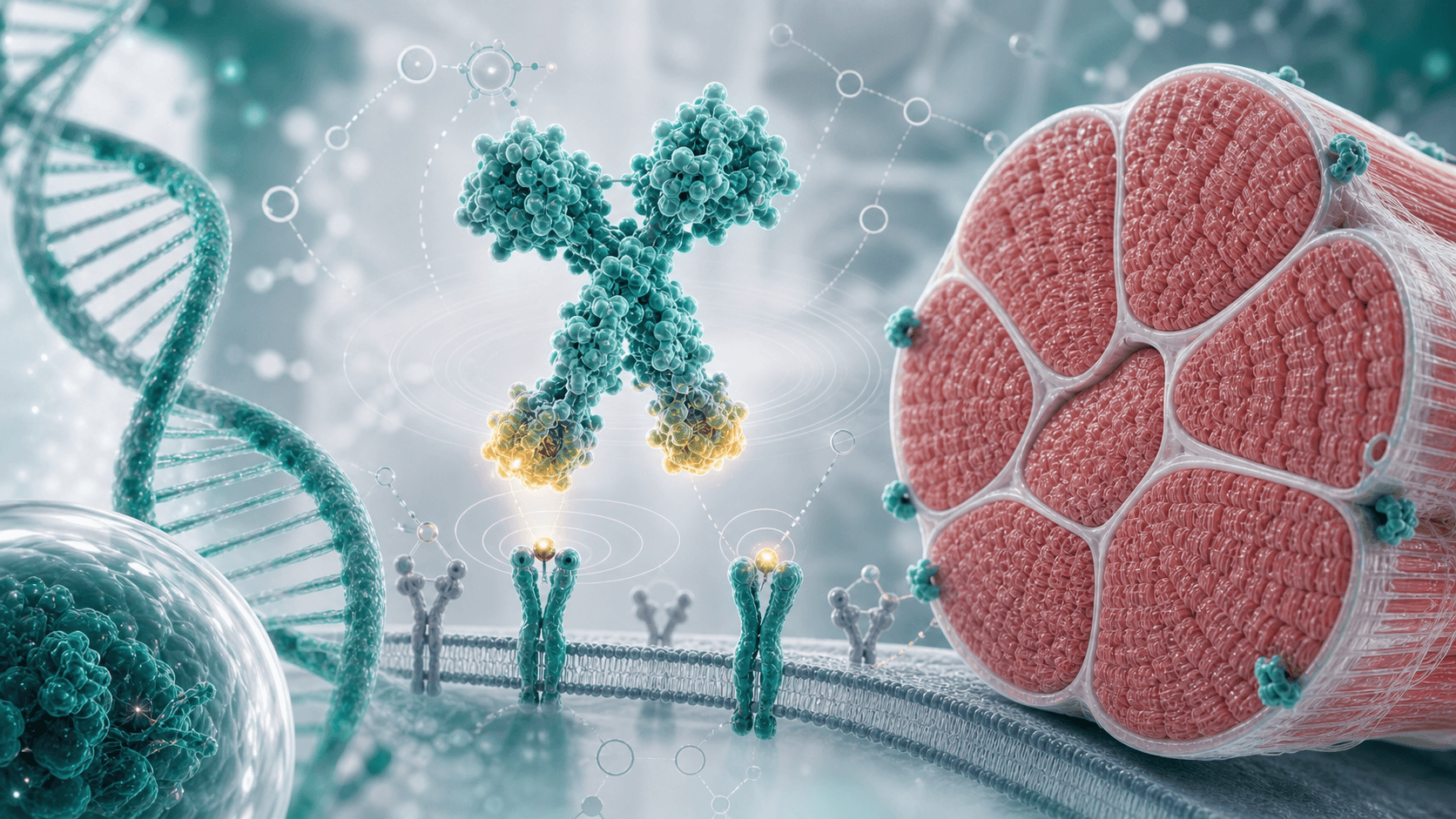
Myostatin protein is the body's best-known muscle-growth brake. It is real biology, not just supplement language, but it is also easier to misunderstand than most search pages admit.
Key takeaways
- Myostatin is the protein product of the MSTN gene and is also called growth differentiation factor 8, or GDF-8.
- It is produced mainly by skeletal muscle and circulates largely in inactive or latent forms before activation.
- Active myostatin signals through activin type II receptors and Smad pathways to restrain muscle growth.
- Serum myostatin, recombinant myostatin, GDF11, propeptides, and inhibitors are related terms, but they are not interchangeable.
- Blocking myostatin can change muscle biology, but it does not automatically guarantee better strength, function, or safe bodybuilding outcomes.
Quick facts
| Term | Plain-English meaning |
|---|---|
| Myostatin | A secreted protein that limits skeletal muscle growth |
| GDF-8 | Another name for myostatin: growth differentiation factor 8 |
| MSTN | The gene that encodes myostatin |
| Pro-myostatin | Precursor form before full activation |
| Latent myostatin | Inactive complex that needs activation before signaling |
| ActRIIB | A receptor involved in myostatin signaling |
| Smad2/3 | Intracellular signaling proteins downstream of myostatin |
| GDF11 | Related TGF-beta family protein often confused with myostatin |
For the broader definition, read what is myostatin?. For interventions, start with the myostatin inhibitor guide.
What the myostatin protein does
Myostatin is a member of the TGF-beta superfamily. Its best-known role is negative regulation of skeletal muscle mass. In simple terms, it helps tell muscle tissue when to stop growing.
That makes it tempting to call myostatin "bad." A better framing is that myostatin is a restraint signal. Growth systems need restraints. Muscle size, tendon capacity, energy cost, metabolism, and movement quality all have to stay coordinated.
When myostatin function is strongly reduced from birth, animals and rare humans can develop unusually high muscle mass. That is why the protein became a major target for drugs, genetic studies, livestock research, and bodybuilding claims.
How myostatin is made and activated
Myostatin is not released as a simple on/off molecule.
It is produced as a precursor protein. After processing, it can remain in a latent complex with its propeptide. Additional activation steps are needed before mature myostatin can bind receptors and send a growth-restraining signal.
That activation process matters because modern drugs do not all target the same form.
| Target form | Why it matters |
|---|---|
| Mature active myostatin | Directly involved in receptor signaling |
| Pro- or latent myostatin | Can be blocked before mature myostatin is released |
| Receptor interaction | Prevents myostatin and related ligands from signaling |
| Downstream signaling | Affects the cell response after receptor binding |
Apitegromab, for example, is designed to bind pro- and latent myostatin rather than acting like a simple generic "muscle protein blocker."
The signaling pathway
Active myostatin binds activin type II receptors, including ActRIIB, and recruits type I receptors. This triggers Smad2/3 signaling inside the cell. The downstream effect is reduced muscle growth signaling and altered protein synthesis, differentiation, and atrophy-related pathways.
That pathway overlaps with related ligands. This is why selectivity matters. A broad receptor trap may affect myostatin, activins, and other TGF-beta family signaling. A more selective antibody may behave differently.
When a product page says "blocks myostatin," ask what it actually blocks.
Myostatin versus GDF11
GDF11 is closely related to myostatin and is sometimes mentioned in the same papers, assays, or inhibitor discussions. They are similar enough that measurement and targeting can become complicated.
The practical point: do not assume every "GDF" result is a myostatin result. A test, antibody, or inhibitor may cross-react or affect related proteins unless it has been validated carefully.
This matters for both research interpretation and supplement marketing.
Recombinant myostatin and lab antibodies
Searchers sometimes find "recombinant myostatin" or "anti-myostatin antibody" product pages. These are usually research reagents, not consumer treatments.
Recombinant myostatin may be used in lab experiments to study signaling. Lab antibodies may be used for Western blotting, immunohistochemistry, ELISA, neutralization experiments, or assay development.
That does not mean the product is a therapy. A research antibody sold for detecting myostatin in tissue is not the same as a clinically developed monoclonal antibody.
For therapeutic antibody context, see anti-myostatin antibodies and drug candidates.
Serum myostatin levels
Serum myostatin means myostatin measured in blood. It sounds straightforward, but interpretation is not simple.
Levels can vary with disease state, muscle mass, age, sex, assay type, acute illness, training, and metabolic context. A low or high value should not be treated as a standalone score of muscle-building potential.
This is especially important because "low myostatin" has two meanings: a rare genetic phenotype and a lab measurement. Those are not the same. Read low myostatin for that distinction.
Why the protein became a drug target
Myostatin is attractive because it is secreted and accessible. Drug developers can target the protein, its precursor forms, its binding partners, or its receptors.
Clinical programs have explored:
| Strategy | Examples |
|---|---|
| Anti-myostatin antibodies | MYO-029, domagrozumab, trevogrumab |
| Latent myostatin inhibitors | apitegromab |
| Receptor traps | ACE-031, bimagrumab-style pathway targeting |
| Follistatin-related approaches | ACE-083 and follistatin claims |
| Short inhibitory peptides | early research peptides |
The results are mixed. Some candidates increase lean mass or muscle volume. Functional outcomes have been harder. Bigger measurements do not always mean stronger, safer, or more useful muscle.
Bottom line
Myostatin protein is a central muscle regulator, but it is not a magic switch. It exists in precursor, latent, and active forms; signals through overlapping receptor biology; and interacts with disease, age, exercise, and body composition.
The best way to read myostatin claims is specific: which form of the protein, which assay, which inhibitor, which population, and which outcome?
Sources and notes
- UniProt: MSTN / GDF-8 human myostatin
- NCBI Gene: MSTN myostatin
- The role of myostatin in muscle wasting: an overview
- Myostatin and its regulation: comprehensive review
- Regulation of myostatin in growth and development of skeletal muscle
Frequently Asked Questions
Is myostatin a protein?
Yes. Myostatin is a secreted signaling protein encoded by the MSTN gene. It is also called growth differentiation factor 8, or GDF-8.
Where is myostatin made?
It is produced mainly in skeletal muscle, though its biology can connect with broader metabolic and disease contexts.
Is lower myostatin always better?
No. Genetic reduction can increase muscle mass, but serum levels are context-dependent and blocking the pathway does not automatically improve function or safety.
Is recombinant myostatin a supplement?
No. Recombinant myostatin is generally a research reagent used in lab work, not a consumer supplement or therapy.
This article is educational and is not medical advice. Do not interpret myostatin lab tests, genetic reports, or inhibitor claims without qualified clinical context.