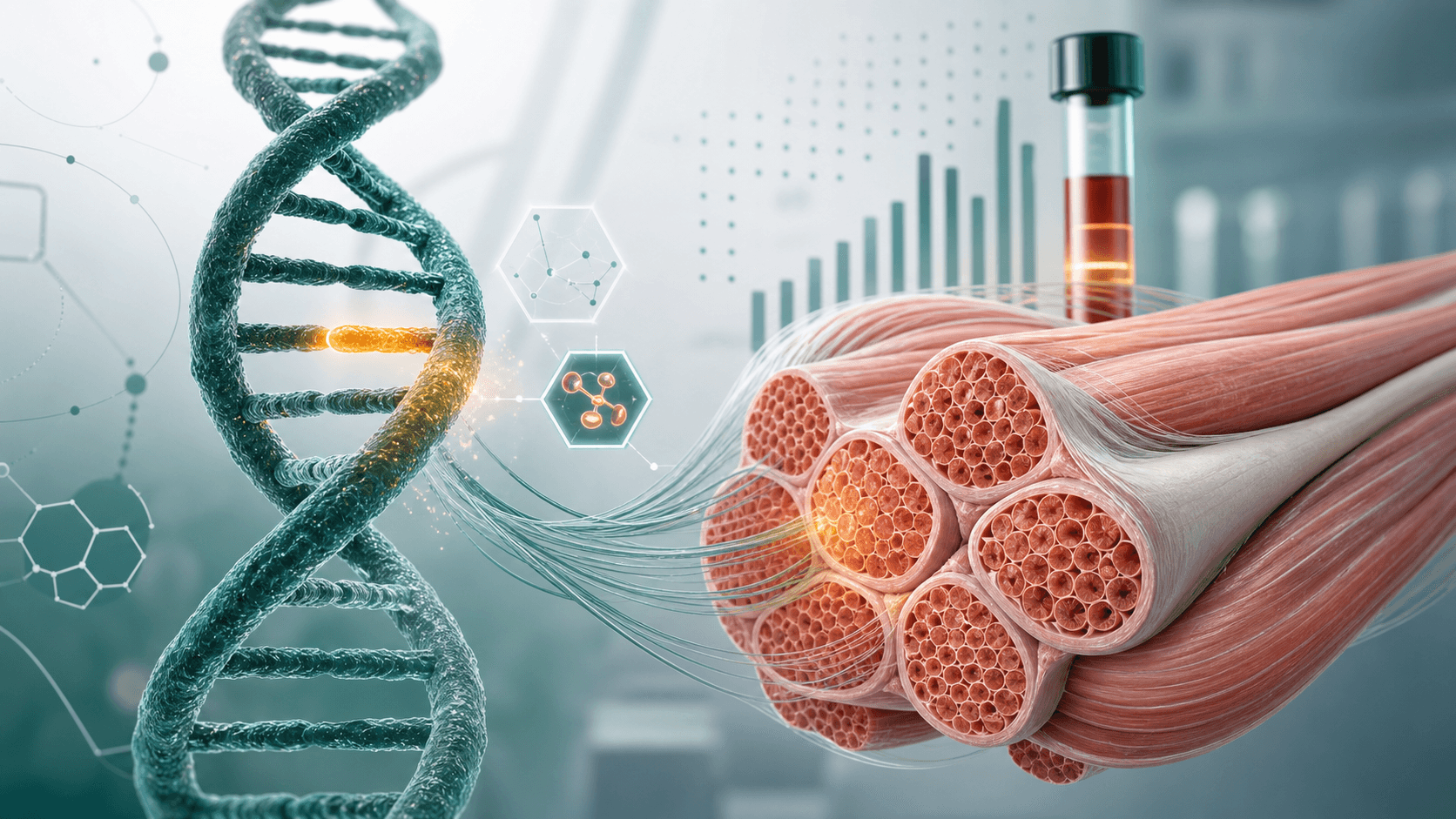
Low myostatin sounds like a muscle-building advantage, but the phrase can mean several different things. A rare MSTN gene variant, a low blood-test value, a temporary illness-related change, and a supplement claim are not the same.
Key takeaways
- True myostatin-related muscle hypertrophy is rare and usually caused by variants in the MSTN gene.
- People with lower functional myostatin can have increased muscle size and lower body fat, but this does not diagnose itself from appearance.
- A low serum myostatin test is not the same as having a lifelong genetic deficiency.
- Low myostatin can appear in illness contexts, so "lower" is not always automatically better.
- Celebrity, bodybuilding, and "Hercules gene" claims need genetic evidence, not visual speculation.
Quick answer
Low myostatin means reduced activity or measured levels of myostatin, a protein encoded by the MSTN gene that helps limit skeletal muscle growth.
The most important distinction is this:
| Type of low myostatin | What it means | What it does not prove |
|---|---|---|
| MSTN gene variant | Reduced functional myostatin from birth | That every muscular person has it |
| Low serum myostatin | A lower blood level at one point in time | Lifelong genetic muscle hypertrophy |
| Training or lifestyle-related change | A possible shift in muscle signaling | A direct drug-like blocker effect |
| Illness-related low level | May reflect systemic stress or altered muscle metabolism | A healthy advantage |
| Supplement marketing claim | A product says it lowers myostatin | Visible muscle gain in humans |
If you are trying to understand the biology, start with what myostatin is. If you are looking for interventions, use the myostatin inhibitor guide.
What myostatin normally does
Myostatin, also called growth differentiation factor 8 or GDF-8, is a signaling protein made mainly in skeletal muscle. Its core job is to help restrain muscle growth so muscle tissue does not expand without limits.
That "brake" is not automatically bad. The body uses growth brakes and growth signals together. Muscle size, tendon capacity, energy demand, metabolism, recovery, and function all have to stay coordinated.
This is why low myostatin can be fascinating without being a simple health hack.
Myostatin-related muscle hypertrophy
The clearest version of low myostatin is myostatin-related muscle hypertrophy. MedlinePlus Genetics describes it as a rare condition linked to reduced body fat and increased muscle size. Variants in the MSTN gene reduce the production of functional myostatin, allowing muscle tissue to overgrow.
Inheritance is described as incomplete autosomal dominance:
| Genetic pattern | Expected effect |
|---|---|
| Variant in both MSTN copies | Significantly increased muscle mass and strength |
| Variant in one MSTN copy | Increased muscle bulk to a lesser degree |
| No functional variant | Normal myostatin regulation |
The classic human case report involved a child with marked muscle hypertrophy and a myostatin mutation, showing that myostatin helps regulate human muscle mass, not only mouse or cattle muscle.
Symptoms and signs
True myostatin-related muscle hypertrophy is usually discussed as a body-composition phenotype more than a disease syndrome.
Possible features include:
- unusually high muscle bulk from early life
- lower body fat
- increased strength relative to peers
- family pattern of unusual muscularity
- normal intellectual development
- no known medical problems in many descriptions
That said, appearance alone is not diagnostic. Many people are muscular because of training, body fat distribution, androgen exposure, sport history, appetite, bone structure, or other genetic factors.
Low serum myostatin is different
Search results for "low myostatin" also surface blood-test studies. These are not the same as genetic deficiency.
For example, a study in critically ill patients found lower serum myostatin levels at ICU admission compared with healthy controls, and low levels were associated with worse clinical outcomes in that cohort.
That does not mean low myostatin causes poor outcomes in every setting. It means a circulating myostatin level can behave like a context-dependent marker. Acute illness, inflammation, organ dysfunction, muscle wasting, surgery, and metabolic stress can change the interpretation.
So a low lab value should be interpreted by a clinician in context, not treated as proof that someone has the "Hercules gene."
Is low myostatin good for muscle growth?
For muscle size, low functional myostatin can be an advantage. Animal models and rare human genetics show that reducing the myostatin brake can increase muscle mass.
But three caveats matter.
First, muscle size is not identical to muscle quality. In myostatin-deficient mouse work, larger muscles did not always produce proportionally better force.
Second, genetic low myostatin from development is different from trying to inhibit myostatin in adulthood. Developmental muscle fiber number, tendon adaptation, training history, and nervous-system skill all matter.
Third, a supplement that claims to "lower myostatin" does not automatically recreate a rare genetic condition.
Can you test for low myostatin?
There are two different questions:
| Question | Test category | Limit |
|---|---|---|
| Do I have an MSTN variant? | Genetic testing | Needs clinical interpretation; many variants do not mean rare hypertrophy |
| Is my circulating myostatin low today? | Blood assay in research or specialty settings | Context-dependent and not a simple muscle-potential score |
Consumer DNA reports can be misleading when users overinterpret single variants. Muscle growth is polygenic and environmental. MSTN matters, but it is not the whole hypertrophy story.
If you have medical concerns, unusual childhood muscularity, family history, unexplained symptoms, or confusing genetic results, talk with a genetics professional or qualified clinician.
Low myostatin vs reducing myostatin
These are different ideas.
Low myostatin from birth can affect muscle development over years. Reducing myostatin in adulthood is an intervention question. It may involve training, nutrition, investigational drugs, antibodies, receptor traps, peptides, or supplement claims.
That difference matters because search pages often blur them.
| Topic | Better article |
|---|---|
| What myostatin is | What is myostatin? |
| Supplements and natural approaches | Natural myostatin inhibitors |
| Practical lifestyle steps | How to reduce myostatin naturally |
| Clinical inhibitors | Myostatin inhibitor drugs |
| Peptide claims | Myostatin inhibitor peptides |
Celebrity and bodybuilding claims
"Low myostatin" is often used to explain elite bodybuilders, strength athletes, and unusually muscular influencers. Most of that is speculation.
Unless someone has credible genetic testing showing an MSTN variant with clinical interpretation, a physique does not prove low myostatin.
This is especially important because performance physiques can reflect many things:
- years of training
- high-calorie eating and protein consistency
- low body fat
- anabolic drugs or hormone exposure
- sport selection bias
- muscle insertions and limb proportions
- recovery capacity
- other genetic variants unrelated to MSTN
Do not build a health or supplement decision around celebrity myostatin rumors.
What to do if you think you have low myostatin
If the question is curiosity, keep expectations grounded. Being naturally muscular does not require a rare MSTN condition.
If the question is medical, use a professional route:
- Document the reason you are concerned: childhood onset, family history, unusual lab results, symptoms, or genetic report.
- Avoid self-diagnosis from physique photos or Reddit threads.
- Bring any genetic raw data or reports to a qualified clinician or genetic counselor.
- Ask whether confirmatory testing is appropriate.
- Interpret blood myostatin levels in the context of health status, muscle mass, inflammation, and recent illness.
Do not try to force low myostatin with unapproved peptides, SARMs, gene-editing ideas, or injectable products.
Bottom line
Low myostatin can be real, but the meaning depends on the context. Rare MSTN variants can cause increased muscle size and lower body fat. A low blood level can reflect illness or physiology rather than a lifelong muscle advantage. A supplement claim may mean very little.
The useful question is not "how do I get low myostatin at any cost?" It is "what kind of low myostatin are we talking about, how was it measured, and what does it actually predict?"
Sources and notes
- MedlinePlus Genetics: Myostatin-related muscle hypertrophy
- Myostatin mutation associated with gross muscle hypertrophy in a child
- Low myostatin serum levels are associated with poor outcome in critically ill patients
- Lack of myostatin results in excessive muscle growth but impaired force generation
- Clinical, agricultural, and evolutionary biology of myostatin: a comparative review
- NCBI Gene: MSTN myostatin
Frequently Asked Questions
What does low myostatin mean?
It can mean reduced functional myostatin from an MSTN gene variant, a low blood level, or a marketing claim. Those meanings are very different and should not be mixed.
Does low myostatin always mean more muscle?
No. Rare genetic low myostatin can increase muscle mass, but a low serum level can occur in illness contexts and does not automatically mean better muscle growth.
Can I tell if I have low myostatin by looking at my body?
No. Appearance alone cannot diagnose myostatin-related muscle hypertrophy. Genetic testing and clinical interpretation are needed for that question.
Is low myostatin dangerous?
Myostatin-related muscle hypertrophy is not known to cause medical problems in standard descriptions, but low serum myostatin in illness can have a different meaning. Context matters.
This article is for educational purposes only and is not medical advice. Talk with a qualified clinician or genetics professional before interpreting genetic results, blood markers, or symptoms related to myostatin.