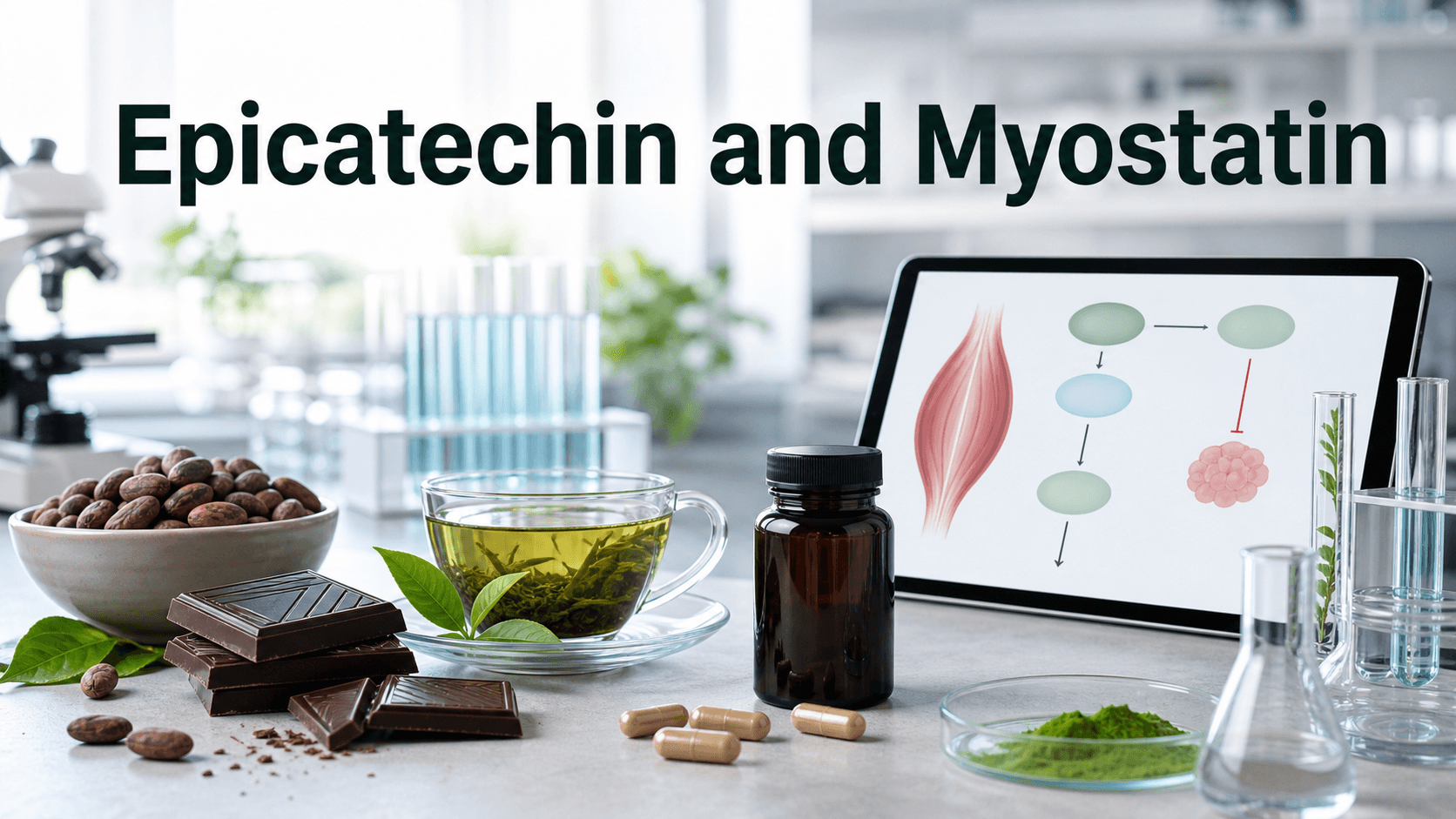
The claim is half true. Epicatechin and myostatin are connected in early human data, but the evidence does not prove that a cocoa extract will reliably build visible muscle.
Key takeaways
- Epicatechin is a cocoa and green tea flavanol that is often marketed as a natural myostatin inhibitor.
- The best-known human paper used only six people for seven days, so it is a signal, not proof.
- The most useful marker is the follistatin-to-myostatin ratio, not a guaranteed muscle-gain result.
- Dark chocolate and green tea can fit a healthy diet, but they should not replace training, protein, and creatine.
- Supplement labels often overstate the human evidence and hide the gap between pathway markers and outcomes.
Epicatechin myostatin evidence at a glance
Start with the scale. The phrase "epicatechin myostatin inhibitor" sounds settled, but the human evidence is still small.
| Evidence point | What it shows | What it does not show |
|---|---|---|
| 7-day human pilot | Hand-grip strength rose about 7%, and the plasma follistatin-to-myostatin ratio rose about 49% | No large blinded trial, no body-composition proof, and only six participants |
| Cocoa and green tea foods | Epicatechin appears naturally in familiar foods | Food intake does not equal a standardized supplement dose |
| Older-adult and sarcopenia interest | The pathway is relevant to age-related muscle loss | It does not prove benefit for healthy lifters |
| Supplement pages | Products often use the myostatin angle as the hook | Most labels cannot prove visible muscle gain |
| Exercise pairing | Training remains the stronger muscle-building signal | Epicatechin alone should not be treated like a training substitute |
That is the honest read. Epicatechin is interesting enough to study and modest enough to keep in perspective.
For the broader natural category, read natural myostatin inhibitor options. For supplement comparisons, use the myostatin inhibitor supplement review.
What epicatechin is
It is a plant flavanol. Epicatechin is found in cacao, dark chocolate, green tea, apples, grapes, and some berries.
That food connection is why the marketing feels approachable. A compound from cocoa sounds safer and more natural than a drug candidate.
But natural does not mean proven. It only tells you where the compound can come from.
The real question is whether epicatechin changes the muscle-growth environment in humans enough to matter.
How it could affect myostatin
The pathway is plausible. Myostatin acts like a brake on muscle growth, while follistatin can bind myostatin and reduce its signaling.
That is why epicatechin discussions usually focus on the ratio between follistatin and myostatin. A higher ratio may point toward a more favorable muscle-growth environment.
The key word is "may." A blood marker is not the same as more contractile tissue, better performance, or a bigger lift.
This is where many supplement pages overreach. They move from pathway language to muscle-building promises too quickly.
What the main human study found
The signal was small. The widely cited human data came from six middle-aged subjects who took 25 mg of pure epicatechin twice daily for seven days.
After one week, the study reported about a 7% bilateral increase in hand-grip strength and about a 49% increase in the plasma follistatin-to-myostatin ratio.
That is why epicatechin keeps showing up in myostatin articles.
It is also why the claim needs limits. Six people, one week, no large outcome trial, and no direct proof of visible hypertrophy is not enough to crown epicatechin as a muscle-building answer.
The right conclusion is narrower: epicatechin has a human signal worth watching, not a result you should plan a physique around.
Food sources versus supplements
Food is simpler. Cocoa, dark chocolate, and green tea can fit a useful diet without turning into a supplement protocol.
The problem is dose math. Dark chocolate varies widely in epicatechin content, and eating enough chocolate to chase a supplement-like dose can add calories, sugar, and saturated fat.
Green tea has its own variability. Brew strength, tea type, serving size, and extract quality all change the amount you actually get.
Supplements solve one problem and create another. They can standardize a dose, but they also introduce label accuracy, testing, contaminants, and exaggerated marketing.
That makes food a low-friction choice and supplements an optional experiment.
What dose do people use?
There is no settled dose. The pilot study used 25 mg twice daily for seven days, while supplement products often use higher daily amounts.
Do not treat product labels as clinical protocols. A label can copy the myostatin language without proving that its dose changes outcomes.
If someone tries epicatechin, the practical questions are basic:
- Is the dose disclosed?
- Is the extract standardized?
- Is third-party testing available?
- Is it free of stimulant stacking?
- Does the price make sense compared with creatine and food quality?
If a product fails those checks, the myostatin claim is not enough to rescue it.
Who might care most
The best fit is narrow. Epicatechin is most relevant to readers who already have training, protein, creatine, and recovery handled.
It may also interest older adults thinking about muscle quality, but that group should be more careful, not less. Medical history, medications, blood pressure, glucose control, and supplement interactions matter.
For healthy lifters, the better order is still obvious: train well, eat enough protein, sleep, use creatine if appropriate, then consider niche add-ons.
Epicatechin belongs near the end of that list.
What competitors overstate
The pattern is predictable. Search results often call epicatechin a natural myostatin inhibitor, then jump straight to muscle growth.
That skips the hard part. A pathway marker must become a meaningful outcome before the claim becomes useful.
Watch for these red flags:
- A page says epicatechin "blocks" myostatin without explaining the study size.
- A product hides the amount per serving.
- The article treats cocoa, peptides, and hormone-like products as the same category.
- The page uses bodybuilder transformation language without human outcome data.
- The recommendation appears before the evidence.
Those are sales signals, not evidence signals.
A realistic way to use the information
Keep the claim small. Epicatechin may shift myostatin-related markers, but it should not be the center of a muscle plan.
Use it this way:
| Goal | Better first move | Where epicatechin fits |
|---|---|---|
| Build muscle | Progressive resistance training and enough calories | Optional add-on after basics |
| Preserve muscle while dieting | Protein, lifting, slower rate of loss | Not a substitute for training |
| Improve diet quality | Cocoa, tea, berries, varied plants | Food-level support |
| Compare supplements | Creatine first, then niche products | Only if label quality is strong |
| Understand myostatin | Read the pathway and clinical evidence | One small part of the picture |
That framing keeps the useful part and removes the hype.
Sources and notes
- Effects of (-)-epicatechin on molecular modulators of skeletal muscle growth and differentiation
- The Effects of Dietary Supplements, Nutraceutical Agents, and Physical Exercise on Myostatin Levels
- Does epicatechin work as a myostatin inhibitor? - DrOracle
- Epicatechin: A Natural Myostatin Inhibitor for Muscle Growth - Sunshine NTC
- The 2 Best Myostatin Supplements - Muscle and Brawn
- Best Myostatin Inhibitor Supplements - Neurogan Health
- Myostatin Inhibitors Definition, List and Application - BOC Sciences
Frequently Asked Questions
Does epicatechin lower myostatin?
Small human data suggest epicatechin may improve the follistatin-to-myostatin ratio, but the evidence is not strong enough to promise muscle gain.
Is dark chocolate a myostatin inhibitor?
Dark chocolate can contain epicatechin, but it is not a reliable myostatin-blocking tool. Cocoa content, serving size, calories, and sugar all matter.
Is epicatechin better than creatine?
No. Creatine has stronger practical evidence for training performance and lean-mass support. Epicatechin is a more speculative add-on.
Should lifters buy epicatechin supplements?
Only after the basics are handled. Training, protein, recovery, and creatine usually deserve attention before a myostatin-labeled supplement.
This article is for educational purposes only and is not medical advice. Talk with a qualified healthcare professional before using supplements, especially if you take medications, have a diagnosed condition, or are managing blood pressure, glucose, liver, kidney, or heart health.