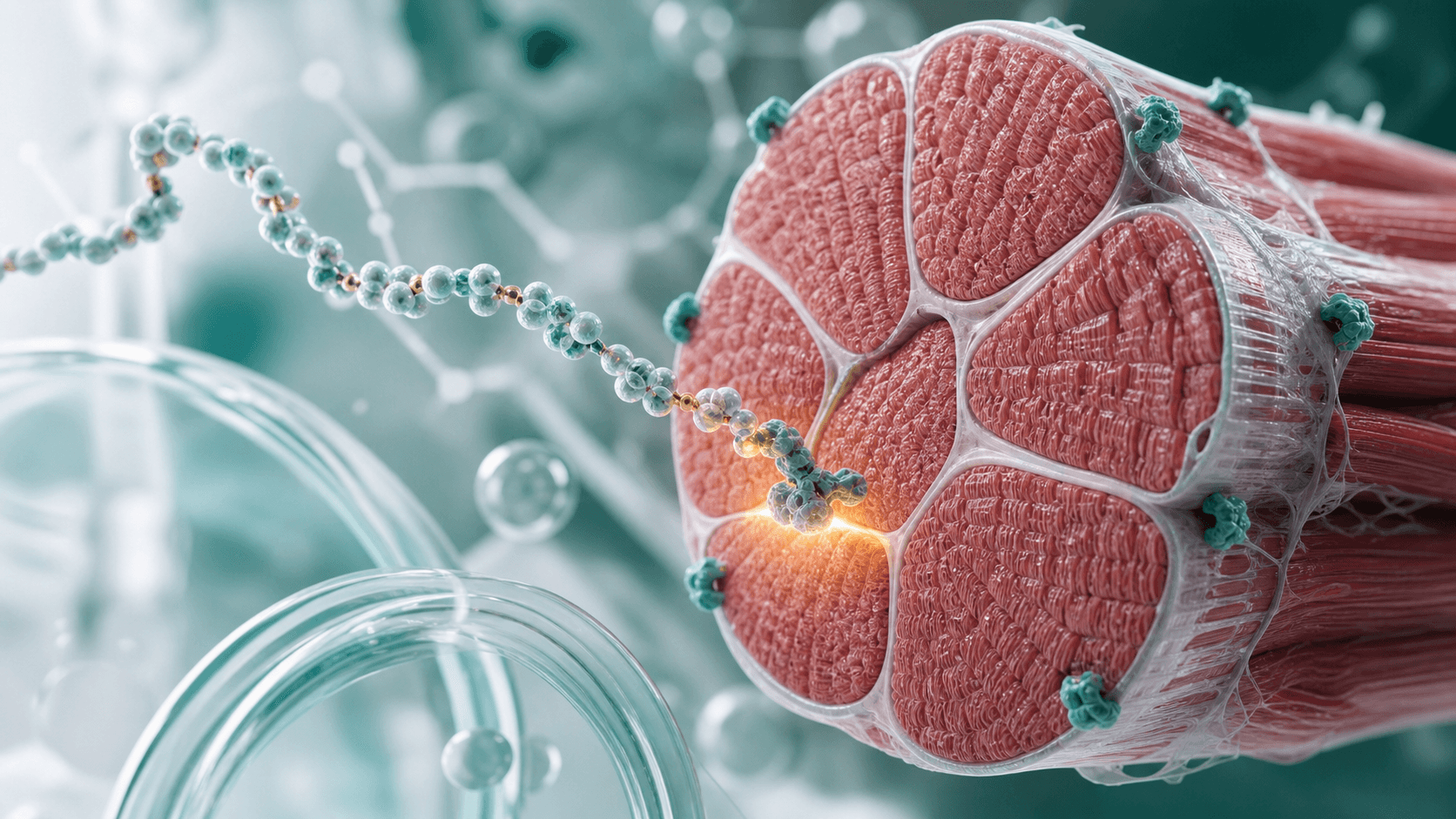
The phrase "myostatin inhibitor peptide" is messy. It can mean a true short peptide tested in cells or animals, a follistatin-related biologic, an activin receptor fusion protein, an antibody that is not a peptide at all, or a gray-market vial using clinical language.
Key takeaways
- No myostatin inhibitor peptide is approved as a general muscle-building product.
- Real research exists, but much of it is early-stage, disease-specific, injectable, or not actually a consumer peptide.
- ACE-031 and ACE-083 are useful cautionary examples: muscle-volume signals did not automatically become safe, functional, available products.
- Apitegromab is clinically important, but it is an investigational monoclonal antibody, not an oral peptide or bodybuilding shortcut.
- Online "research-use" products create identity, sterility, purity, dosing, and legal questions that search-result pages often underplay.
Quick answer
A myostatin inhibitor peptide is supposed to reduce the activity of myostatin, a protein that limits skeletal muscle growth. The problem is that the search term is broader than the science.
Some candidates bind myostatin directly. Some imitate follistatin or block activin receptor signaling. Some target latent myostatin before it becomes active. Some "peptide" pages discuss YK11, antibodies, or receptor traps that do not fit a clean peptide definition.
That matters because mechanism, evidence, safety, and regulatory status change by category.
| Category | Examples people search | What it really is | Evidence read | Consumer takeaway |
|---|---|---|---|---|
| Short inhibitory peptides | DF-3, MIPE-style research peptides | Lab-designed peptide fragments | Mostly cell and animal research | Interesting science, not a normal supplement |
| Ligand traps / receptor fusion proteins | ACE-031 | Biologic decoy receptor, not a simple peptide | Human trials, discontinued | Proof of concept plus safety warning |
| Follistatin-based agents | ACE-083, follistatin-344 claims | Follistatin-derived or related biologic concepts | Human ACE-083 data; gray-market claims vary | Bigger muscle volume did not guarantee function |
| Selective antibodies | Apitegromab | Monoclonal antibody, not a peptide | Phase 2 and Phase 3 SMA data | Medical candidate under regulatory review, not a gym product |
| Gray-market vials | "myostatin peptide," ACE-031, FST-344 | Often unclear identity and quality | Vendor claims, not clinical use evidence | Highest practical risk category |
Why the search results are confusing
The SERP for this keyword mixes three intents.
The first is research intent. These readers want to know whether peptides can bind or inhibit myostatin. For them, short inhibitory peptide papers and mechanism reviews matter.
The second is clinical intent. These readers are looking for drug candidates for muscular dystrophy, spinal muscular atrophy, obesity-related lean-mass preservation, or other muscle-wasting settings. Those candidates are usually biologics, not simple retail peptides.
The third is buying intent. These pages use peptide language to describe products that may not have validated identity, sterility, stability, human safety, or legal status.
This article is written for the overlap: what the category means, what has actually been studied, and why unsupervised use is not the same as clinical research.
For the broader category, start with the myostatin inhibitor guide. For drug candidates, read the myostatin inhibitor drug pipeline.
How myostatin inhibition can work
Myostatin is produced mainly by skeletal muscle and belongs to the TGF-beta family. In simplified terms, active myostatin binds receptors on muscle cells and sends a signal that restrains muscle growth.
Inhibitor strategies try to interrupt that signal at different points.
| Strategy | What it blocks | Why it matters |
|---|---|---|
| Bind active myostatin | The mature ligand after activation | Direct concept, but selectivity and potency are hard |
| Bind pro- or latent myostatin | The inactive precursor before release of active myostatin | More selective approaches may avoid some off-target signaling |
| Use a decoy receptor | Myostatin and related ligands before they reach cell receptors | Can be powerful, but may also catch other ligands |
| Increase follistatin-like binding | Myostatin and related activin-family ligands | Broad biology may affect more than skeletal muscle |
| Block receptor signaling | Downstream receptor pathway | Often not myostatin-only |
The key phrase is "and related ligands." More blockade is not automatically better. Myostatin overlaps with activins, GDF11, BMP-related biology, vascular biology, reproductive signaling, and tissue remodeling. A broad trap can produce effects that a selective inhibitor might not.
Short myostatin inhibitory peptides
True short peptides are real in research. Scientists have designed or discovered peptide fragments that inhibit myostatin in assays. Some are derived from regions of myostatin-binding proteins. Others are optimized with unusual amino acids, chain shortening, or structural changes.
The important limitation is translation. A peptide that looks potent in a luciferase reporter assay or improves grip strength in a mouse model is not automatically a safe human therapy. It still has to solve stability, delivery, tissue exposure, immune response, off-target signaling, manufacturing, and clinical endpoint problems.
That is why short inhibitory peptide papers should be read as drug-discovery work, not as a shopping list.
ACE-031: proof of concept and warning sign
ACE-031 is often described on peptide websites, but it was an activin receptor type IIB fusion protein. It acted like a decoy receptor for myostatin and other related ligands.
Its story matters because it shows both sides of the target. Blocking this pathway can change muscle biology, but broad ligand trapping can create safety problems.
In Duchenne muscular dystrophy development, ACE-031 studies were halted after participants experienced minor nose and gum bleeding and dilated blood vessels in the skin. The program was later discontinued. That does not mean every myostatin program is unsafe. It means the exact molecule and exact selectivity matter.
If a sales page treats ACE-031 like a routine peptide, that is a red flag.
ACE-083: bigger muscle volume was not enough
ACE-083 was a locally acting follistatin-based muscle-promoting agent. In a randomized phase 2 study in facioscapulohumeral muscular dystrophy, ACE-083 significantly increased total muscle volume in treated muscles. The reported treatment difference was 16.4% in the biceps brachii group and 9.5% in the tibialis anterior group.
That sounds like an impressive "before and after" result. The catch is that those volume gains did not produce consistent improvements in functional or patient-reported outcomes.
This is one of the most important lessons in the whole myostatin category: more measured muscle is not the same as more useful performance.
Follistatin-344 and online peptide claims
Follistatin binds myostatin and other members of the activin family. That makes it biologically relevant, but it also makes the consumer peptide market risky.
Search pages often describe follistatin-344 as if it were a clean, predictable, clinically validated muscle-growth product. That is too simple. The clinical-grade question is not just whether a molecule can influence the pathway. It is whether the product is what the label says, whether it is sterile, whether exposure is predictable, whether it affects other pathways, and whether benefits outweigh risks in a defined population.
For unsupervised use, those answers are usually missing.
Apitegromab is not a peptide shortcut
Apitegromab is one of the most important current myostatin-pathway candidates, but it is not a peptide supplement. It is an investigational monoclonal antibody designed to bind pro- and latent myostatin and prevent activation of mature myostatin.
In spinal muscular atrophy, the logic is different from bodybuilding. Patients already receiving SMN-targeted therapy may still have persistent muscle weakness. A muscle-targeted therapy could add benefit by improving residual muscle function.
Phase 2 TOPAZ data reported sustained motor-function gains through longer follow-up. Phase 3 SAPPHIRE met its primary endpoint in nonambulatory SMA patients receiving standard SMN-targeted therapy. As of May 7, 2026, Scholar Rock reported that the FDA accepted the apitegromab BLA with a September 30, 2026 PDUFA action date.
That is clinical medicine, not a gray-market peptide protocol.
Why oral myostatin inhibitor peptide claims deserve skepticism
Peptides are usually vulnerable to digestion and poor oral absorption unless specifically engineered for delivery. An oral product claiming peptide-like myostatin inhibition needs unusually strong evidence.
Ask basic questions before trusting the claim.
- Is the active molecule named clearly?
- Is it actually a peptide, antibody, receptor trap, SARM, plant extract, or proprietary blend?
- Is there human evidence for the exact ingredient and route?
- Were outcomes muscle function, DXA/MRI body composition, or only biomarkers?
- Is there independent identity and contaminant testing?
- Does the page avoid dosing and sourcing claims for unapproved compounds?
Most online products fail at least one of those checks.
Safety questions that matter
Myostatin looks tempting because less myostatin can mean more muscle. But the pathway is not a simple on/off switch for better physiques.
Safety questions include:
| Question | Why it matters |
|---|---|
| How selective is the inhibitor? | Broad activin-family blockade may affect more than skeletal muscle |
| Is the product sterile and correctly identified? | Injectable gray-market products create contamination and mislabeling risks |
| Are effects local or systemic? | Systemic pathway changes may create different risks than local treatment |
| What endpoints improved? | MRI volume, lean mass, strength, walking, and daily function are not interchangeable |
| Was the product tested in the population using it? | Disease trials do not prove safety for healthy bodybuilding |
| Is it legal or prescribed? | "Research use" labeling is not a medical approval |
Do not use this article as dosing or sourcing guidance. It is not a substitute for medical care.
What a realistic evidence hierarchy looks like
Use this hierarchy when judging a myostatin inhibitor peptide claim.
| Evidence level | Example | How much confidence it should create |
|---|---|---|
| Cell binding or reporter assay | Short peptide inhibits myostatin signaling in vitro | Mechanism clue only |
| Animal model | Mouse muscle mass or grip strength changes | Promising but not human proof |
| Early human safety | Healthy volunteer or small disease study | Useful for safety and exposure |
| Controlled disease trial | ACE-083, apitegromab studies | More relevant, but disease-specific |
| Approved indication | None for general myostatin peptide muscle building | Required for routine medical use |
When a sales page jumps from cell data to dramatic human transformation claims, the evidence chain is broken.
Bottom line
Myostatin inhibitor peptides are a real research area, but the consumer phrase is overloaded. The strongest human data in this space often comes from biologics, antibodies, or receptor/follistatin-based agents rather than simple peptides.
The practical answer is cautious. If you are a healthy reader looking for muscle gain, do not treat "myostatin peptide" as a shortcut around training, nutrition, sleep, and ordinary safety judgment. If you are a patient or caregiver following clinical candidates, focus on the exact drug, indication, trial results, regulatory status, and prescribing clinician guidance.
For next reading, compare this with myostatin inhibitors in humans, the drug pipeline, and the broader supplement evidence review.
Sources and notes
- Development of Myostatin Inhibitory d-Peptides to Enhance the Potency, Increasing Skeletal Muscle Mass in Mice
- Chain-Shortened Myostatin Inhibitory Peptides Improve Grip Strength in Mice
- Discovery of a follistatin-derived myostatin inhibitory peptide
- Randomized phase 2 study of ACE-083 in facioscapulohumeral muscular dystrophy
- MDA update on ACE-031 clinical trials in Duchenne muscular dystrophy
- Long-term TOPAZ apitegromab results in spinal muscular atrophy
- Scholar Rock first quarter 2026 apitegromab regulatory update
Frequently Asked Questions
Are myostatin inhibitor peptides approved for muscle growth?
No. There is no approved myostatin inhibitor peptide for general muscle growth or bodybuilding. Some myostatin-pathway drugs are being studied for defined medical conditions.
Is ACE-031 a peptide?
ACE-031 is often discussed on peptide sites, but it was a biologic fusion protein acting as an activin receptor decoy. Its clinical development was discontinued after safety concerns.
Is apitegromab a peptide?
No. Apitegromab is an investigational monoclonal antibody that inhibits activation of myostatin. It is being reviewed as a medical treatment for spinal muscular atrophy, not sold as a peptide supplement.
Do myostatin peptides work for bodybuilding?
There is not enough reliable human evidence to support unsupervised myostatin peptide use for bodybuilding. Online transformation claims should be treated as anecdotal unless backed by controlled human data and verified product identity.
This article is for educational purposes only and is not medical advice. Do not use unapproved peptides, biologics, or injectable products without qualified medical supervision.