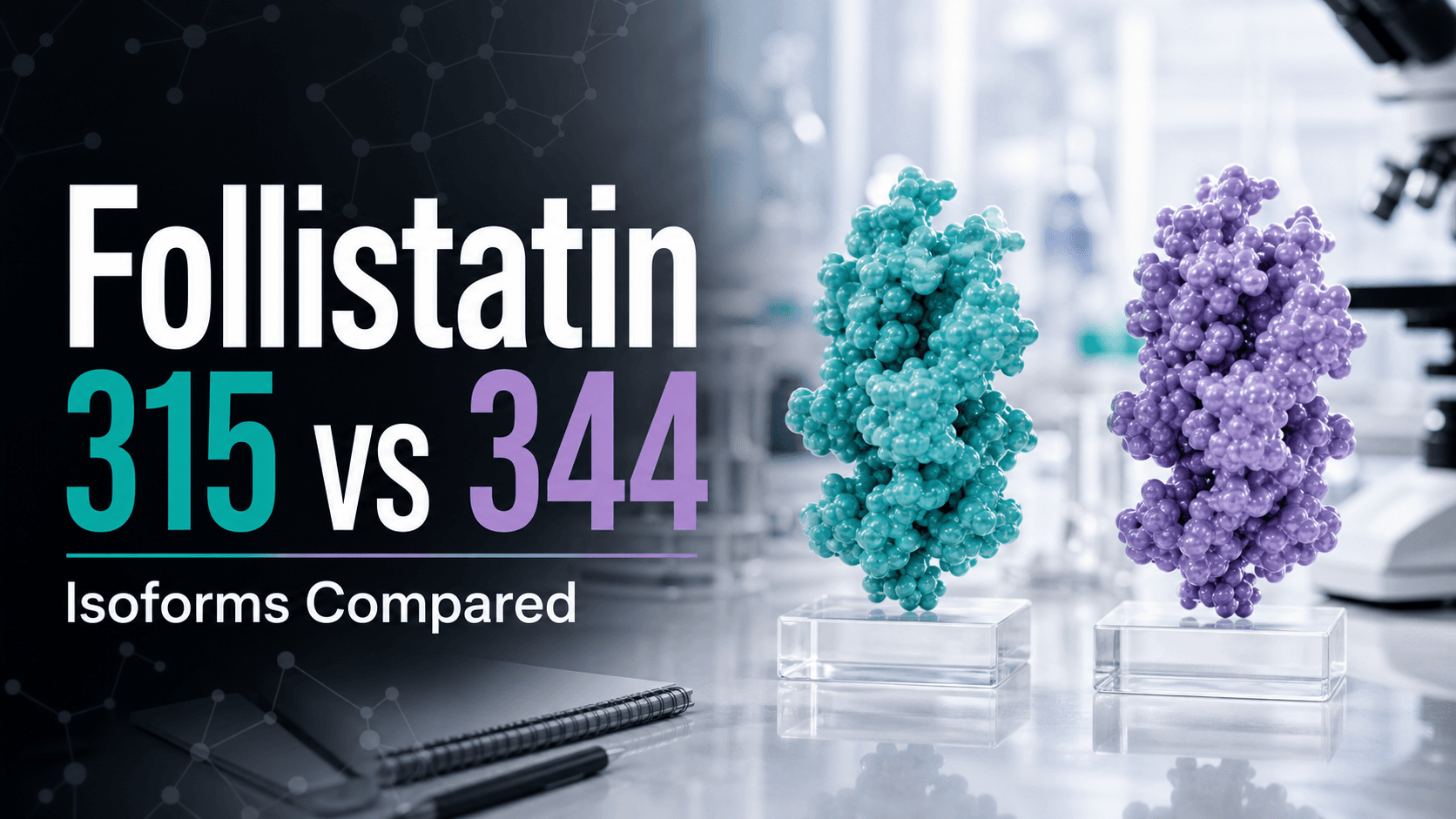
They are not the same molecule. Follistatin 315 and follistatin 344 differ by only 29 amino acids, but those 29 change where the protein goes, how long it lasts, and what it binds.
The marketing usually skips this. The decision should not.
Key takeaways
- Both isoforms come from the FST gene; FS-344 includes a 29-amino-acid C-terminal tail with a heparin-binding domain.
- FS-344 sticks to cell surfaces and acts locally; FS-315 lacks the heparin tail and circulates systemically.
- Reported half-life is roughly 24–48 hours for FS-344 and up to 72 hours for FS-315 in research models.
- In gene therapy, FS-344 is the chosen isoform because it produces FS-315 in serum without disrupting the HPG axis.
- Independent peptide-market testing found only 9 of 17 vendor products contained any follistatin at all.
- For most lifters, the choice between 315 and 344 matters less than whether the vial actually contains pure follistatin.
Follistatin 315 vs 344 — quick comparison
Start with the table. This is the version most pages bury under three paragraphs of background.
| Feature | Follistatin 315 (FS-315) | Follistatin 344 (FS-344) |
|---|---|---|
| Amino acids | 315 | 344 (precursor; cleaves to 315 in serum) |
| C-terminal tail | None | 29 amino acids with heparin-binding domain |
| Where it goes | Circulates systemically in extracellular fluid | Binds cell surface proteoglycans, stays local |
| Half-life (research models) | Up to ~72 hours | ~24–48 hours before cleavage |
| Main target binding | Myostatin and activin A, lower activin affinity than FS-288 | Same targets; localized neutralization |
| FSH / HPG axis effect | Lower risk of FSH suppression | FS344 chosen in trials specifically to spare the HPG axis |
| Where it is used most | Reproductive, immune, systemic muscle work | Gene therapy programs (AAV1-FS344, plasmid FST-344) |
| Vendor market purity | Mixed; same WADA forensic concerns as FS-344 | Mixed; 9 of 17 tested products actually contained follistatin |
| Typical "research" dose discussed online | 100 mcg / day | 100 mcg / day, 10–30 day cycles |
| Reasonable choice for | Systemic, slower, balanced effect | Localized muscle work or gene-therapy context |
That table is the whole answer most readers came for. The rest of the article explains why the rows read this way.
For background on the broader category, read the follistatin overview and the follistatin peptide article. For dose specifics, use the follistatin dosage guide.
What the two isoforms actually are
One gene, two transcripts. The FST gene produces two main transcripts through alternative splicing: a long precursor that becomes FS-344, and a shorter transcript that becomes FS-315.
FS-344 carries an extra 29 amino acids on its C-terminal tail. That tail contains a heparin-binding domain — a short, sticky stretch that grabs onto proteoglycans on cell surfaces.
After secretion, FS-344 is enzymatically cleaved. The signal peptide and tail are removed, leaving FS-315 floating freely in blood and extracellular fluid.
So in a strict sense, FS-344 is the parent form and FS-315 is the circulating mature form. Calling them "competing peptides" is misleading.
Why the heparin tail matters
This is the single most important biological difference. The heparin-binding tail on FS-344 acts like a magnet for cell-surface sugars.
That magnetism pulls FS-344 out of the bloodstream and onto local cell surfaces near the injection site. So FS-344 acts mostly where it was put down.
FS-315 lacks the tail. It stays in solution, drifts around the body, and neutralizes activin and myostatin further from where it was secreted.
In gene-therapy work, an AAV-delivered FS-344 transcript transcribes locally inside muscle fibers, then matures to FS-315 in serum. That two-step pattern is the reason the sIBM trial chose FS-344: local production, systemic clearance, low off-target endocrine effect.
Half-life and clearance in practice
The numbers most often cited are research-model figures, not human pharmacokinetic studies.
- FS-344 in research preparations: reported active duration of about 24–48 hours before tail cleavage.
- FS-315 after cleavage: longer circulating half-life, up to about 72 hours, partly because it does not stick to cell surfaces.
- Real human pharmacokinetic data for either isoform as an injected peptide are essentially absent.
That gap matters. The dosing protocols circulating in online communities — 100 mcg daily or every other day — were not built from formal human PK studies. They were extrapolated from animal work and lifter forums.
Off-target binding — the FSH question
This is where the safety conversation actually lives. Follistatin binds activins; activins drive FSH release from the pituitary.
Heavy systemic follistatin can lower FSH and disrupt fertility. A 2025 antibody study found a 75% FSH drop within a week of strong myostatin-pathway suppression and impaired ovulation in females.
That is why the AAV-FS344 trial in sIBM was watched so carefully — and why no FSH, LH, testosterone, or estrogen disturbances were seen at the 6 × 10¹¹ vg/kg quadriceps dose. The FS-344 isoform was specifically chosen to keep the action local.
FS-315 has lower affinity for activins than the cell-bound FS-288 form, but its systemic distribution can still affect the HPG axis at high doses. Anyone running long, high-dose cycles of either isoform should track FSH and LH at baseline and at follow-up.
Hypertrophy magnitude — what the data suggest
The peptide market makes both isoforms sound interchangeable. The available data say otherwise.
One comparative model reported by isoform researchers:
- Local FS-315 gene transfer produced about 41% hypertrophy in the injected muscle, with no effect on distant muscles.
- Local FS-344 gene transfer produced about 23% hypertrophy in the injected muscle and 14–18% in non-injected muscles.
The mouse muscle-mass numbers cited in older reviews — 100–150% increases at high doses in normal mice and roughly 34% fiber-diameter gains in dystrophic models — were generated by AAV-mediated transgenic overexpression, not peptide injection. They overstate what a peptide cycle can deliver.
Human results are far smaller. A 2019 lean-mass study in hypogonadal males reported 8.2% lean mass gain over 12 weeks vs 2.1% placebo, and human case reports show single-digit-percent lean changes paired with strength gains.
The peptide market reality
This is the part most "315 vs 344" articles skip. The bigger problem with both isoforms is what is actually in the vial.
A WADA-affiliated forensic study analyzed 17 black-market follistatin products. Only 9 of 17 contained any follistatin at all. The rest contained other peptides like MGF or GHRP-2.
Of the 9 that did contain follistatin, all carried a His-tag and visible protein clumping — not characteristics of native human follistatin. The Real Peptides team reports that human-grade follistatin costs over $4,500 per milligram, which is why adulteration is so widespread.
The reasonable read:
- The "is 315 better or worse than 344" question only matters if the vial contains real follistatin.
- Most lifters comparing 315 vs 344 in forums are comparing two products that may share the same purity problems.
- Third-party testing, COA review, and a reputable supplier matter more than picking an isoform.
For supplier diligence basics, read the where to buy follistatin guide.
Which isoform fits which goal
If purity is sorted, the isoform choice maps to your goal.
| Goal | Better choice | Why |
|---|---|---|
| Single muscle group, post-injury or local hypertrophy | FS-344 | Sticks near the injection site, more local action |
| Whole-body recovery, systemic anabolic environment | FS-315 | Circulates, longer half-life, fewer local-only effects |
| Mimicking the AAV-FS344 trial logic | FS-344 | Local FS-344 transcribes to systemic FS-315 over time |
| Lower theoretical FSH disruption | FS-344 (low systemic spread) | Local action reduces activin-A circulating reach |
| Reproductive or immune-focused goals | FS-315 | Systemic distribution and activin neutralization |
For lifters with no specific local target, FS-315's longer half-life and systemic distribution is the more common pick. For people running it post-tear or for a single muscle group, FS-344 is the more common pick.
Neither isoform should be confused with gene therapy, which is a fundamentally different intervention.
Side effect profile by isoform
Both share the same documented side-effect list. The differences are mostly in distribution.
- Injection-site reactions (15–25%): roughly equal across isoforms.
- Headaches (8–15%) and fatigue (5–12%): more often reported with FS-315 because of its systemic spread.
- FSH suppression: a temporary 15–30% FSH drop has been documented at therapeutic peptide doses; greater theoretical risk with FS-315.
- Tendon weakness: a theoretical concern with both, based on myostatin-deficient mouse tendon data.
- Central serous chorioretinopathy: documented in 11 male bodybuilders using 1 mg FS-344 injections — roughly 10× a normal "research" dose. Most cases resolved in 2–3 months; multi-injection cases recurred.
- Liver enzyme elevation: about 17% of subjects in a 16-week FS-315 protocol showed mild ALT rises (1.5–2× upper limit), resolving 4–6 weeks after stopping.
The bigger picture is the same for both: long-term safety beyond 16 weeks is essentially unstudied, and chronic high-dose use of either isoform is not supported by human data. For the full safety review, see the follistatin side effects article.
How to think about the choice
Practical decision flow. Do not start with the isoform; start with the prerequisites.
- Is the product third-party tested with a recent COA?
- Does the vial show no visible clumping after reconstitution?
- Have you already optimized training, sleep, protein, and creatine?
- Do you have baseline labs (CBC, CMP, lipid panel, FSH/LH) you can compare against?
- Is the cycle short (≤4 weeks), not chronic?
If those answers are yes, then the isoform choice is straightforward: FS-315 for systemic goals, FS-344 for localized goals, and follow-up labs to confirm nothing drifted.
If those answers are no, no isoform choice rescues the run.
Sources and notes
- Long-term enhancement of skeletal muscle mass and strength by single gene administration (Kota / Mendell 2009)
- Follistatin gene therapy for sporadic inclusion body myositis (Mendell 2017)
- SteroidWiki — Follistatin 315 vs 344: What's the Difference?
- Behemoth Labz — Follistatin 315 vs Follistatin 344 comparison
- Beyond Health Lab — Follistatin 344 mechanism and FS-315 distinction
- Real Peptides — What Is FST-344
- Stacktrax follistatin guide — WADA forensics
- PeptideInsight — Follistatin-315 profile
- PeptideInsight — Follistatin-344 profile
Frequently Asked Questions
Is follistatin 315 stronger than 344?
Not in a simple "stronger or weaker" sense. FS-315 distributes more systemically and has a longer half-life, while FS-344 sticks closer to the injection site. For systemic muscle and recovery goals, FS-315 acts more broadly; for a single targeted muscle, FS-344 stays local.
Which follistatin isoform is used in gene therapy?
FS-344. Both the AAV1-FS344 sIBM trial and the Minicircle plasmid use the FST-344 transcript because it transcribes locally and matures to FS-315 in serum without disturbing the HPG axis.
What is the half-life of follistatin 315 vs 344?
Reported research-model figures suggest about 24–48 hours of active FS-344 before tail cleavage and up to about 72 hours of circulating FS-315. Formal human pharmacokinetic data for either injected peptide are limited.
Does follistatin 344 cause FSH suppression?
Possibly at high systemic doses. The FS-344 isoform was chosen in clinical trials specifically to limit HPG-axis effects, and the sIBM trial saw no FSH or LH changes. Peptide cycles run at higher systemic exposure can still suppress FSH 15–30% temporarily.
How can I tell if my follistatin is real?
Ask for a recent third-party COA, check for visible clumping after reconstitution, and avoid vendors who refuse identity testing. Independent forensic work found that only 9 of 17 tested follistatin products actually contained the protein.
Is there a better natural way to raise follistatin?
For most lifters, the safer first step is dietary and training-based. See the [how to increase follistatin naturally guide](/blog/how-to-increase-follistatin-naturally) for soy isoflavones, epicatechin-rich foods, eccentric training, and other low-friction levers.
This article is for educational purposes only and is not medical advice. Follistatin 315 and 344 peptides lack FDA clearance for human use, are prohibited in regulated sport, and carry unknown long-term safety risks. Talk with a qualified clinician before any peptide cycle, especially if you take medication, plan a pregnancy, or have a cancer, fertility, or hormonal history.