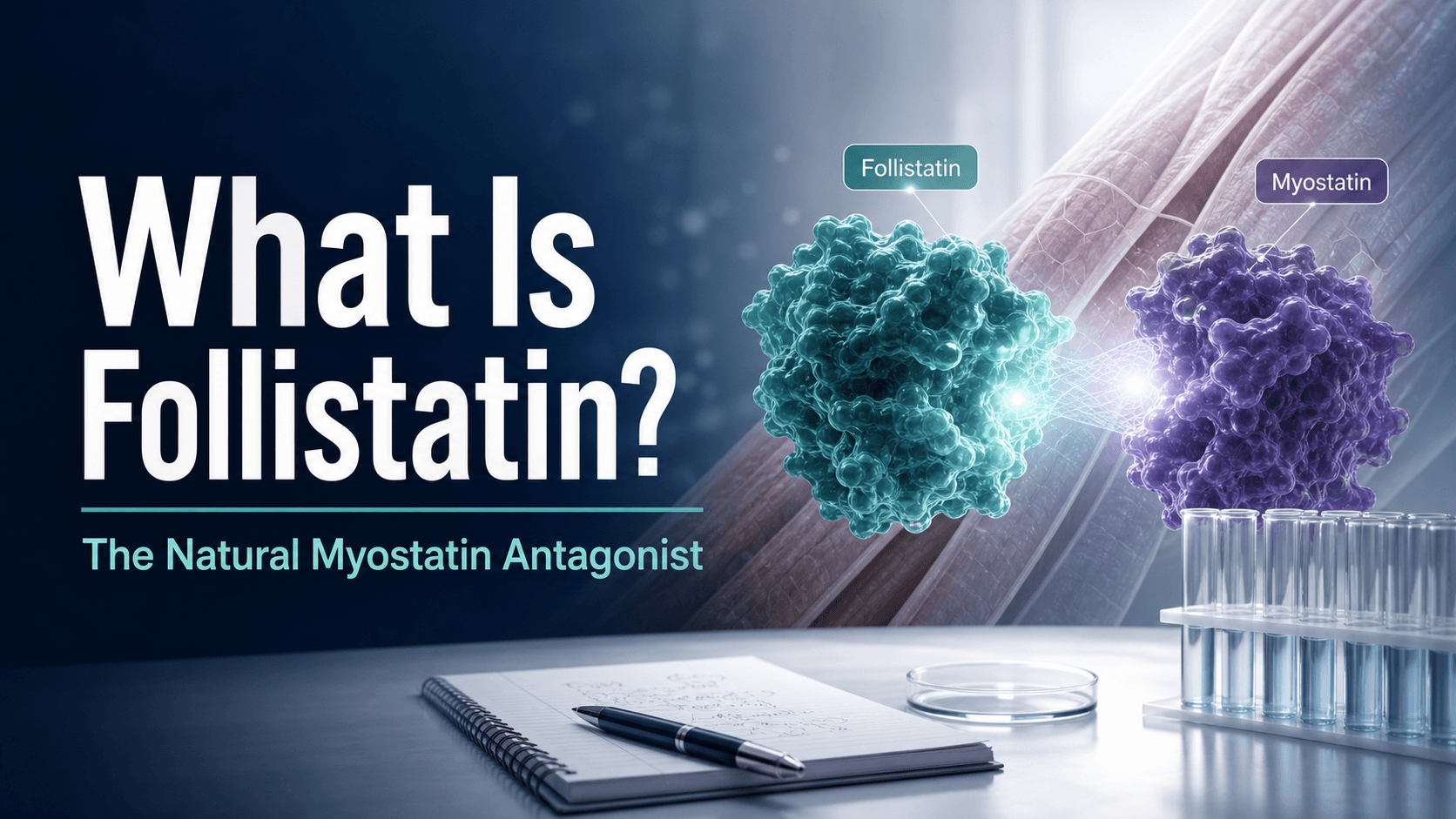
It is the brake remover. Follistatin is the glycoprotein your body makes to bind and neutralize myostatin, the signal that limits how much muscle you can carry.
That single sentence drives most of the search interest. The rest of this guide explains where the science is real, where the supplement marketing overreaches, and what to read next depending on your goal.
Key takeaways
- Follistatin is a 288 or 315-amino-acid glycoprotein encoded by the FST gene on chromosome 5q11.2.
- It binds myostatin, activin A, and several BMPs, then prevents them from reaching their receptors.
- FS-288 binds heparan sulfate on cell surfaces locally; FS-315 circulates freely in blood.
- The strongest human muscle data is from AAV1-FS344 gene therapy, not injectable peptide.
- Acute exercise raises plasma follistatin sharply for hours, mostly from the liver.
- Elevated chronic circulating follistatin is linked to higher type 2 diabetes risk, not a free pass to muscle.
Follistatin at a glance
Start with the snapshot. This table sets the frame before any deeper section.
| Property | What to know |
|---|---|
| Gene / location | FST on chromosome 5q11.2, ~6.5 kb |
| Main isoforms | FS-288 (tissue-bound), FS-315 (circulating), FST-344 (precursor used in gene therapy) |
| Primary muscle role | Binds and neutralizes myostatin (GDF-8) and activin A |
| Strongest human data | AAV1-FS344 gene therapy, Becker muscular dystrophy and sporadic inclusion body myositis |
| Recombinant protein half-life | About 90 minutes in circulation, cleared by the liver |
| Exercise response | Plasma follistatin rises within hours after a hard session, liver-derived |
| FDA status (2026) | No approved injectable follistatin product for any indication |
That snapshot is the honest skeleton. The next sections add the muscle, the limits, and the buying reality.
If you want the pure muscle-suppressor side first, read about myostatin and its role in muscle growth before continuing.
What follistatin is
It is an activin-binding glycoprotein. Follistatin was first isolated from ovarian follicular fluid in 1987 and originally named FSH-suppressing protein, because it dampened follicle-stimulating hormone release from the pituitary.
Later work showed it does much more. Follistatin binds and neutralizes multiple TGF-beta superfamily ligands, including activin A, myostatin, and several BMPs.
That is why it sits at the center of the myostatin conversation. The body already makes the inhibitor; the question is whether more of it helps adults who are not sick.
Why it matters for muscle
The pathway is simple. Myostatin binds the ActRIIB receptor on muscle cells and tells satellite cells to slow down, fibers to stay small, and protein synthesis to cool off.
Follistatin grabs myostatin before it reaches that receptor. With the brake off, satellite cells proliferate, fuse with existing fibers, and add nuclei that can support more growth.
Mice with follistatin overexpression carry roughly twice the muscle mass of controls. Belgian Blue cattle and the so-called mighty mice show the same logic from the myostatin side: remove the inhibitor of growth, and the system can do far more than people assume.
For the broader picture, see the myostatin inhibitor category overview.
The three isoforms that confuse everyone
Names matter here. Search results blur FS-288, FS-315, and FST-344 as if they were interchangeable, but each has a different job.
| Isoform | Length | Where it lives | Practical relevance |
|---|---|---|---|
| FS-288 | 288 amino acids | Heparan-sulfate bound to cell surfaces and matrix | Local tissue effects, binds activin tightly, reproductive biology |
| FS-315 | 315 amino acids | Circulating in serum, no heparin tail | Systemic myostatin neutralization, dominant in blood tests |
| FST-344 | 344 amino acids (precursor) | mRNA-level precursor used in gene therapy | Cleaved in vivo into FS-288 and FS-315 after expression |
Most "follistatin peptide" products online are sold as FST-344 or fragments of it. We compare them in detail in follistatin 315 vs 344 and in the follistatin peptide guide.
How the body changes follistatin levels
Exercise moves the needle first. Hansen and colleagues showed plasma follistatin rises sharply during and after exercise, mostly from the liver in response to a falling insulin-to-glucagon ratio.
That spike is short. It lasts hours, not days, and it tracks with training stress, fasting, and metabolic state more than with muscle mass alone.
Other inputs that raise endogenous follistatin in human or early human data:
- Resistance training, especially eccentric and high-volume sessions
- Fasted exercise and prolonged fasts
- Dietary epicatechin from cocoa, green tea, apples, and grapes
- Soy isoflavones and Ecklonia cava extract
- Egg-yolk-derived MYO-X powder paired with resistance training
We unpack the food and lifestyle side in how to increase follistatin naturally and the broader category in reduce myostatin naturally.
The human evidence honestly
This is where most articles cheat. They quote macaque and mouse data, then promise transformation. The honest map looks like this.
Gene therapy in humans. Jerry Mendell's group at Nationwide Children's Hospital ran two Phase 1/2a trials of AAV1.CMV.FS344. In Becker muscular dystrophy, 4 of 6 patients gained between 29 and 125 meters on the six-minute walk test at 180 days. In sporadic inclusion body myositis, the treated group improved by about 56 meters per year versus a 25-meter decline in untreated controls.
Both trials were small, open-label, and uncontrolled. A 2017 critique by Hanna and colleagues argued that prednisone and prescribed exercise in the sIBM cohort could explain much of the gain. The signal is real enough to fund more trials, not strong enough to call settled.
Injectable peptide in humans. Effectively zero placebo-controlled efficacy data. Underground users report 100 to 300 micrograms per day for short cycles. A 2020 case series in Springer Ophthalmology described 11 male bodybuilders who developed central serous chorioretinopathy after 1 mg subcutaneous doses, about ten times the cited starting dose.
Aging muscle. Follistatin overexpression in 24 to 27-month-old mice produced hypertrophy plus improved neuromuscular junction transmission. Early human data on epicatechin and exercise hint that nudging the follistatin-to-myostatin ratio is achievable without injections.
For the antibody side of the pathway, see anti-myostatin antibody.
Where follistatin sits in disease
Muscle is only one chapter. Elevated circulating follistatin has been linked to higher type 2 diabetes risk, fatty liver, heart failure, stroke, and chronic kidney disease in large prospective cohorts.
That is the opposite of "more follistatin is always better." The signal probably reflects metabolic stress in the liver rather than a direct cause-effect, but it earns caution before anyone pushes systemic levels up indefinitely.
Other clinical contexts that show up in the literature:
- Becker muscular dystrophy and sporadic inclusion body myositis (gene therapy)
- Charcot-Marie-Tooth disease and Duchenne muscular dystrophy (ACE-083 fusion protein trials)
- Spinal muscular atrophy in mouse models
- Polycystic ovary syndrome, where the FST gene is a candidate trait gene
- Cancer biology, with both tumor-suppressing and tumor-supporting effects depending on tissue
The pattern is consistent. Follistatin is a pathway, not a single-use lever.
The therapeutic landscape in 2026
There is no approved follistatin drug. The pipeline runs in three lanes.
- Gene therapy with AAV1-FS344, still investigational and confined to a handful of trial sites.
- Fusion proteins and ligand traps such as ACE-083 (intramuscular), bimagrumab (an anti-ActRII antibody), and sotatercept-family activin traps.
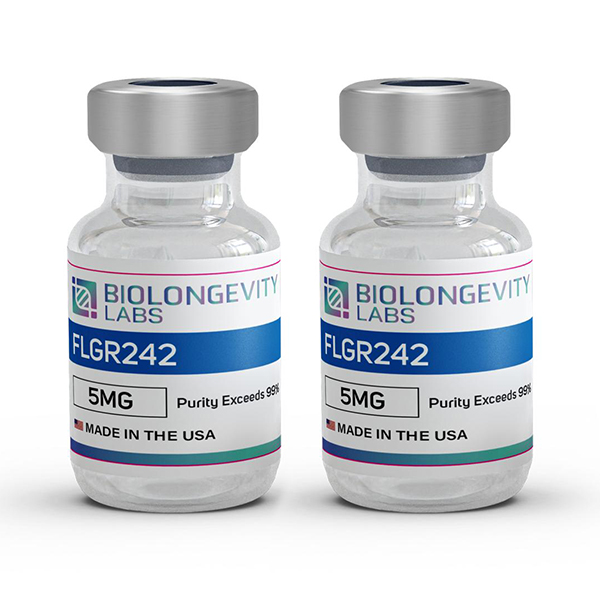
- Underground injectable peptides sold as FST-344, FST-315, and FLGR242, with no FDA pathway and no controlled human pharmacokinetic data.
The last lane is where most consumer interest lives. We cover it in follistatin gene therapy and the follistatin peptide guide, and the broader regulatory side in are myostatin inhibitors legal.
What this means for healthy lifters
The honest answer is unglamorous. Most of the visible muscle you can build still comes from training stimulus, total protein intake, sleep, and consistency.
Follistatin sits behind those levers. You can raise endogenous levels acutely with hard sessions and a clean diet. You cannot reliably buy a long, safe, controlled elevation through online peptides as of 2026.
If your gains have actually stalled and you have already covered the basics, the highest-yield reading next is:
- Natural myostatin inhibitor options for food and lifestyle levers
- Epicatechin and myostatin for the cocoa angle
- Best myostatin inhibitor for category comparison
- Follistatin dosage if you are weighing peptide cycles
- Follistatin side effects before any injection plan
That order respects evidence and cost.
Sources and notes
- Follistatin — Wikipedia
- 4 Benefits of Follistatin + Side Effects — SelfHacked
- Follistatin: A Myostatin-Inhibiting Glycoprotein — Superpower
- Follistatin 344 Peptide — Jay Campbell
- Phase 1/2a follistatin gene therapy for Becker muscular dystrophy
- Follistatin gene delivery enhances muscle growth and strength in nonhuman primates
- Elevated circulating follistatin associates with type 2 diabetes risk
- Exercise induces a marked rise in plasma follistatin
Frequently Asked Questions
Is follistatin the same as myostatin?
No. Myostatin is the brake on muscle growth, and follistatin is one of the proteins that binds myostatin and blocks its signal at the receptor.
What is the difference between FS-288, FS-315, and FST-344?
FS-288 binds tissue surfaces locally, FS-315 circulates in blood, and FST-344 is the longer precursor used in gene therapy that the body cleaves into the other two forms.
Can you raise follistatin naturally?
Yes, modestly. Hard resistance training, eccentric work, fasted exercise, epicatechin from cocoa and green tea, and Ecklonia cava extract have all raised follistatin in early human or human-adjacent data.
Is injectable follistatin approved by the FDA?
No. As of 2026, there is no FDA-approved injectable follistatin product. Gene therapy with AAV1-FS344 exists only inside registered clinical trials.
Does high follistatin have downsides?
Yes. Elevated chronic circulating follistatin is associated with higher type 2 diabetes risk, fatty liver, and cardiovascular events in large cohorts, so chasing higher levels indefinitely is not obviously safe.
What is the strongest human muscle evidence?
The Mendell group's AAV1-FS344 gene therapy trials in Becker muscular dystrophy and sporadic inclusion body myositis, which showed gains on the six-minute walk test but were small and uncontrolled.
This article is for educational purposes only and is not medical advice. Speak with a qualified healthcare professional before starting any peptide, supplement, or experimental therapy, especially if you have a diagnosed condition or take prescription medications.