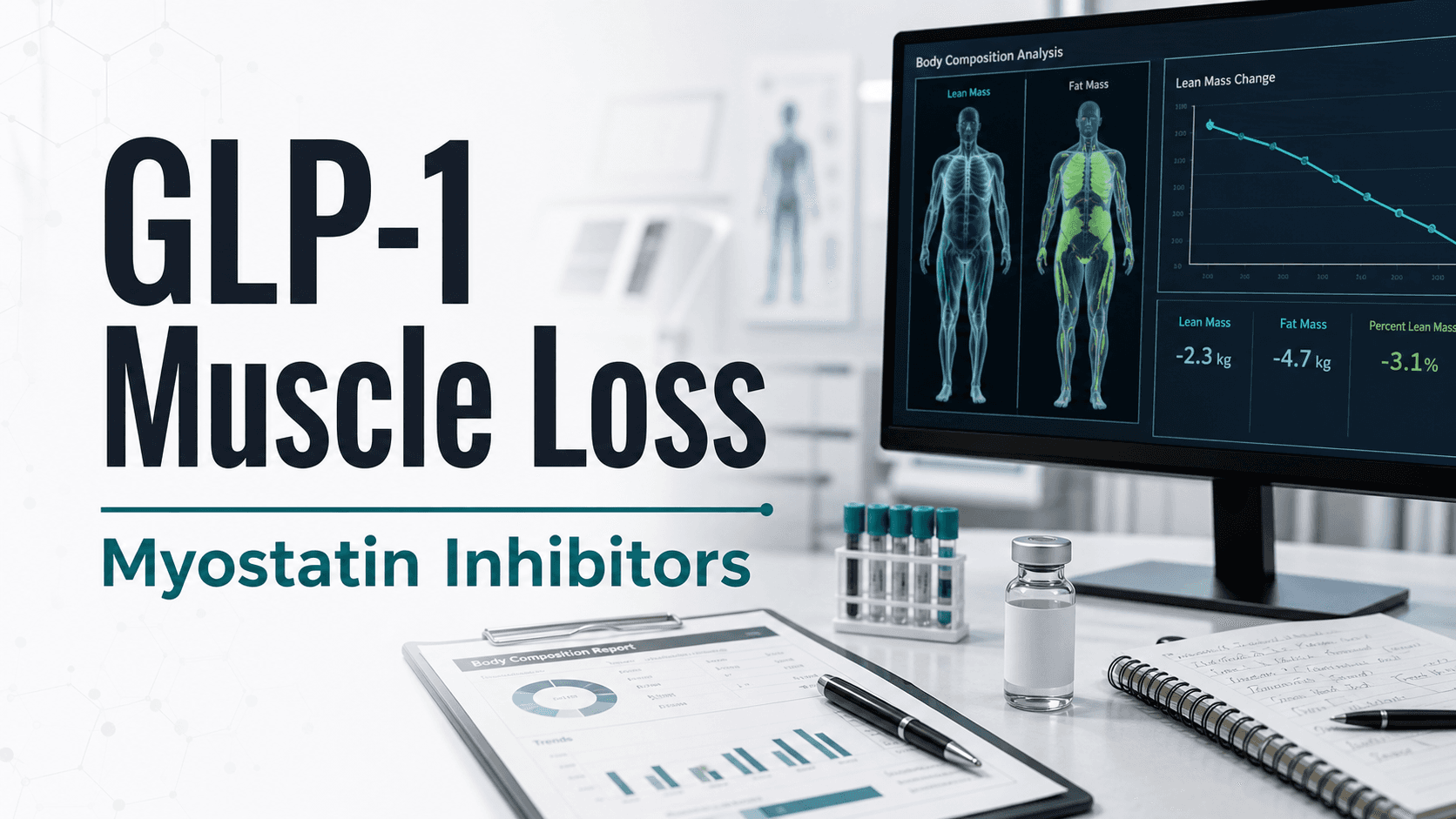
Ozempic shrinks more than fat. About a quarter to two-fifths of the weight people lose on semaglutide or tirzepatide comes from lean tissue, and that is the gap myostatin-blocking drugs are racing to fill. These weight loss injections work — the body composition trade-off is what nobody warned people about.
Key takeaways
- Roughly 25 to 40 percent of weight lost on semaglutide or tirzepatide is lean mass, not fat.
- The bimagrumab plus semaglutide BELIEVE trial (NCT05616013) cut lean-mass loss to about a third of semaglutide-alone numbers.
- Regeneron's COURAGE trial paired trevogrumab and garetosmab with semaglutide and roughly halved lean-mass loss.
- The Nature 2025 GDF8 plus activin A paper showed combined blockade nearly doubled fat loss in animals on GLP-1.
- None of these muscle-sparing add-ons are approved yet; the earliest realistic launch is 2027 to 2028.
- Protein at 1.6 to 2.2 g per kg and resistance training remain the cheapest, most evidence-backed muscle defense today.
How much muscle people actually lose on GLP-1s
The numbers are not small. In STEP-1 and follow-up analyses of semaglutide, roughly 39 percent of the weight lost was lean soft tissue. Tirzepatide trials show a similar pattern, with about 25 percent of total loss coming from lean compartments.
| Drug | Mean weight loss | Share from lean tissue | Practical concern |
|---|---|---|---|
| Semaglutide 2.4 mg (Wegovy) | About 15 percent in 68 weeks | 25 to 40 percent of total | Lower resting metabolic rate, harder regain |
| Tirzepatide (Zepbound) | About 21 percent in 72 weeks | About 25 percent of total | Same regain risk, sometimes worse in older adults |
| Bimagrumab plus semaglutide (BELIEVE) | 22.1 percent at week 72 | About 3 to 8 percent of total | Muscle spasms and acne increase |
| Trevogrumab plus semaglutide (COURAGE) | About 10 percent at 26 weeks | About 13 to 18 percent of total | Adds infusion or injection burden |
The unflattering version is simple. A 200-pound person dropping 40 pounds on Wegovy may be losing 10 to 15 pounds of lean tissue. For an older patient already short on muscle, that is the difference between independent stairs and a cane.
For background on the broader category, see myostatin inhibitor drugs and the wider myostatin inhibitor obesity pipeline.
Why this matters for metabolism and rebound
Muscle pays the rent. Skeletal muscle is the body's biggest glucose sink, the main place fatty acids get burned, and the main driver of resting metabolic rate.
Lose 8 to 12 pounds of it and resting expenditure can drop by 100 to 200 kcal a day. That hidden penalty is one reason the rebound on GLP-1 discontinuation is so brutal: about 70 percent of users stop within a year, and fat returns fast while muscle does not.
There is also the sarcopenic obesity problem. Patients can hit a "healthy" BMI but still have less working tissue than before, which raises fall risk, fracture risk, and insulin resistance later.
What myostatin actually does
Myostatin is a brake. The protein, also called GDF8, signals through activin type II receptors (ActRIIA and ActRIIB) and limits how much muscle the body will build and keep.
Block that signal and muscle gets a chance to defend itself even when calories are dropping fast. That is the mechanistic bet behind every drug in this article.
For a plain-language explainer, read what myostatin is and the related myostatin protein guide.
Bimagrumab plus semaglutide: the BELIEVE trial
The data is real. BELIEVE (NCT05616013) was a phase 2 study at 26 sites across the United States, Australia, and New Zealand, randomizing 507 adults across nine arms over 72 weeks.
The headline numbers from the high-dose combination arm (bimagrumab 30 mg/kg IV every 12 weeks plus semaglutide 2.4 mg weekly):
- 22.1 percent total weight loss at week 72.
- 45.7 percent fat-mass loss.
- Just 2.9 percent lean-mass loss, versus 7.4 percent lean loss on semaglutide alone.
- 84.9 percent of patients hit 15 percent or more weight loss.
- 58.2 percent visceral fat reduction.
Bimagrumab monotherapy was striking on body composition. The 30 mg/kg group gained 2.5 percent lean mass while losing 10.8 percent of weight, with essentially 100 percent of that loss coming from fat.
The cost is real too. Muscle spasms hit 57 to 64 percent of bimagrumab patients, diarrhea was common, and 14 to 21 percent of bimagrumab-only patients dropped out of the trial. Four skin cancers occurred in monotherapy arms.
What Lilly did next
Lilly bought bimagrumab in 2023 by acquiring Versanis Bio for 1.9 billion dollars. In September 2025 the company quietly withdrew a planned phase 2b trial in obese T2DM patients before enrollment opened, citing "strategic business reasons."
A separate phase 2 study testing bimagrumab with Zepbound is still running, with readouts expected through 2026. The pull-back has been read by analysts as Lilly hedging while the side-effect profile gets clearer, not killing the program.
Regeneron's COURAGE trial: trevogrumab and garetosmab
Regeneron took a different angle. COURAGE (NCT06299098) enrolled 605 obese adults without diabetes, mean age 49 and 67 percent women, comparing semaglutide alone with semaglutide plus trevogrumab (anti-myostatin) and a triple arm that added garetosmab (anti-activin A).
At 26 weeks the dual blockade arm cut lean-mass loss from 6.5 percent on semaglutide alone to about 2.0 percent.
| Arm | Weight loss | Lean mass loss | Fat mass loss | Muscle spasms |
|---|---|---|---|---|
| Semaglutide 2.4 mg | About 10 percent | 6.5 percent (3.3 kg) | 15.7 percent | 4.6 percent |
| + trevogrumab 200 mg | About 10 percent | 3.3 percent (1.5 kg) | 17.3 percent | 6.1 percent |
| + trevogrumab 400 mg | About 10 percent | 3.8 percent (1.9 kg) | 19.1 percent | 9.3 percent |
| + trevogrumab + garetosmab | 13.4 percent | 2.0 percent (0.9 kg) | 27.1 percent | 40.9 percent |
The triple combination looked beautiful on body composition but ugly on tolerability. Treatment discontinuation hit 30.9 percent and 14 serious adverse events, including two deaths, were reported in that arm.
That is the recurring lesson: stacking biologics on top of semaglutide buys real lean-mass protection, but the side-effect curve is not free.
Apitegromab and the EMBRAZE trial
Scholar Rock chose a quieter target. Apitegromab binds pro- and latent forms of myostatin only, which in theory cuts off-target effects on GDF11 and activins.
EMBRAZE (NCT06445075) tested apitegromab on top of tirzepatide and reportedly preserved roughly 55 percent more lean mass than tirzepatide alone, with a tolerability profile that looks cleaner than bimagrumab so far. The company's PDUFA date for the SMA indication sits in late 2025, which would make apitegromab the first myostatin antibody on the market.
Taldefgrobep alfa: Biohaven's adnectin bet
Different molecule, different shape. Taldefgrobep is an anti-myostatin adnectin (a small protein scaffold, not a full antibody), originally Bristol Myers Squibb's BMS-986089 and licensed to Biohaven in 2022.
The phase 3 RESILIENT trial in spinal muscular atrophy missed its primary endpoint in 2024, but body composition signals were strong: a statistically significant reduction in fat mass (p=0.008) and numerical gains in lean mass. That body-comp signal is exactly why Biohaven pivoted to obesity, with the phase 2 NCT07281495 study now fully enrolled and topline data expected in the second half of 2026.
See the dedicated taldefgrobep alfa page for the full story.
The GDF8 plus activin A Nature 2025 paper
The mechanistic case got clearer. A 2025 Nature Communications paper showed that blocking both GDF8 and activin A on top of semaglutide:
- Reversed lean-mass loss in obese mice and produced a net lean-mass gain.
- Nearly doubled fat loss compared with semaglutide alone.
- Drove progressive lean-mass and fat-loss improvements in obese cynomolgus monkeys over 20 weeks.
- Improved HbA1c, LDL, HDL, and liver fat alongside the body-composition wins.
That paper is the scientific backbone for the dual-blockade arms in COURAGE and for Regeneron and Lilly's combination strategies.
What is actually available in 2026
Nothing, for muscle preservation. Bimagrumab, trevogrumab, apitegromab, taldefgrobep, garetosmab and the rest are all phase 2 or phase 3 with no FDA approval for obesity or for muscle preservation on a GLP-1.
That means the only options that exist right now for a Wegovy or Zepbound user worried about lean mass are the boring ones:
- Protein at 1.6 to 2.2 g per kg of body weight per day.
- Resistance training two to four times per week with progressive overload.
- Creatine monohydrate at 3 to 5 g daily, the only supplement with consistent lean-mass support data. For the broader category, see natural myostatin inhibitor options.
- Slowing the rate of weight loss when lean mass starts dropping noticeably.
- Annual DEXA scans if available, otherwise grip strength and a tape measure.
A bodybuilder-tier list with peptides and niche products is not going to beat those four for most patients, and it adds risk.
Realistic timeline through 2028
The first muscle-sparing GLP-1 add-on probably lands in 2027 to 2028. Bimagrumab and trevogrumab are the most likely first approvals if their phase 3 programs replicate. Apitegromab may arrive earlier in SMA, then pivot to obesity. Taldefgrobep results from the phase 2 obesity study will tell us in late 2026 whether Biohaven stays in the race or pivots again.
| Drug | Sponsor | Earliest realistic obesity approval | Confidence |
|---|---|---|---|
| Bimagrumab | Eli Lilly | 2027 to 2028 | Moderate, side-effect dependent |
| Trevogrumab plus garetosmab | Regeneron | 2028 | Moderate, tolerability is the risk |
| Apitegromab | Scholar Rock | 2028 | Moderate, cleaner side-effect profile |
| Taldefgrobep alfa | Biohaven | 2028 or later | Lower, needs phase 2 win |
| IBIO-600 | iBio and AstralBio | 2030 plus | Early, IND filing pending |
Combined GLP-1 plus myostatin-blocker therapy is also expected to cost 1,500 to 2,000 dollars per month at launch in the United States, on top of injection-site burden and required monitoring.
Hype versus signal
The pattern is repeating. Pages selling early myostatin add-ons often borrow numbers from animal work, blur trial arms, and treat phase 2 results as endpoints rather than way points.
A few honest filters before believing any of this:
- Is the trial NCT number actually phase 3, not phase 2?
- Are the lean-mass numbers from DEXA, not bioimpedance?
- Is the comparator semaglutide or tirzepatide at the approved dose, not a sub-therapeutic one?
- Is the side-effect profile reported alongside the efficacy number?
- Is the patient population older adults or sarcopenic patients, where this actually matters most?
If any of those answers is no, treat the headline with caution.
Sources and notes
- Bimagrumab plus semaglutide alone or in combination - Nature Medicine 2026
- GDF8 and activin A blockade protects against GLP-1-induced muscle loss - Nature Communications 2025
- Effect of Bimagrumab vs Placebo on Body Fat Mass - JAMA Network Open 2021
- Myostatin Blocker Preserves Muscle With GLP-1 Treatment - Medscape
- Myostatin inhibitors target muscle loss prevention - Pharmaceutical Technology
- Muscle-preserving therapies in the era of pharmacological weight loss - Oxford Obesity & Endocrinology
- Emerging Role of Myostatin Inhibitors in the Management of Glucagon - PMC
- Lilly withdraws phase 2b obesity trial - Fierce Biotech
- Lilly stops trial of muscle-sparing obesity drug - BioPharma Dive
- Bimagrumab and Semaglutide in Obesity - NCT05616013
Frequently Asked Questions
How much muscle do people really lose on Ozempic?
In published GLP-1 trials, about 25 to 40 percent of total weight loss comes from lean tissue, depending on age, training status, and protein intake. Older adults and sedentary patients sit at the worse end of that range.
Is bimagrumab approved with semaglutide yet?
No. The BELIEVE phase 2 trial reported strong body-composition data in 2026, but the program is still pre-approval. Lilly withdrew one planned phase 2b study in late 2025 while a separate phase 2 with Zepbound continues.
What is the difference between trevogrumab and bimagrumab?
Trevogrumab is a myostatin-specific antibody. Bimagrumab blocks activin type II receptors, which sit downstream of myostatin and activin A. Bimagrumab is broader and more potent on muscle, but also more prone to muscle spasms.
Should someone on Wegovy try a myostatin supplement instead?
No supplement replicates trial-grade myostatin blockade. Protein, resistance training, and creatine are the only consistently evidence-supported levers a Wegovy user can pull today. Supplement labels claiming "myostatin inhibitor" results almost always overstate the human data.
When will a muscle-sparing GLP-1 add-on actually launch?
Best case is 2027 to 2028 for bimagrumab or trevogrumab. Apitegromab may arrive earlier in SMA and then pivot. Anything sold today claiming to do this is either an unapproved peptide or a supplement, not an approved muscle-sparing therapy.
Does losing muscle on GLP-1 cause weight regain?
Indirectly, yes. Lost muscle lowers resting metabolic rate by an estimated 100 to 200 kcal per day, which makes it easier to regain fat once the GLP-1 is stopped. About 70 percent of GLP-1 users discontinue within a year, which is why muscle preservation has become the most important secondary endpoint in the field.
This article is for educational purposes only and is not medical advice. GLP-1 medications, anti-myostatin antibodies, and combination protocols must be prescribed and monitored by a qualified clinician. Discuss any change in medication, supplement, or training program with your own physician, especially if you have diabetes, kidney disease, heart disease, or are over age 65.