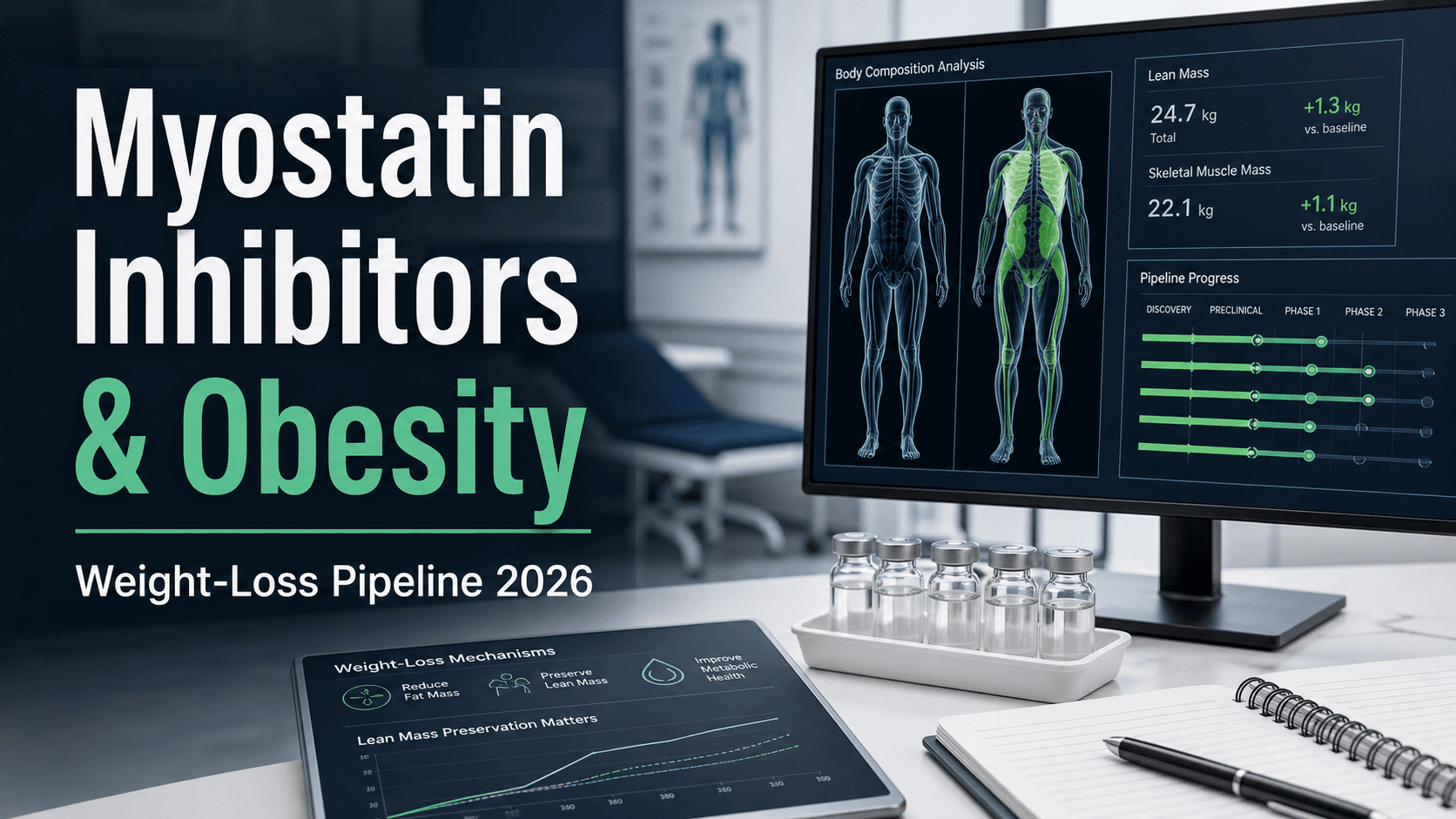
GLP-1 broke something. The same drugs that cut obesity by 15 to 22 percent also strip a quarter to two-fifths of that weight loss from lean tissue, and that gap created the entire myostatin-inhibitor-for-obesity category.
Key takeaways
- About a dozen myostatin or activin-pathway drugs are in clinical trials for obesity, almost all paired with semaglutide or tirzepatide.
- Bimagrumab, apitegromab, and trevogrumab plus garetosmab are the closest to launch, with phase 2 data already in print.
- The strongest body-composition signal so far came from BELIEVE: 22.1 percent weight loss with only 2.9 percent lean-mass loss.
- Side effects are real. Muscle spasms hit 40 to 64 percent in some arms, and the triple-combination COURAGE arm saw a 30.9 percent drop-out rate.
- FDA has signaled it will accept "incremental weight loss" or lean-mass preservation as an approval endpoint, which clears the regulatory path.
- First approval is realistic in 2027 to 2028; nothing in this class is buyable in 2026.
The pipeline at a glance
Start with the map. Six drugs are leading the obesity race, with another half-dozen earlier-stage candidates in development.
| Drug | Sponsor | Target | Stage in obesity | Earliest approval |
|---|---|---|---|---|
| Bimagrumab | Eli Lilly (ex-Versanis, ex-Novartis) | ActRIIA / ActRIIB receptor | Phase 2 BELIEVE complete; Zepbound combo ongoing | 2027 to 2028 |
| Trevogrumab + garetosmab | Regeneron | Myostatin + activin A | Phase 2 COURAGE complete; expansion 2026 | 2028 |
| Apitegromab | Scholar Rock | Pro- and latent myostatin | Phase 2 EMBRAZE complete; obesity expansion | 2028 |
| Taldefgrobep alfa | Biohaven | Myostatin (adnectin) | Phase 2 obesity fully enrolled, readout H2 2026 | 2028 or later |
| RG6237 | Roche | Latent myostatin | Phase 2 monotherapy plus CT-388 combo | 2029 |
| Enobosarm | Veru | Androgen receptor (SARM, not strictly myostatin) | Phase 2b QUALITY with semaglutide | 2028 |
| KER-065 | Keros Pharma | ActRII ligand trap | Phase 1 to 2 transition | 2029 to 2030 |
| ARO-INHBE | Arrowhead | RNAi against activin E | Phase 1/2a | 2030 plus |
| IBIO-600 | iBio with AstralBio | Long-acting anti-myostatin | Lead-molecule stage, IND filing pending | 2030 plus |
| HS235 | 35Pharma | Activin pathway | Early discovery | 2030 plus |
That breadth is the story. Almost every big pharma and biotech with a muscle-biology asset has refocused it on obesity in the past three years.
For background on the GLP-1 side of the equation, see myostatin inhibitors and GLP-1 muscle loss. For the broader category history, read myostatin inhibitor drugs.
Why obesity became the new use case
The pivot is recent. Anti-myostatin antibodies were originally developed for muscular dystrophies and sarcopenia, where the trials repeatedly failed on functional endpoints (MYO-029 in 2008, domagrozumab in 2018, taldefgrobep in SMA in 2024).
GLP-1 changed everything. Weight loss injections like semaglutide and tirzepatide produce 15 to 22 percent weight loss but with 25 to 40 percent of that weight loss coming from lean tissue. In an older patient, that is the difference between independent stairs and a walker.
The commercial logic is brutal. A muscle-sparing add-on to semaglutide does not need to cure anything. It just needs to keep 5 to 10 pounds of lean tissue on the patient, and the FDA has indicated that "incremental weight loss" beyond GLP-1 alone is an acceptable approval endpoint.
That is why every credible myostatin or activin asset is now in an obesity combination trial.
How these drugs work
There are three biological hits.
- Anti-myostatin antibodies (apitegromab, trevogrumab, taldefgrobep). They bind myostatin (GDF8) and prevent it from signaling through activin type II receptors. The effect is muscle-selective.
- Anti-activin receptor antibodies (bimagrumab). They bind the receptor itself, blocking myostatin, activin A, activin B, GDF11, and parts of BMP signaling. Bigger effect on both muscle and fat, but also broader off-target risk.
- Anti-activin A antibodies (garetosmab). Used in combination to block activin A, which is itself a driver of fat-mass gain. Adds to fat loss but raises muscle-spasm rates.
The combination logic is straightforward. Hit myostatin or its receptor to keep muscle, hit activin A to accelerate fat loss, pair it with semaglutide or tirzepatide for the appetite arm.
The lean-mass numbers that built the category
This is the only chart that matters.
| Regimen | Total weight loss | Lean-mass loss | Notes |
|---|---|---|---|
| Semaglutide 2.4 mg alone | 15.7 percent at 68 weeks | 7.4 percent | STEP-1 and BELIEVE control |
| Tirzepatide alone | About 21 percent at 72 weeks | About 25 percent of total | SURMOUNT-1 |
| Bimagrumab 30 mg/kg monotherapy | 10.8 percent at 72 weeks | Plus 2.5 percent (gain) | BELIEVE |
| Bimagrumab + semaglutide high dose | 22.1 percent at 72 weeks | Minus 2.9 percent | BELIEVE |
| Trevogrumab + semaglutide | About 10 percent at 26 weeks | 3.3 to 3.8 percent | COURAGE |
| Trevogrumab + garetosmab + semaglutide | 13.4 percent at 26 weeks | 2.0 percent | COURAGE triple arm |
| Apitegromab + tirzepatide | Tirzepatide level | 55 percent less lean loss vs tirzepatide alone | EMBRAZE |
| Enobosarm + semaglutide | Semaglutide level | 71 percent less lean loss | QUALITY |
| Pemvidutide (GLP-1 / glucagon) | Mid-teens | Only 21.9 percent of loss as lean | MOMENTUM |
The pattern is consistent. Adding a myostatin or activin blocker to a GLP-1 cuts lean-mass loss by half to two-thirds and sometimes converts it to a net gain.
The trials worth knowing by name
Five trials are the spine of the field.
BELIEVE (NCT05616013). Bimagrumab plus semaglutide, 507 patients, 72 weeks. The high-dose combination produced 22.1 percent weight loss and lean-mass loss capped at 2.9 percent. Read the full breakdown on the bimagrumab page.
COURAGE (NCT06299098). Regeneron's trevogrumab and garetosmab plus semaglutide, 605 patients, 26 weeks. Lean-mass loss cut to 2.0 percent in the triple-combination arm, but discontinuation hit 30.9 percent there. Expected full completion late 2026.
EMBRAZE (NCT06445075). Scholar Rock's apitegromab on top of tirzepatide. Roughly 55 percent more lean-mass preservation than tirzepatide alone, with a cleaner side-effect profile than bimagrumab.
QUALITY (NCT06282458). Veru's enobosarm plus semaglutide. Lean-mass loss cut by 71 percent and stair-climb power decline reduced by 55 percent. Enobosarm is a SARM, not a myostatin antibody, but it is the closest direct competitor on the lean-mass-preservation thesis.
Taldefgrobep alfa obesity phase 2 (NCT07281495). Biohaven's adnectin, 150 patients across about 20 US sites, weekly or monthly subcutaneous dosing, 24-week primary endpoint with a 24-week extension. Topline data is expected in the second half of 2026. See the taldefgrobep alfa page for the full story.
The Nature 2025 paper that anchored the science
The mechanistic case got bigger. A 2025 Nature Communications paper showed that combined GDF8 and activin A blockade on top of semaglutide:
- Reversed semaglutide-induced lean-mass loss in diet-induced obese mice and produced a net lean-mass gain.
- Nearly doubled fat loss compared with semaglutide alone.
- Drove progressive lean-mass and fat-loss improvements in obese cynomolgus monkeys over 20 weeks.
- Improved HbA1c, LDL, HDL, and liver fat content.
That paper is the scientific spine of Regeneron's triple-combination strategy and helps explain why the activin A piece keeps showing up next to anti-myostatin.
The tolerability problem
This is the part the press releases bury.
Muscle spasms (or cramps) are the single most common side effect across the class:
- Bimagrumab: 41 to 64 percent across trials, 5 patients in BELIEVE stopped because of them.
- Trevogrumab 400 mg: 9.3 percent in COURAGE.
- Triple combination (trev + gareto + sema): 40.9 percent.
- Apitegromab: notably lower, in the single digits.
Other recurring findings include diarrhea (30 to 41 percent with bimagrumab), acne, transient bumps in liver enzymes and creatine kinase, and rare cases of skin cancer or pancreatitis in monotherapy arms. The triple-combination COURAGE arm saw 14 serious adverse events including two deaths, and a 30.9 percent drop-out rate.
The honest read: there is no free muscle here. Every approved combination will have to manage spasms, GI effects, and the long-term safety of chronic activin-pathway blockade.
Who actually needs this
Not everyone on Wegovy. The clearest case for a myostatin-inhibitor add-on is older adults, sarcopenic patients, and people with type 2 diabetes who are already on the lean-mass-loss edge of the curve.
A useful filter:
| Patient type | Likely benefit from a myostatin add-on |
|---|---|
| Adult under 50, training regularly, eating 1.6 g/kg protein | Low; protein and lifting already do most of the work |
| Adult 50 to 65 with sedentary baseline | Moderate; muscle defense is real |
| Adult over 65 or already sarcopenic | High; lean-mass loss may directly hurt mobility |
| Patient losing more than 15 percent of body weight | High; absolute lean-mass loss can exceed 10 pounds |
| Patient with type 2 diabetes plus obesity | High; metabolic and body-composition wins stack |
For everyone else, the cheap interventions are still the best: progressive resistance training, protein at 1.6 to 2.2 g per kg, and creatine at 3 to 5 g daily. The reduce myostatin naturally guide covers those levers in more detail. None of those replace a real anti-myostatin antibody in the high-risk groups, but they cover most patients.
What is likely to launch first
A rough ranking by probability of 2027 to 2028 launch:
- Apitegromab for SMA approval first, then an obesity supplemental indication based on EMBRAZE.
- Bimagrumab plus semaglutide or tirzepatide if Lilly's Zepbound combination phase 2 reproduces BELIEVE.
- Trevogrumab plus semaglutide if Regeneron can tighten the side-effect profile in the dual combination (skipping the triple).
- Enobosarm plus semaglutide as a small-molecule, oral alternative on a different mechanism.
Taldefgrobep, IBIO-600, KER-065, and ARO-INHBE are 2029 and later in the realistic case. Expect combination pricing in the United States to start at 1,500 to 2,000 dollars per month.
Candid limits of the category
Five honest constraints anyone reading this should hold onto:
- The trials are short. 26 to 72 weeks is not enough to know what chronic activin-pathway blockade does over a decade.
- The drugs are biologics. Most are intravenous or subcutaneous injectables, not oral pills, which limits access.
- The cost will not be small. Combination therapy will likely cost more than current GLP-1s alone.
- Muscle protected on drug can disappear off drug. Discontinuation patterns matter, and almost no published data covers a full off-drug year.
- None of these matter without the basics. A patient who will not eat protein or do resistance work will still lose function on combination therapy, just at a slower rate.
The category is real, the science is solid, and the first wave of launches is plausible. None of that justifies paying for a 2026 supplement that claims to copy the effect.
Sources and notes
- Bimagrumab plus semaglutide alone or in combination - Nature Medicine 2026
- GDF8 and activin A blockade protects against GLP-1-induced muscle loss - Nature Communications 2025
- Effect of Bimagrumab vs Placebo on Body Fat Mass - JAMA Network Open 2021
- Muscle-preserving therapies in the era of pharmacological weight loss - Oxford Obesity & Endocrinology
- Emerging Role of Myostatin Inhibitors in the Management of Glucagon - PMC
- Myostatin Blocker Preserves Muscle With GLP-1 Treatment - Medscape
- Myostatin inhibitors target muscle loss prevention - Pharmaceutical Technology
- Biohaven Phase 2 Obesity Study with Taldefgrobep Alfa - PR Newswire
- iBio and AstralBio Provide Update on Myostatin Program for Obesity
- Lilly stops trial of muscle-sparing obesity drug - BioPharma Dive
Frequently Asked Questions
Is there a myostatin inhibitor approved for obesity yet?
No. As of May 2026, every myostatin inhibitor in development for obesity is in phase 2 or phase 3 trials. The earliest plausible approval is 2027 to 2028, likely for bimagrumab plus a GLP-1 or apitegromab as a follow-on after its SMA approval.
What is the best myostatin inhibitor for muscle preservation on Ozempic?
"Best" depends on what is measured. Bimagrumab produces the biggest body-composition swing in BELIEVE. Apitegromab is the cleanest on side effects. Trevogrumab plus garetosmab matches bimagrumab in body composition but at a worse tolerability cost. None are buyable yet.
Will a myostatin inhibitor help me lose more fat?
In trials, yes. Bimagrumab plus high-dose semaglutide produced 22.1 percent total weight loss versus 15.7 percent on semaglutide alone. Triple combinations in COURAGE produced even greater fat-mass reductions, but with worse tolerability.
Are there oral myostatin inhibitors for obesity?
Not yet in late-stage trials. Most candidates are injectable antibodies or adnectins. Enobosarm (Veru) is an oral SARM and the closest small-molecule competitor on the lean-mass preservation thesis, but it is not strictly a myostatin inhibitor.
What about supplements that claim to inhibit myostatin?
Supplement myostatin claims do not replicate antibody-level effects. Epicatechin and follistatin-marketed supplements have small human signals at best. For a Wegovy user worried about muscle loss in 2026, protein, resistance training, and creatine are still the strongest available levers.
How much will combination therapy cost?
Estimates range from 1,500 to 2,000 dollars per month in the United States at launch, on top of the GLP-1 cost. Insurance coverage will likely depend on age, BMI, baseline lean-mass loss, and comorbidities like type 2 diabetes or sarcopenia.
This article is for educational purposes only and is not medical advice. All myostatin and activin-pathway drugs discussed here are investigational and not approved for any obesity indication. Discuss any change in medication, supplement, or weight-loss strategy with a qualified clinician.