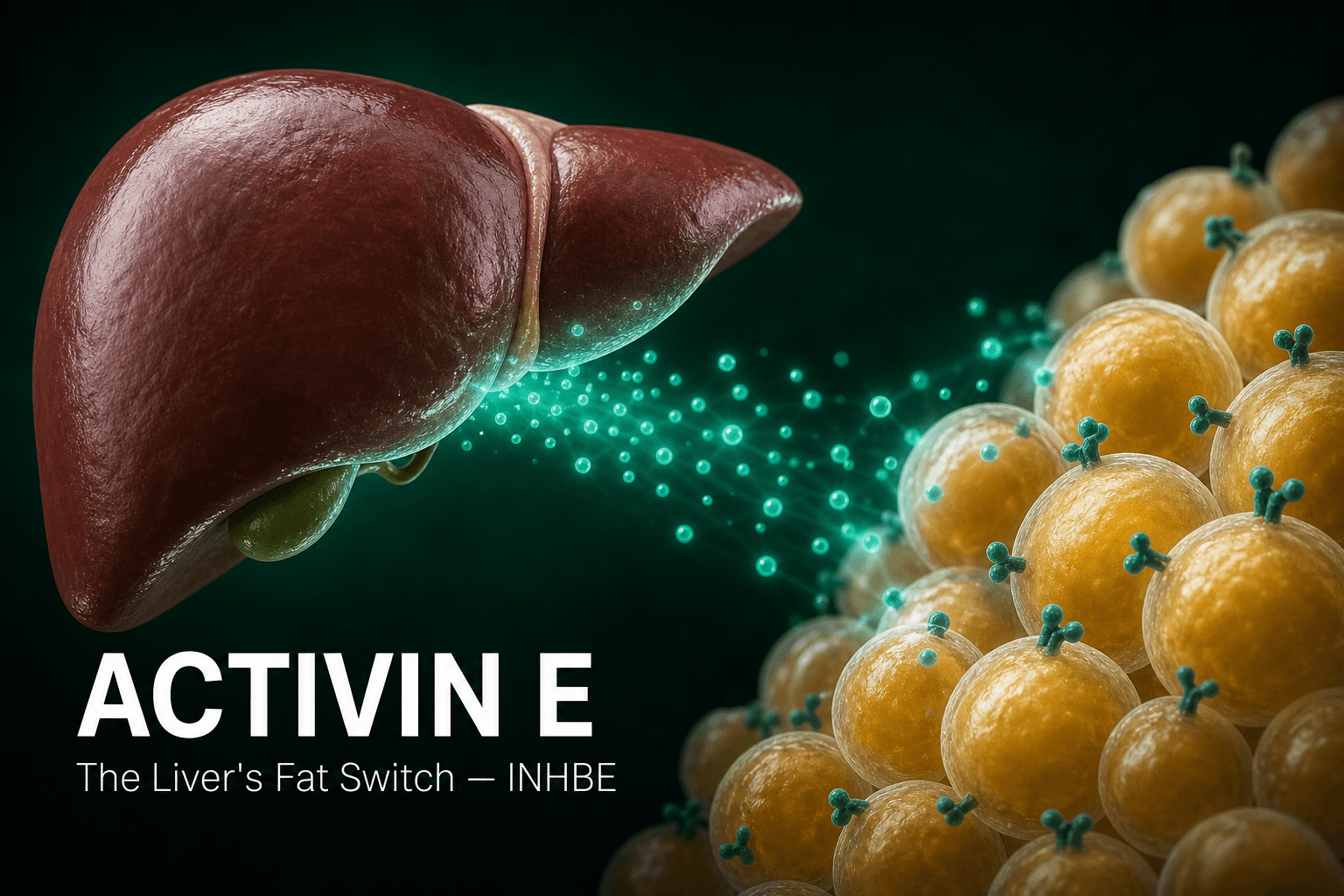
Your liver makes a hormone that decides where your fat goes. It is called activin E, and the people born making less of it stay leaner without trying.
Key takeaways
- Activin E is a hormone made almost entirely by the liver, encoded by the INHBE gene. It belongs to the same TGF-beta family as myostatin (GDF8) and activin A.
- It does not act on muscle the way myostatin does. It signals through the ALK7 receptor (ACVR1C) on fat cells and tells them to hold onto fat.
- People who inherit rare broken copies of INHBE carry less belly fat, have lower blood sugar and triglycerides, and develop type 2 diabetes less often.
- That genetic clue turned activin E into one of the hottest obesity drug targets of 2026, with Arrowhead, Wave, Alnylam, Vial, and an iBio/AstralBio antibody all chasing it.
- Arrowhead's ARO-INHBE knocked activin E down by 85 percent from a single dose and cut liver fat 44 percent, with one of the appeals being fat loss that spares muscle better than appetite-only drugs.
Quick facts on activin E
| Field | Value |
|---|---|
| Hormone | Activin E (a homodimer of the inhibin beta-E subunit) |
| Gene | INHBE |
| Family | TGF-beta superfamily (same family as myostatin/GDF8 and activin A) |
| Made by | The liver, almost exclusively (a "hepatokine") |
| Receptor | ALK7, also called ACVR1C, found mostly on fat cells |
| Main job | Tells fat cells to suppress fat breakdown (lipolysis) |
| Human genetics | Loss-of-function INHBE variants protect against abdominal obesity and diabetes |
| Drug approach | Silence it (siRNA) or block it (antibody) to release stored fat |
| Lead program (2026) | ARO-INHBE (Arrowhead), Phase 1/2a |
For how this fits the bigger picture of muscle-sparing weight loss, see myostatin inhibitors and GLP-1 muscle loss and the wider myostatin inhibitor obesity class.
What activin E actually is
Start with the family. Activin E is a member of the TGF-beta superfamily, the same broad protein family that contains myostatin and activin A.
Most of that family talks to muscle. Activin E does not.
It is built from two copies of a subunit called inhibin beta-E, joined together. The gene that codes for it is INHBE. And unlike its cousins, activin E is made in one place: the liver. Hormones made by the liver get a special name, hepatokines, and activin E is one of the clearest examples.
So picture it as a chemical message the liver sends out to the rest of the body. The message lands on fat.
How activin E controls your fat
Here is the part that matters. Activin E does not bind the receptor myostatin uses. It signals through a different one called ALK7 (also written ACVR1C), and that receptor sits mostly on fat cells.
When activin E reaches a fat cell and switches on ALK7, it tells the cell to stop releasing fat. In lab terms it suppresses lipolysis, the process that breaks stored fat down so the body can burn it.
The effect is strong. In isolated fat cells, activin E cut stimulated free-fatty-acid release by roughly half across several different triggers. It lowers the cell's response to the signals that normally unlock fat.
There is also a feedback loop. When the liver is loaded with fat and fatty acids are high, it makes more activin E. Fasting alone raised liver activin E around six-fold in animal work. The liver, in other words, uses activin E to tell fat tissue to keep its stores locked during stress.
That loop is useful in a famine. It is a problem in a world of constant calories.
The genetic accident that made it a drug target
Now the human evidence, because this is what turned a niche liver hormone into a 2026 obesity race.
Large genetic studies found that some people carry rare broken (loss-of-function) copies of the INHBE gene. They make less working activin E for life. And their bodies look different in a specific, valuable way.
Carriers of these protective INHBE variants tend to have:
- Less abdominal fat, measured as a lower waist-to-hip ratio
- Reduced visceral fat, the dangerous fat around the organs
- Lower fasting glucose and lower triglycerides
- A reduced risk of type 2 diabetes
That is close to the exact profile a metabolic drug aims for. Nature gave it away in a title: rare loss-of-function variants in INHBE protect from abdominal obesity. The same favorable pattern shows up in people with loss-of-function variants in ALK7, the receptor activin E acts on, which confirms the two work as a pair.
When a natural genetic "off switch" produces healthier bodies, drug developers try to copy it. That is the entire thesis here.
The honest caveat
Do not read this as risk-free. The biology has a catch worth stating plainly.
In mice engineered with no INHBE at all, the fat results were good, less body fat and more relative lean mass on a high-fat diet, but the liver picked up extra triglyceride and the animals became more insulin resistant under that same diet. Turning the system fully off in a mouse was not pure upside.
Human carriers of partial loss-of-function variants look metabolically healthy, which is reassuring. But the gap between "mouse knockout" and "human genetic carrier" is exactly why this needs clinical trials, not hype. The honest position in 2026 is that the genetics are compelling and the early human drug data is encouraging, while the long-term liver and glucose effects in people are still being measured.
Why this is being called "beyond GLP-1"
This is the angle that should interest anyone watching weight-loss drugs. Activin E works on a completely different lever than the GLP-1 drugs everyone already knows.
GLP-1 drugs like semaglutide and tirzepatide mostly work in the brain and gut. They shrink appetite. You eat less, so you lose weight, and a large share of that lost weight is muscle. We cover that problem in depth in myostatin and GLP-1 muscle loss.
Silencing activin E works in the periphery, on fat metabolism directly. It releases stored fat for burning rather than starving the whole body of calories. The hoped-for result is fat loss that leans harder on actual fat and less on muscle, which is why the field keeps pairing the phrase "muscle preservation" with activin E.
It is the same instinct driving the myostatin and activin A drugs: stop weight-loss medicine from eating muscle. Activin E just attacks the fat side of that equation instead of the muscle side, which is why several programs are testing it on top of a GLP-1 rather than against it.
The 2026 pipeline: who is chasing activin E
The race is real and it is mostly built on gene silencing.
| Company | Drug | Approach | Status (2026) |
|---|---|---|---|
| Arrowhead | ARO-INHBE | siRNA that silences liver INHBE | Phase 1/2a, first human data reported |
| Wave Life Sciences | INHBE silencer (INLIGHT) | siRNA | Phase 1, positive interim data |
| Alnylam | INHBE silencer | siRNA, built on its own genetics discovery | Early-stage |
| Vial | VIAL-INHBE | siRNA | Phase 1 in obesity |
| iBio / AstralBio | Anti-activin E antibody | Antibody, not gene silencing | Discovery-stage |
Arrowhead's ARO-INHBE, the lead
The clearest human data so far comes from Arrowhead. ARO-INHBE is an RNAi medicine designed to lower the liver's production of activin E.
In its first-in-human Phase 1/2a study (NCT06700538), reported at the EASL 2026 congress, a single 400 mg dose cut activin E by a mean maximum of 85 percent, and the effect lasted beyond three months. Tested with tirzepatide, it produced a 44 percent placebo-adjusted drop in liver fat in people who started with high liver fat, plus extra reductions in visceral fat. It was generally well tolerated with no treatment-related dropouts, and the long duration points to a possible twice-a-year injection.
Single doses lasting months are the whole reason siRNA is attractive here. A twice-yearly shot is a very different commitment from a weekly one.
How activin E compares to its muscle-targeting cousins
The activin family splits into jobs. Knowing which protein hits which tissue is the fastest way to understand the whole class.
| Protein | Main target tissue | What blocking or silencing it does | Drug examples |
|---|---|---|---|
| Myostatin (GDF8) | Muscle | Releases the brake on muscle growth; preserves muscle | Trevogrumab, apitegromab |
| Activin A | Muscle and fat | Larger body-composition shifts; more side effects | Garetosmab, part of bimagrumab's reach |
| Activin E | Fat (via the liver) | Releases stored fat for burning; aims to spare muscle | ARO-INHBE, Wave, Vial |
The receptor antibodies like bimagrumab hit the whole activin type II receptor and catch several of these signals at once. Activin E drugs are deliberately narrow: one liver hormone, one fat-facing receptor. That focus is the bet that they will be cleaner.
What this means if you are watching weight-loss drugs
Be patient and be specific. Activin E silencers are early. None is approved, and the human efficacy story is just one or two readouts deep.
What makes it worth tracking is the rare combination behind it: a human genetic experiment that already happened and pointed the right way, a peripheral mechanism that does not rely on appetite, and dosing that could be twice a year. If even one program reproduces the genetics in a clean trial, activin E becomes a serious partner for the GLP-1 drugs rather than a competitor.
For now it belongs on the same watch list as trevogrumab, bimagrumab, and the rest of the muscle-sparing obesity pipeline, not in anyone's medicine cabinet.
Sources and notes
- Rare loss of function variants in the hepatokine gene INHBE protect from abdominal obesity - Nature Communications 2022
- Hepatic Activin E mediates liver-adipose inter-organ communication - PMC
- Activin E-ACVR1C cross talk controls energy storage - PNAS
- INHBE - Inhibin beta E chain - UniProtKB P58166
- Arrowhead Pharmaceuticals presents new clinical data on RNAi-based ARO-INHBE
- A First-In-Human Study of ARO-INHBE in Adults With Obesity - NCT06700538
- Wave Life Sciences positive interim Phase 1 INLIGHT data
- Alnylam uncovers genetic mutations in INHBE that protect against metabolic disease
- Vial initiates Phase 1 trial of VIAL-INHBE, an INHBE (activin E) siRNA for obesity
- iBio discovers novel antibody targeting activin E with AstralBio
Frequently Asked Questions
What is activin E?
Activin E is a hormone made almost entirely by the liver and encoded by the INHBE gene. It belongs to the TGF-beta family, the same family as myostatin and activin A, but instead of acting on muscle it acts on fat tissue through the ALK7 receptor, where it suppresses the breakdown of stored fat.
Is activin E the same as activin A or myostatin?
No. They are cousins in the same protein family but they do different jobs. Myostatin (GDF8) limits muscle growth. Activin A affects both muscle and fat through the activin type II receptor. Activin E is made by the liver and works on fat cells through a different receptor, ALK7 (ACVR1C).
Why is activin E an obesity drug target?
People who inherit rare broken copies of the INHBE gene make less activin E and tend to carry less abdominal fat, have lower blood sugar and triglycerides, and get type 2 diabetes less often. Drug developers are trying to copy that natural protection by silencing or blocking activin E.
Is there an activin E drug available?
Not yet. The most advanced program, Arrowhead's ARO-INHBE, is in early Phase 1/2a trials. Wave, Alnylam, Vial, and an iBio/AstralBio antibody are also in development. None is approved or for sale, and they are only available through clinical trials.
How is silencing activin E different from Ozempic or Mounjaro?
GLP-1 drugs like semaglutide and tirzepatide mainly reduce appetite, so you eat less and lose both fat and muscle. Silencing activin E works directly on fat metabolism in the periphery, releasing stored fat for burning. The hope is fat loss that protects muscle better, which is why several programs test it on top of a GLP-1 rather than instead of one.
Does blocking activin E have downsides?
Possibly. In mice with no INHBE at all, body fat dropped but the liver gained triglyceride and the animals became more insulin resistant on a high-fat diet. Humans with partial loss-of-function variants look metabolically healthy, but the long-term liver and glucose effects of fully silencing activin E in people are still being studied in trials.
This article is for educational purposes only and is not medical advice. Activin E (INHBE) inhibitors are investigational, are not approved for any use, and are only available within registered clinical trials. Talk with a qualified clinician before changing any medication, supplement, or weight-loss strategy.