A peptide calculator converts a dose into the number of units you draw on a syringe. It needs three inputs: the vial strength in milligrams, the volume of bacteriostatic water you add, and the dose. From those it returns concentration in mg/mL, injection volume in mL, doses per vial, and units on a U-100 scale. Four formulas, and a misplaced decimal in any of them changes the dose tenfold.
Key takeaways
- Concentration is vial strength divided by water volume. A 5 mg vial with 2 mL of bacteriostatic water is 2.5 mg/mL, and every other number follows from that one.
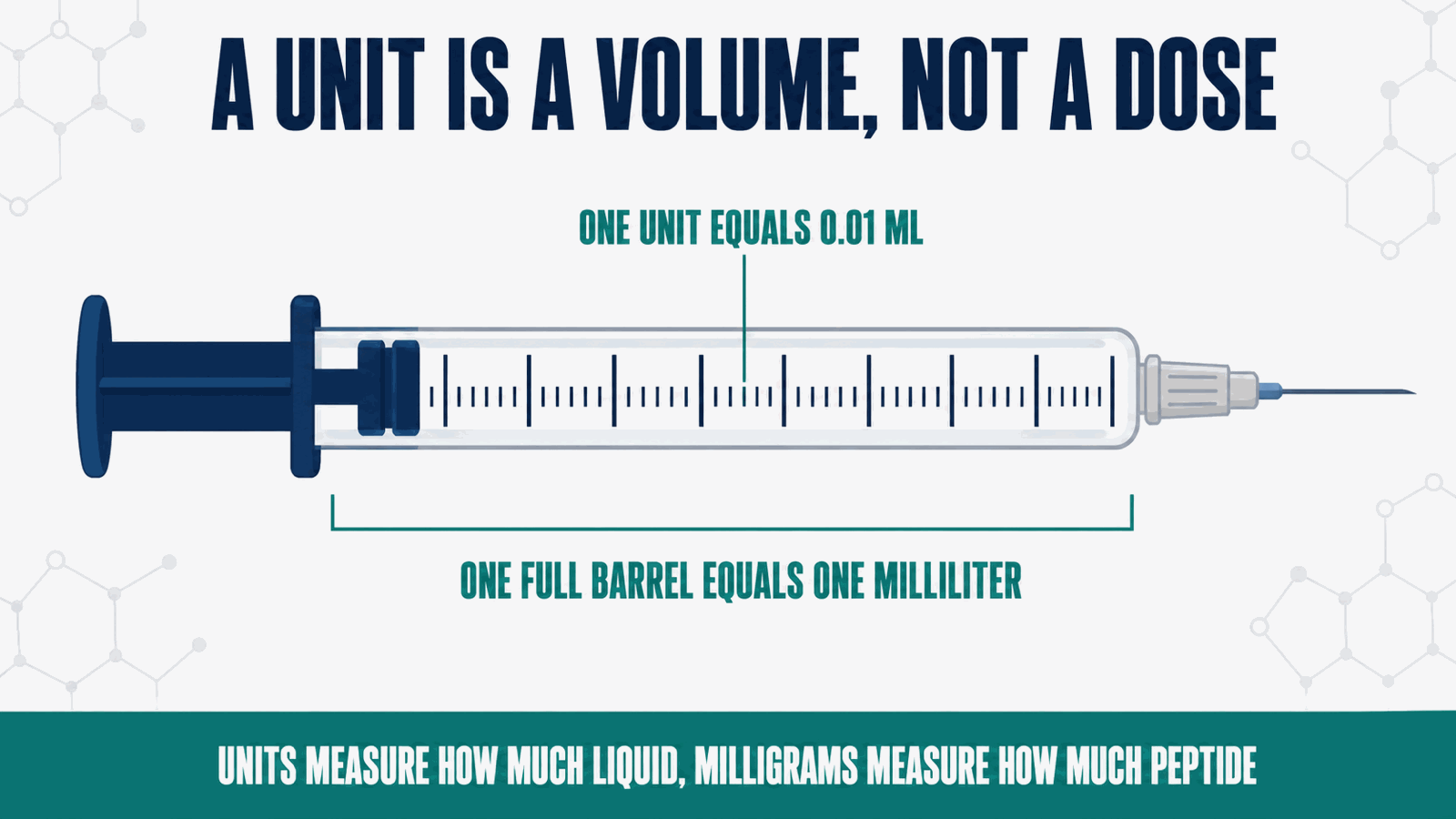
- A unit on a U-100 insulin syringe is 0.01 mL of liquid. It is a volume marking, not a quantity of peptide, so "10 units" means nothing until the concentration is known.
- Shortcut worth memorizing: micrograms per unit equals the concentration in mg/mL multiplied by 10. At 2.5 mg/mL, one unit is 25 mcg.
- Adding more water does not weaken the dose. It lowers the concentration and raises the number of units you draw, and the doses per vial stay the same.
- Dilution is a precision tool. At 10 mg/mL a 250 mcg dose is 2.5 units, where half a unit of misreading is a 20 percent error. At 2.5 mg/mL the same dose is 10 units and the same misread is 5 percent.
- Doses per vial is vial strength divided by dose, and it is unaffected by how much water you added.
What does a peptide calculator actually compute?
A peptide calculator is a reconstitution and dose-conversion tool. Research peptides and compounded incretin analogs arrive as lyophilized powder, a dry cake at the bottom of a sealed vial with a stated mass in milligrams and no volume at all. Nothing can be drawn from that vial until a diluent, usually bacteriostatic water, turns the powder into a solution. The calculator's job is to bridge the gap between the mass printed on the vial and the volume marking on a syringe barrel.
It computes four things, and only four things:
- Concentration, in mg/mL, which is a property of the whole vial once you have mixed it.
- Injection volume, in mL, which is how much liquid one dose occupies.
- Syringe units, which is that same volume expressed on the U-100 scale.
- Doses per vial, which is how many times the stated dose divides into the vial.
Everything else a calculator shows you is derived from those. It does not decide the dose, it does not know your compound, and it cannot tell whether the vial contains what the label claims.
How do you calculate peptide dosage from a vial?
Four formulas cover the entire calculation. They are worth writing down once, because a peptide calculator is doing nothing more than this.
| What you want | Formula |
|---|---|
| Concentration, mg/mL | vial strength (mg) divided by BAC water volume (mL) |
| Injection volume, mL | dose (mg) divided by concentration (mg/mL) |
| U-100 syringe units | injection volume (mL) multiplied by 100 |
| Doses per vial | vial strength (mg) divided by dose (mg) |
| Unit conversion | 1 mg = 1000 mcg, so mcg divided by 1000 gives mg |
Work one example all the way through. Take a 5 mg vial and add 2 mL of bacteriostatic water. Concentration is 5 divided by 2, which is 2.5 mg/mL. A 250 mcg dose is 0.25 mg, because 250 divided by 1000 is 0.25. Injection volume is 0.25 divided by 2.5, which is 0.1 mL. On a U-100 syringe that is 0.1 multiplied by 100, which is 10 units. Doses per vial is 5 divided by 0.25, which is 20.
The unit conversion in the middle is where most errors happen. Peptide doses are quoted in micrograms and vial strengths are printed in milligrams, so one of the two has to be converted before the division. If you would rather not run this by hand every time you change a vial size, PeptideDeck's peptide calculator takes the syringe type, vial size, water volume and dose and returns the concentration, the volume per dose, the doses per vial, and the units to draw on a U-100 scale. It carries presets for BPC-157, TB-500, CJC-1295 without DAC, Ipamorelin, Retatrutide, GHK-Cu, MOTS-c and Semax, and it also has a half-life view and a microdosing schedule generator.
Use a tool to remove arithmetic error from a dose you already have. Do not use one to invent a dose.
What do the numbers look like across common vial sizes?
Every row below was computed from the four formulas above and checked independently. Vial strength divided by water gives the concentration, dose divided by concentration gives the volume, volume multiplied by 100 gives the units, and vial strength divided by dose gives the count.
| Vial strength | BAC water | Concentration | Dose | Injection volume | U-100 units | Doses per vial |
|---|---|---|---|---|---|---|
| 5 mg | 1 mL | 5 mg/mL | 250 mcg | 0.05 mL | 5 units | 20 |
| 5 mg | 2 mL | 2.5 mg/mL | 250 mcg | 0.1 mL | 10 units | 20 |
| 5 mg | 2.5 mL | 2 mg/mL | 500 mcg | 0.25 mL | 25 units | 10 |
| 10 mg | 2 mL | 5 mg/mL | 500 mcg | 0.1 mL | 10 units | 20 |
| 10 mg | 5 mL | 2 mg/mL | 250 mcg | 0.125 mL | 12.5 units | 40 |
| 15 mg | 3 mL | 5 mg/mL | 750 mcg | 0.15 mL | 15 units | 20 |
| 20 mg | 2 mL | 10 mg/mL | 2 mg | 0.2 mL | 20 units | 10 |
| 30 mg | 3 mL | 10 mg/mL | 2.5 mg | 0.25 mL | 25 units | 12 |
| 30 mg | 6 mL | 5 mg/mL | 5 mg | 1 mL | 100 units | 6 |
Three rows in that table are worth pausing on.
The 10 mg vial in 5 mL produces a 12.5 unit draw for a 250 mcg dose. Half-unit graduations are readable on some barrels and guesswork on others, and a dose that lands on a half unit is a dose you will estimate rather than measure. Changing the water volume moves the answer onto a whole number.
The 20 mg and 30 mg rows are dosed in milligrams rather than micrograms, which is the scale the incretin analogs work at. That is a thousandfold difference in dose size from the peptide rows above them, which is exactly why a unit slip between mg and mcg is so destructive. The class differences behind those doses are covered in the guide to GLP-1 medications and lean mass.
The last row is a warning. A 5 mg dose at 5 mg/mL is 1 mL of liquid, which is 100 units, the entire barrel of a full-size U-100 syringe. Every other row in the table draws 25 units or fewer and fits comfortably in a small barrel.
How many units is 250 mcg?
There is no single answer, and any source that gives you one without naming a concentration is wrong. A 250 mcg dose is 10 units at 2.5 mg/mL, 5 units at 5 mg/mL, and 2.5 units at 10 mg/mL. The dose is identical in all three cases. Only the liquid it is dissolved in changed.
The fastest way to work in your head is to convert the concentration into micrograms per unit. Since one unit is 0.01 mL, one unit contains the concentration in mg/mL multiplied by 0.01 mg, which is the concentration multiplied by 10 in micrograms.
| Concentration | Micrograms per unit | 250 mcg dose | 500 mcg dose |
|---|---|---|---|
| 1 mg/mL | 10 mcg | 25 units | 50 units |
| 2 mg/mL | 20 mcg | 12.5 units | 25 units |
| 2.5 mg/mL | 25 mcg | 10 units | 20 units |
| 5 mg/mL | 50 mcg | 5 units | 10 units |
| 10 mg/mL | 100 mcg | 2.5 units | 5 units |
| 20 mg/mL | 200 mcg | 1.25 units | 2.5 units |
Once you know the micrograms per unit for the vial in front of you, every dose on that vial is a single division. At 25 mcg per unit, a 250 mcg dose is 10 units and a 100 mcg dose is 4 units.
Why is a unit on a U-100 syringe a volume, not a dose?
This is the single most common misunderstanding in peptide dosing, and it causes real overdoses.
U-100 describes insulin syringes and means the barrel is graduated for insulin at a strength of 100 units per milliliter. That graduation is a volume marking. One unit is one hundredth of a milliliter, 0.01 mL, and it stays 0.01 mL no matter what liquid is in the barrel. Fill a U-100 syringe with water, saline, or a reconstituted peptide, and 10 units is 0.1 mL of it every time.
The practical consequence is that a phrase like "draw 10 units" carries no dosing information on its own. Ten units of a 5 mg vial mixed in 1 mL is 500 mcg of peptide. Ten units of the same vial mixed in 5 mL is 100 mcg. Same syringe, same marking, same visible volume in the barrel, five times the difference in delivered mass. A protocol that specifies units without specifying the reconstitution it assumes is incomplete.
Two related labels cause trouble. Some barrels and some calculator interfaces print IU on the scale rather than "units", but on a U-100 insulin syringe that graduation is still the 0.01 mL volume mark. It is not the international unit, which is a measure of biological activity defined separately for each substance and used for things like HCG and growth hormone. And "units" here has nothing to do with milligrams or micrograms, which measure mass.
So the safe habit is to record all three numbers together in your notes: the dose in mcg or mg, the concentration in mg/mL, and the units on the barrel. Any one of the three alone can be misread. All three together cannot.
How much BAC water should you use?
The reconstitution volume does not change the dose. It changes the resolution of the draw. Take a single 10 mg vial and a single 500 mcg dose, and vary only the water.
| BAC water added | Concentration | Injection volume | U-100 units | Doses per vial |
|---|---|---|---|---|
| 1 mL | 10 mg/mL | 0.05 mL | 5 units | 20 |
| 2 mL | 5 mg/mL | 0.1 mL | 10 units | 20 |
| 3 mL | 3.33 mg/mL | 0.15 mL | 15 units | 20 |
| 5 mL | 2 mg/mL | 0.25 mL | 25 units | 20 |
The rightmost column never moves. Twenty doses of 500 mcg come out of a 10 mg vial whether you dissolved it in 1 mL or 5 mL, because doses per vial depends only on how many times the dose divides into the mass. More water does not dilute the dose, it just spreads the same 10 mg over more liquid, so each dose occupies more of that liquid.
What does change is how precisely you can measure. Consider a 250 mcg dose. At 10 mg/mL it is a 2.5 unit draw, so misreading the plunger by half a unit delivers an error of 50 mcg, which is 20 percent of the intended dose. At 2.5 mg/mL the same dose is a 10 unit draw, and the same half-unit misread is 12.5 mcg, or 5 percent. Diluting further buys accuracy.
The limits on the other side are physical. Bacteriostatic water is preserved with benzyl alcohol, and the more solution you have to keep, the longer the vial sits in the refrigerator before it is used up. A very dilute vial can also push the draw past what a small barrel holds. The working rule is to pick the volume that lands your usual dose somewhere between roughly 10 and 40 units on a whole or half graduation, then keep that ratio constant for the rest of the vial.
Which syringe barrel fits the draw?
Insulin syringes come in three common barrel sizes, and all three are U-100, so one unit is 0.01 mL in every one of them. What differs is capacity and how far apart the marks are printed.
- A 1 mL barrel is marked to 100 units and holds 1 mL.
- A 0.5 mL barrel is marked to 50 units.
- A 0.3 mL barrel is marked to 30 units.
Smaller barrels are easier to read for small draws because the same 30 units of scale is spread over a similar physical length, so the graduations sit further apart. The trade is capacity. A draw of 40 units is 0.4 mL and simply does not fit a 30 unit barrel, and there is no partial workaround worth using. In the nine-row table above, every draw except the 100 unit one fits a 30 unit barrel.
Pick the smallest barrel that comfortably holds the draw. That is the barrel on which a half unit is a visible distance rather than a judgment call.
How many doses are in a vial?
Doses per vial is vial strength divided by dose, with both in the same unit. A 10 mg vial dosed at 500 mcg gives 20 doses, because 500 mcg is 0.5 mg and 10 divided by 0.5 is 20. A 30 mg vial dosed at 2.5 mg gives 12.
Two caveats keep the calculated number honest. It assumes the vial contains its labeled mass, which is an assumption about the supplier rather than a fact about the arithmetic. It also ignores the liquid left in the needle hub and on the vial stopper, so the final dose in a vial is often short. Plan on the calculated count as a ceiling, not a promise.
That figure is what turns a dose into a supply calculation, which is the number that actually matters when you are budgeting a cycle length rather than a single injection.
Why does dosing precision matter more for lean-mass compounds?
Body composition work is unusually unforgiving of arithmetic error, for two structural reasons that have nothing to do with the compounds being especially dangerous.
The first is unit scale. Peptides studied for muscle and connective tissue are dosed in micrograms from milligram vials, so every calculation crosses a thousandfold conversion. Errors at that boundary are almost never small. A mcg-for-mg slip does not give you a 15 percent overdose, it gives you a factor of a thousand, and the reason is that the mistake is a units swap rather than a heavy hand. Approved incretin pens exist in pre-filled form partly to delete this entire step.
The second is asymmetry in what you are protecting. During an aggressive energy deficit, a meaningful share of the weight lost can be lean tissue, and lean tissue rebuilds far more slowly than fat returns. That asymmetry is the whole reason the muscle-preservation pipeline exists, and it is discussed in more depth in the piece on myostatin inhibitors and GLP-1 muscle loss. A dosing error that costs you weeks of an intervention aimed at protecting lean mass is not recovered by simply resuming the protocol.
None of the research compounds in this space is approved for muscle preservation, and none of the arithmetic above changes that. Getting the math right makes a dose reproducible. It does not make it effective, and it does not make it safe.
What a calculator cannot decide for you
A calculator answers "how much liquid", and nothing else. It is silent on every question that actually determines outcome.
- It does not choose the dose. The dose comes from a protocol, a label, or a prescribing clinician. The calculator only converts it.
- It does not know the compound. Half-life, route, and frequency change the schedule and the calculator does not see any of them.
- It does not verify the vial. If a vial labeled 10 mg contains 7 mg, every downstream number is wrong by 30 percent and the arithmetic will still look immaculate.
- It does not account for draw loss. Residual volume in the hub means the real last dose is smaller than the calculated one.
- It cannot tell you whether to do this at all. Research peptides are not approved for human use, and for any compound with an approved label, the label is the authority.
For compound-specific reconstitution worked at a smaller vial size, the follistatin dosage guide runs the same math for a 1 mg vial across three water volumes. For a comparison of which published references actually carry dosing detail rather than describing compounds, see the ranking of peptide dosing sources.
Sources and notes
- All arithmetic in this article was recomputed with exact fractions before publication. Each table row satisfies three independent checks: doses per vial multiplied by dose equals the vial strength, units divided by 100 multiplied by concentration equals the dose, and water volume divided by injection volume equals doses per vial.
- The 10 mg vial in 3 mL of water is exactly 10/3 mg/mL. It is shown rounded to 3.33 mg/mL in the table, and the 0.15 mL and 15 unit figures in that row are exact.
- Features of the PeptideDeck peptide calculator were checked on the live page on August 3, 2026.
Frequently Asked Questions
What is a peptide calculator?
A peptide calculator is a reconstitution and dose-conversion tool. You give it the vial strength in milligrams, the volume of bacteriostatic water you added, and the dose you want. It returns the concentration in mg/mL, the injection volume in mL, the number of units to draw on a U-100 insulin syringe, and how many doses the vial contains. It converts a dose, it does not choose one.
How many units is 250 mcg on an insulin syringe?
It depends entirely on the concentration, so the question has no fixed answer. At 2.5 mg/mL a 250 mcg dose is 0.1 mL, which is 10 units. At 5 mg/mL it is 0.05 mL, or 5 units. At 10 mg/mL it is 0.025 mL, or 2.5 units. Divide the dose in mg by the concentration in mg/mL, then multiply the result by 100.
Does adding more bacteriostatic water reduce the dose?
No. Adding more water lowers the concentration and increases the number of units you draw for the same dose, so the delivered mass is unchanged. A 10 mg vial gives 20 doses of 500 mcg whether it is mixed in 1 mL or 5 mL. What changes is measurement resolution: a more dilute vial spreads each dose across more graduations, which makes small doses easier to draw accurately.
Are units on an insulin syringe the same as milligrams?
No. A unit on a U-100 insulin syringe is a volume marking equal to 0.01 mL, and it stays 0.01 mL regardless of what the barrel contains. Milligrams and micrograms measure mass. Ten units of a 5 mg vial in 1 mL delivers 500 mcg, while ten units of the same vial in 5 mL delivers 100 mcg. Units are also not international units, which measure biological activity.
How do I calculate concentration after reconstitution?
Divide the vial strength in milligrams by the volume of bacteriostatic water in milliliters. A 5 mg vial reconstituted with 2 mL gives 2.5 mg/mL. A 10 mg vial with 2 mL gives 5 mg/mL. To convert that into micrograms per syringe unit, multiply the concentration by 10, because one unit is 0.01 mL. So 2.5 mg/mL is 25 mcg per unit.
How many doses will a vial give me?
Divide the vial strength by the dose, using the same unit for both. A 10 mg vial at 500 mcg per dose gives 20 doses, since 500 mcg is 0.5 mg. The water volume does not affect this count. Treat the result as a ceiling rather than a guarantee, because liquid retained in the needle hub and on the stopper usually makes the final dose short.
This article explains unit conversion arithmetic and is for educational purposes only. It is not medical advice, not a dosing recommendation, and not an endorsement of any compound. Research peptides are not approved for human use, and no myostatin or activin pathway agent is approved for muscle preservation during weight loss. Any dose referenced here is an arithmetic example, not a suggested protocol. Prescription medications must be selected, dosed, and monitored by a qualified clinician.