
Most coverage of this drug class stops at the scale. That is the wrong instrument. Weight is a single number that hides two very different tissues moving in the same direction, and on this site the tissue that matters is the one your body spends the rest of its life defending.
GLP-1 medications are not interchangeable. They differ in receptor targets, dosing schedule, how fast weight comes off, and how much of that weight is muscle. If you want a full comparison of what is on the market and how each option is accessed, GLP-1 medications are catalogued in one place there. What follows is the part that catalogue cannot answer for you: what each drug does to lean mass, and what you are supposed to do about it.
Key takeaways
- Across the class, roughly a quarter to two-fifths of the weight lost is lean tissue rather than fat.
- That fraction is broadly what caloric restriction alone produces. The drugs are not uniquely muscle-hostile; they are unusually effective, so the absolute lean-mass loss is larger.
- Total lean-mass loss tracks total weight loss, which is why the most potent agents (tirzepatide, then semaglutide 2.4 mg) shed the most muscle in absolute kilograms.
- Age, baseline muscle, protein intake, and resistance training change your outcome far more than the choice between one GLP-1 medication and another.
- No myostatin-pathway drug is approved yet to protect lean mass during GLP-1 therapy, so the levers available today are dietary and mechanical.
- Body composition, not body weight, is the endpoint worth tracking. Ask for a baseline measurement before your first dose.
What actually counts as a GLP-1 medication
Glucagon-like peptide-1 is a gut hormone released after eating. It stimulates insulin release when glucose is high, suppresses glucagon, slows gastric emptying, and acts on hypothalamic circuits that reduce appetite. Native GLP-1 is destroyed within minutes, so every drug in this class is an engineered analogue built to survive long enough to be dosed daily or weekly.
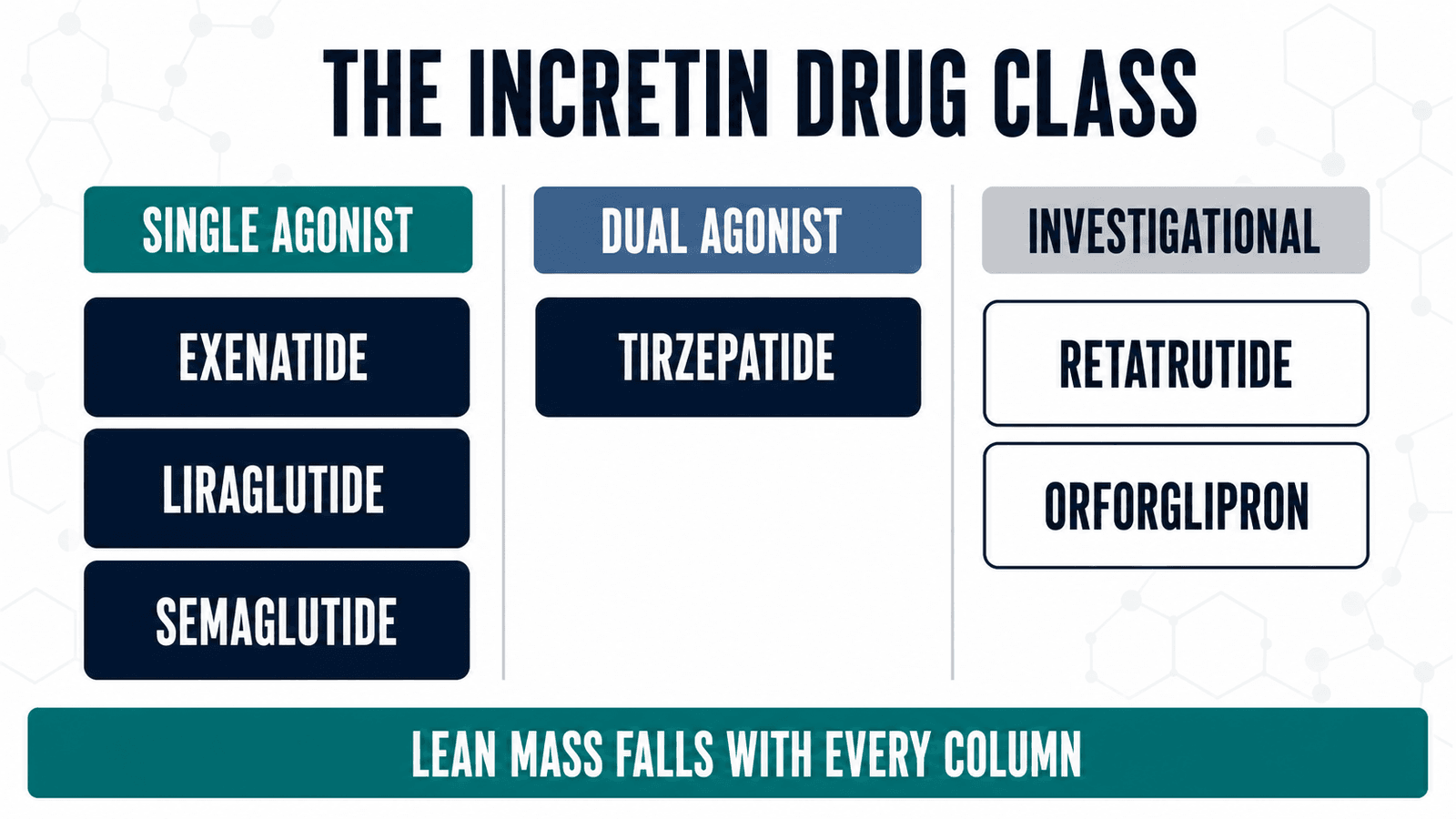
The category has grown untidy in ordinary usage. People say "GLP-1" when they mean anything injected for weight loss. Strictly, three groups sit under the umbrella:
- Pure GLP-1 receptor agonists. Exenatide, liraglutide, dulaglutide, and semaglutide. These hit one receptor.
- Multi-receptor incretin agonists. Tirzepatide activates both GIP and GLP-1 receptors. It is routinely called a GLP-1 medication in practice, and it behaves like a more potent one.
- Investigational agents. Retatrutide adds glucagon receptor activity to the other two. Orforglipron is a small-molecule oral GLP-1 agonist rather than a peptide. Neither is approved.
That distinction matters here because potency and lean-mass loss move together. The harder a drug pushes energy intake down, the more total tissue comes off, and lean tissue is part of that total.
The class, drug by drug
| Drug | Common brand names | Route and schedule | Primary approved use | Weight-loss magnitude in pivotal trials | Body-composition evidence |
|---|---|---|---|---|---|
| Exenatide | Byetta, Bydureon | Injection, twice daily or weekly | Type 2 diabetes | Modest, low single digits | Sparse; predates the modern DXA substudy era |
| Liraglutide | Victoza, Saxenda | Injection, once daily | Type 2 diabetes; obesity at the higher dose | About 8 percent at 56 weeks in SCALE | Lean-mass loss present but small in absolute terms because total loss is small |
| Dulaglutide | Trulicity | Injection, once weekly | Type 2 diabetes | Modest, low single digits | Limited dedicated body-composition data |
| Semaglutide | Ozempic, Wegovy, Rybelsus | Weekly injection, or daily oral tablet | Type 2 diabetes; obesity and cardiovascular risk reduction at 2.4 mg | About 15 percent at 68 weeks in STEP 1 | DXA substudy: lean mass falls in kilograms while rising as a share of body weight |
| Tirzepatide | Mounjaro, Zepbound | Injection, once weekly | Type 2 diabetes; obesity; obstructive sleep apnea with obesity | About 21 percent at 72 weeks in SURMOUNT-1 | Fat mass falls several times faster than lean mass, but absolute lean loss is the largest in the class |
| Retatrutide | Investigational | Weekly injection | None yet | Larger still in phase 2 | Early; the lean-mass question is an explicit focus of the ongoing program |
| Orforglipron | Investigational | Daily oral tablet | None yet | Reported in phase 3 as competitive with injectable single agonists | Early |
Two practical readings of that table. First, if you are choosing between agents purely to protect muscle, the honest answer is that no approved GLP-1 medication is meaningfully muscle-sparing relative to the others once you adjust for how much weight it removes. Second, the least potent option is not automatically the safest one, because undertreating obesity carries its own costs to joints, glucose control, and cardiovascular risk.
Why lean mass falls on all of them
There is no evidence that GLP-1 receptor activation directly instructs muscle to break down. The mechanism is more ordinary and, in a sense, more stubborn.
When energy intake drops sharply, the body draws on stored substrate. Fat is the main reservoir, but skeletal muscle is a protein bank that gets tapped as well, particularly when dietary protein is low and the mechanical signal to keep muscle is absent. On top of that, a smaller body needs less structural tissue to carry it, so some lean-mass loss is appropriate rather than pathological. Water and glycogen shifts, and reductions in the lean tissue attached to the fat depots themselves, are counted in the "lean" compartment on a DXA scan too.
The GLP-1-specific contribution is appetite suppression that is unusually powerful. Patients frequently report that protein-dense foods are the first thing they stop wanting. Meat becomes unappealing, portions shrink, and total protein intake falls at exactly the moment when protein requirements per kilogram rise. That is the pathway that turns an expected lean-mass decline into an avoidable one.
Myostatin, the brake this site exists to explain, sits underneath all of it. GDF-8 signals through activin type II receptors to limit how much muscle the body will build and hold, and that brake stays engaged during a deficit. For the underlying biology, see what myostatin is and the deeper treatment in myostatin inhibitors and GLP-1 muscle loss.
What the body-composition data actually shows
The single most misquoted statistic in this field is the lean-mass fraction. Here is the careful version.
In the DXA substudy of the semaglutide 2.4 mg program, participants lost lean body mass in absolute terms, but because fat mass fell faster, lean mass increased as a proportion of total body weight. Reported analyses put the lean-tissue share of total weight lost at roughly 39 percent. Tirzepatide substudy analyses land lower, in the region of a quarter of total loss, with fat mass falling several times faster than lean mass.
Three things follow that most articles skip:
- The percentages are not directly comparable across trials. Different DXA protocols, different durations, different baseline populations, and different definitions of lean soft tissue all move the number.
- A falling lean-mass number can coexist with an improving body. If fat falls faster than muscle, the ratio improves even as the kilogram count on the lean line goes down. That is what happened in the semaglutide substudy.
- The fraction is not unusual. Reviews comparing incretin therapy with diet-induced weight loss and with bariatric surgery find broadly similar lean-mass fractions. What is different is the magnitude. Losing 39 percent of a large total is a much bigger absolute number than losing 39 percent of a small one.
The clinically meaningful question is therefore not "what percentage" but "how many kilograms of muscle, starting from how much, in a person of what age". A 34-year-old who lifts and starts with abundant muscle can absorb the loss. A 72-year-old with age-related muscle decline already underway may not.
Your lean-mass risk tier
Use this to work out how aggressively you need to defend muscle. Count how many statements in each tier apply to you and take the highest tier where you meet two or more.
| Tier | Profile | What it means | Action level |
|---|---|---|---|
| Tier 3, standard care | Under 45; trains with resistance at least twice weekly; hits a protein target; total weight loss expected under about 10 percent | Expected lean-mass loss is proportionate and largely recoverable | Protein target plus existing training; re-check body composition at six months |
| Tier 2, active defense | 45 to 64; sedentary or newly training; on a high-dose agent; losing faster than about 1 percent of body weight per week | Lean-mass loss will be substantial in absolute terms and slower to rebuild | Add supervised resistance training before dose escalation; raise protein first, not last; body composition at baseline and every three to four months |
| Tier 1, highest concern | 65 or older; low baseline muscle or a prior sarcopenia flag; grip strength or chair-rise already impaired; on a potent agent; poor appetite for protein | This is the sarcopenic obesity scenario, where a "healthy" BMI can hide functional decline | Ask the prescriber about a slower titration; formal strength assessment; baseline DXA if available; escalate only when protein and training are actually in place |
The framework is deliberately blunt because the inputs are cheap to assess. Nobody needs a research protocol to know whether they lift, whether they eat protein, and how old they are. For the clinical background on why the older tiers matter most, see myostatin and sarcopenia.
The four levers that actually work today
These are the interventions with real supporting evidence. There is nothing exotic on this list, and that is the point.
- Protein, deliberately. Requirements per kilogram rise during an energy deficit. Commonly used targets sit around 1.2 to 1.6 g per kg of body weight per day, with athletes and older adults in a deficit often advised toward the upper end or beyond. Front-load it into the meals you can still face. Discuss the target with your clinician if you have kidney disease, where protein intake is not a free variable.
- Resistance training, progressively. Two to four sessions per week covering the major movement patterns is the strongest non-pharmacological signal for retaining muscle in a deficit. The mechanical signal is what tells the body which tissue to spare. See how resistance training suppresses myostatin.
- Rate control. If you are dropping weight faster than roughly 1 percent of body weight per week over a sustained period, that is a reasonable trigger to discuss pausing a titration step rather than accelerating through it.
- Measurement. Weight alone cannot tell you whether the plan is working. A baseline body-composition reading, or failing that grip strength, a tape measure, and a repeatable chair-rise test, converts an invisible problem into a tracked one.
Creatine monohydrate at 3 to 5 g daily is the one supplement with consistent lean-mass support data in the broader literature, and it is inexpensive. Beyond that, the natural myostatin inhibitor category is far weaker than its marketing.
Where myostatin blockade fits
This is the part of the field moving fastest, and none of it is buyable yet.
The strategy is to pair a GLP-1 medication with a drug that blocks myostatin or the activin receptors it signals through, so the weight that comes off is closer to pure fat. Bimagrumab, an activin type II receptor antibody, has produced the most striking body-composition data when combined with semaglutide. Trevogrumab, a myostatin-specific antibody, has been tested with semaglutide alone and alongside an activin A blocker. Apitegromab and taldefgrobep alfa take narrower approaches to the same target.
The consistent finding across these programs is that lean-mass loss can be reduced substantially. The consistent caveat is tolerability: muscle spasms, discontinuations, and in the most aggressive combination arms serious adverse events. None of these agents is approved for muscle preservation during weight loss, and anything sold today claiming to do this job is a supplement or an unapproved peptide, not an approved therapy. The detail sits in bimagrumab, trevogrumab, and the wider myostatin inhibitor obesity pipeline.
Questions worth asking before the first prescription
- What is my baseline body composition, and how will we measure change?
- What is my protein target in grams per day, expressed as a number, not a principle?
- What does the titration schedule look like, and what would make us slow it down?
- At what point would you consider the rate of loss too fast for my age and muscle status?
- If I stop this medication, what is the plan for the regain phase?
That last question is the one most often skipped. Discontinuation is common, fat returns faster than muscle does, and the body composition you come back to can be worse than the one you started with even at a similar weight.
Sources and notes
- Once-Weekly Semaglutide in Adults with Overweight or Obesity (STEP 1) - New England Journal of Medicine
- Tirzepatide Once Weekly for the Treatment of Obesity (SURMOUNT-1) - New England Journal of Medicine
- Semaglutide and Cardiovascular Outcomes in Obesity without Diabetes (SELECT) - New England Journal of Medicine
- A Randomized, Controlled Trial of 3.0 mg of Liraglutide in Weight Management (SCALE) - New England Journal of Medicine
- Muscle-preserving therapies in the era of pharmacological weight loss - Oxford Obesity & Endocrinology
- Emerging Role of Myostatin Inhibitors in the Management of GLP-1 Associated Muscle Loss - PMC
- GDF8 and activin A blockade protects against GLP-1-induced muscle loss - Nature Communications 2025
Frequently Asked Questions
Which GLP-1 medication preserves the most muscle?
None of the approved agents is meaningfully muscle-sparing compared with the others once you account for how much total weight it removes. Lean-mass loss tracks total weight loss. The variables that genuinely change your outcome are protein intake, resistance training, age, and baseline muscle, not the brand on the pen.
Is tirzepatide worse for muscle than semaglutide?
In absolute kilograms it removes more lean tissue, because it removes more total weight. As a proportion of weight lost, published substudy analyses put tirzepatide at roughly a quarter and semaglutide closer to two-fifths, but those figures come from different trials with different methods and should not be treated as a head-to-head result.
Do GLP-1 medications cause muscle loss directly?
There is no evidence of a direct catabolic signal at the muscle. The loss is driven by the energy deficit, by falling protein intake when appetite collapses, and by the absence of a training stimulus telling the body to keep the tissue. That is why the countermeasures are dietary and mechanical rather than pharmacological.
How much protein should I eat on a GLP-1 medication?
Requirements per kilogram rise during weight loss, and commonly used targets sit around 1.2 to 1.6 g per kg of body weight per day, with older adults and people who train often advised toward the higher end. Set the number with your prescribing clinician, particularly if you have kidney disease.
Can I take a myostatin inhibitor alongside my GLP-1 medication?
Not as an approved therapy. Bimagrumab, trevogrumab, apitegromab, and taldefgrobep alfa are all in trials for exactly this purpose, with encouraging body-composition results and real tolerability problems. Supplements marketed as myostatin inhibitors do not reproduce trial-grade blockade.
Will the muscle come back if I stop?
Not automatically, and not at the same speed as fat. Regain after discontinuation is well documented and is disproportionately fat tissue unless training and protein are in place. This is the main argument for building the muscle-preservation habits during treatment rather than after it.
This article is for educational purposes only and is not medical advice. GLP-1 medications are prescription drugs that must be selected, dosed, and monitored by a qualified clinician. Do not start, stop, or change the dose of any medication, and do not change your protein intake or training program, without discussing it with your own physician, particularly if you have diabetes, kidney disease, a history of pancreatitis, thyroid disease, or are over age 65.