The phrase covers at least five unrelated things. A prescription incretin from a licensed pharmacy and a vial of amino acids sold from a website with no prescriber both get called the same name, and they sit at opposite ends of the evidence spectrum.
That matters more on this site than it does elsewhere, because the thing that separates a good injectable from a bad one is not just whether the scale moves. It is what tissue moves. A shot that removes fat and takes a large share of muscle with it can leave someone lighter, weaker, and more likely to regain. If you want the full landscape of what is sold, weight loss injections are catalogued in one place there. This page grades them on the muscle question.
Key takeaways
- Only prescription incretin injections (semaglutide, tirzepatide, liraglutide) have randomized outcome data behind them.
- Those same drugs take a large absolute amount of lean tissue with the fat, which is the trade-off nobody discloses at the point of sale.
- Compounded copies contain the same molecule but a different supply chain, and the shortage-based legal basis most compounders relied on has narrowed.
- Research peptides sold as fat-loss shots have no controlled human efficacy data for obesity, and at least one failed its own obesity trial.
- Lipotropic, MIC, B12, and HCG injections have no credible controlled evidence for weight loss. Any result comes from the diet attached to them.
- The muscle-sparing add-ons in development are real but unapproved, so today the defense is protein, resistance training, and rate control.
The five categories, graded
| Category | Typical examples | Regulatory status | Weight-loss evidence | Effect on lean mass |
|---|---|---|---|---|
| Prescription incretins | Semaglutide, tirzepatide, liraglutide | FDA approved for obesity or diabetes | Strong, multiple large randomized trials | Substantial absolute lean-mass loss because total loss is large |
| Compounded incretins | Compounded semaglutide, compounded tirzepatide | Not FDA-approved finished drugs; compounding rules have tightened | Inferred from the branded molecule, not independently trialed | Same mechanism, plus dosing-error risk that can worsen the deficit |
| Research peptides | AOD-9604, HGH fragment 176-191, various growth-hormone secretagogues | Not approved for obesity; often sold as research chemicals | Weak to absent; the largest published obesity trial of AOD-9604 did not separate from placebo | Unknown, and unmeasured in most of these products |
| Lipotropic and vitamin shots | MIC (methionine, inositol, choline), B12 | Compounded or supplement; B12 is a legitimate treatment for deficiency | No credible controlled evidence for weight loss | No plausible protective effect |
| HCG injections | Human chorionic gonadotropin protocols | FDA labeling states it has not been shown effective as adjunctive obesity therapy | Absent; results come from the severe calorie restriction attached | Severe restriction of this kind is a classic driver of lean-mass loss |
Read that table as a ranking of two separate axes. The top row is the only one that reliably works, and it is also the row where the muscle question is most urgent. The bottom rows are safer only in the sense that ineffective things rarely have large effects of any kind.
Prescription incretins: effective, and expensive in lean tissue
Semaglutide, tirzepatide, and liraglutide are the only injectables with pivotal trial programs behind them. Semaglutide at the obesity dose produced roughly 15 percent mean weight loss over 68 weeks in its pivotal trial, tirzepatide roughly 21 percent over 72 weeks at the top dose, and liraglutide about 8 percent over 56 weeks. Semaglutide has additionally shown cardiovascular benefit in adults with overweight or obesity and established cardiovascular disease.
The body-composition footnote is where this site comes in. Published DXA substudy analyses put the lean-tissue share of total weight lost at roughly a quarter to two-fifths, depending on the agent and the analysis. That fraction is broadly similar to what caloric restriction alone produces. The difference is scale: a large fraction of a large number is a lot of muscle.
For the drug-by-drug breakdown of the class, see GLP-1 medications and lean mass. For the mechanism and the pipeline aimed at fixing it, see myostatin inhibitors and GLP-1 muscle loss.
Compounded copies: same molecule, different chain of custody
Compounded semaglutide and tirzepatide became widespread during the branded shortages. Two things have changed since.
First, the shortage-based legal basis narrowed once the FDA declared the shortages resolved, which removed the justification most large-volume compounders had been operating under. Second, the safety picture filled in. The recurring problem reported to regulators has not been the molecule; it has been dosing. Products supplied in unfamiliar concentrations, instructions given in "units" rather than milligrams, and patients drawing up several times the intended dose. Overdosing an incretin does not accelerate fat loss in any useful way. It produces vomiting, dehydration, and a deeper energy deficit, which is exactly the condition under which lean tissue is lost fastest.
If a clinician recommends a compounded product, the questions are concrete: is this a 503A pharmacy or a 503B outsourcing facility, what is the legal basis for compounding it in your case, what is the exact concentration, and what is your draw volume in milliliters for each dose. Get all four in writing. The same sourcing logic applies across this category, and the reasoning is laid out in more detail in where to buy follistatin and cheapest tirzepatide.
Research peptides sold as fat-loss shots
This is the category with the widest gap between marketing and evidence.
AOD-9604 is a synthetic fragment of the human growth hormone molecule, promoted for years on the theory that the fat-mobilizing portion of growth hormone could be separated from its growth-promoting effects. Its largest published obesity trial did not show a meaningful advantage over placebo. It is not an approved drug in the United States, and it has not been accepted for use as a bulk substance in compounded preparations.
HGH fragment 176-191 is essentially the same fragment sold under a different name, with the same absence of controlled human obesity data.
Tesamorelin is the interesting outlier. It is a growth hormone releasing hormone analogue that is genuinely FDA approved, but for reducing excess visceral abdominal fat in HIV-associated lipodystrophy, not for general obesity. Using an approved-for-something-else drug as evidence that "peptides burn fat" is a category error.
Growth hormone secretagogues sold for body recomposition are a separate problem again. They are not approved for weight loss, they are commonly sold without prescriber involvement, and the claims made for them rest on mechanism rather than outcome.
The honest summary: no peptide in this group has shown, in a controlled human trial, that it removes meaningful fat. None has shown that it protects muscle during weight loss either. The claim that they do the second thing is usually borrowed from the myostatin literature, where the actual work is being done by drugs like bimagrumab and trevogrumab rather than by anything on a research-chemical website.
Lipotropic, MIC, and B12 shots
Methionine, inositol, and choline are real compounds with real metabolic roles. Injecting them has not been shown in controlled trials to cause weight loss. Vitamin B12 injections correct B12 deficiency, which is a legitimate and sometimes important thing to do, but correcting a deficiency is not a weight-loss mechanism in someone who is not deficient.
These are usually sold as part of a program that also includes a calorie-restricted diet and regular check-ins. The program may work. Attributing the result to the injection is the error.
HCG injections
Human chorionic gonadotropin protocols pair injections with an extremely low calorie intake. FDA labeling for HCG states plainly that it has not been demonstrated to be effective adjunctive therapy in the treatment of obesity, and that it does not increase weight loss beyond that resulting from caloric restriction.
From a body-composition standpoint this is the worst option on the list. Very low calorie intake without adequate protein or a resistance training stimulus is the textbook recipe for losing lean tissue, and the injection contributes nothing to offset it.
Why the muscle question decides the whole comparison
Skeletal muscle is the body's largest glucose disposal site and a major determinant of resting energy expenditure. Losing a significant amount of it during weight loss has three downstream consequences that show up later rather than immediately:
- Lower resting energy expenditure, which makes maintenance harder and regain easier.
- Functional decline, particularly in adults over 65, where the same weight loss that improves a lab panel can reduce the ability to climb stairs or rise from a chair. See myostatin and sarcopenia.
- Worse body composition after regain, because fat returns faster than muscle does. Someone who cycles on and off an injectable can end up at their starting weight with less lean tissue than they began with.
Myostatin, or GDF-8, is the signalling brake that keeps muscle from rebuilding easily during a deficit. It is the reason the entire pipeline of muscle-sparing add-ons exists. The background is in what myostatin is, and the drug programs are covered in myostatin inhibitors and obesity.
The vetting checklist
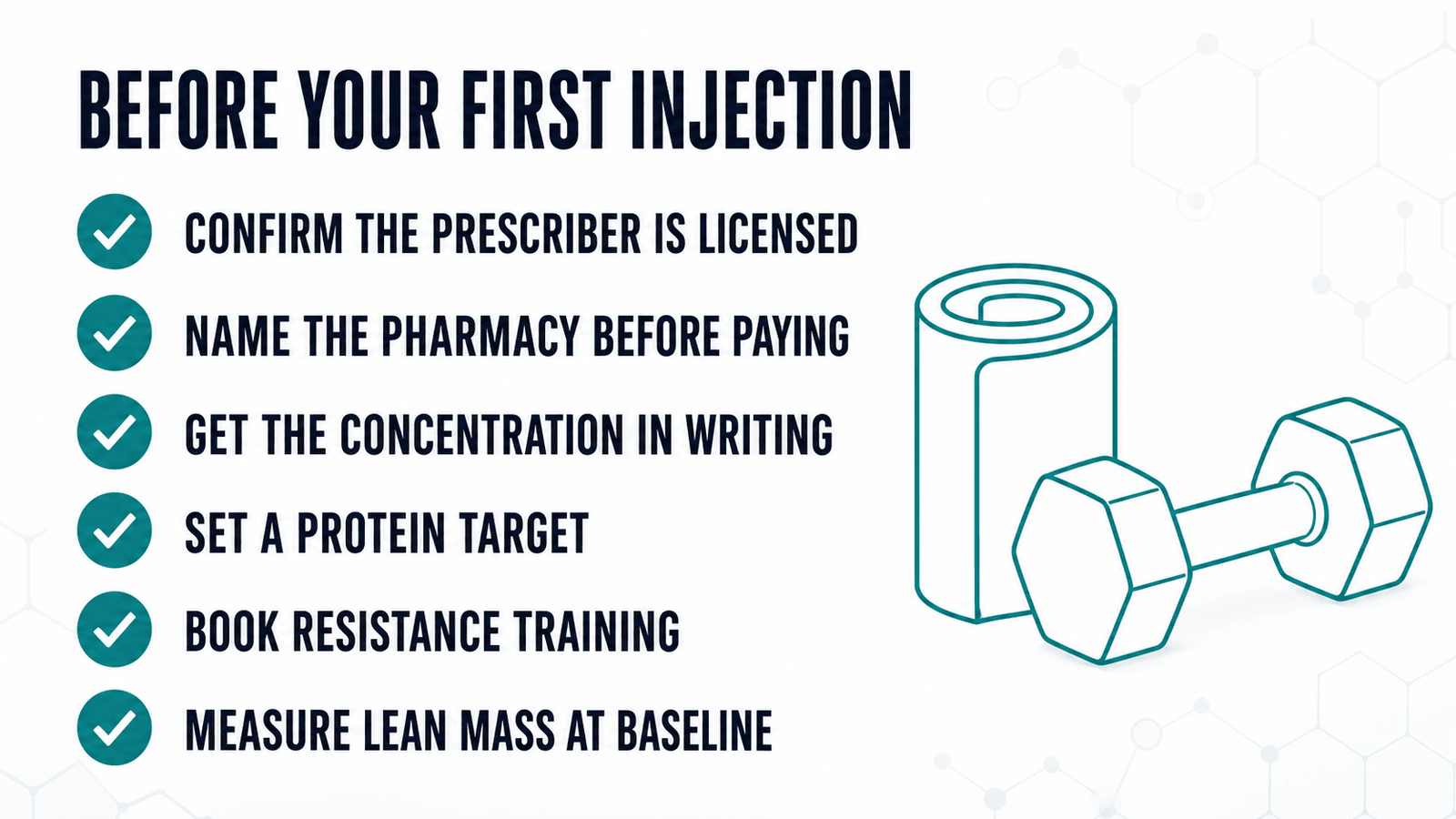
Run any injectable through these before the first dose. A product that fails the first three is not a treatment decision, it is a purchase.
- Is there a licensed prescriber who has reviewed your history? Not a questionnaire. A clinician who can be named and verified.
- Can you name the dispensing pharmacy before you pay? A seller who will not disclose it before checkout has told you something important.
- Is the product an FDA-approved finished drug, or something else? If something else, what is the specific legal basis for it in your case.
- Do you have the concentration and draw volume in writing? This is where the reported harm in the compounded category actually comes from.
- Is there a protein target attached to the plan, expressed as grams per day? See protein intake and myostatin.
- Is there a resistance training plan? Two to four sessions per week is the strongest available signal telling your body which tissue to keep. See how resistance training suppresses myostatin.
- Is lean mass being measured at baseline? DXA if available, otherwise grip strength, a chair-rise test, and tape measurements. Without a baseline you cannot tell a good outcome from a bad one.
- What happens when you stop? Ask before you start, not after.
A provider that ships medication and answers none of points five through eight is selling you weight loss and leaving you to discover the composition of it on your own.
What is coming, and what is not buyable yet
The genuine solution to the muscle problem is a second drug rather than a better injection technique. Bimagrumab blocks activin type II receptors, trevogrumab targets myostatin directly, and apitegromab and taldefgrobep alfa take narrower approaches. Combined with semaglutide, these have reduced lean-mass loss substantially in trials, at the cost of muscle spasms, discontinuations, and in the most aggressive combination arms serious adverse events.
None of them is approved for muscle preservation during weight loss. Anything currently sold as a muscle-sparing weight loss injection is either a supplement or an unapproved peptide. The realistic timeline sits several years out, and the detail is in taldefgrobep alfa and apitegromab.
Sources and notes
- Once-Weekly Semaglutide in Adults with Overweight or Obesity (STEP 1) - New England Journal of Medicine
- Tirzepatide Once Weekly for the Treatment of Obesity (SURMOUNT-1) - New England Journal of Medicine
- A Randomized, Controlled Trial of 3.0 mg of Liraglutide in Weight Management (SCALE) - New England Journal of Medicine
- FDA: Medicines made by compounders are not FDA-approved
- FDA: Caution when using compounded GLP-1 drugs, including dosing errors
- Muscle-preserving therapies in the era of pharmacological weight loss - Oxford Obesity & Endocrinology
- Emerging Role of Myostatin Inhibitors in the Management of GLP-1 Associated Muscle Loss - PMC
Frequently Asked Questions
Which weight loss injections actually work?
Only the prescription incretins have randomized trial evidence: semaglutide, tirzepatide, and liraglutide. Compounded versions contain the same molecules but have not been independently trialed. Research peptides, lipotropic and B12 shots, and HCG protocols have no credible controlled evidence for weight loss.
Do weight loss injections make you lose muscle?
The effective ones do, in absolute terms, because they remove a lot of total weight. Published analyses put the lean-tissue share of weight lost at roughly a quarter to two-fifths. That proportion is similar to caloric restriction alone; the difference is how much total weight comes off.
Is compounded semaglutide the same as the branded product?
It contains the same active molecule but is not an FDA-approved finished drug, and it comes through a different supply chain with different concentrations and instructions. The shortage-based basis most large compounders relied on has narrowed. If a clinician recommends one, get the pharmacy type, legal basis, concentration, and draw volume in writing.
Do peptide fat-loss injections like AOD-9604 work?
Its largest published obesity trial did not show a meaningful advantage over placebo, and it is not an approved drug in the United States. HGH fragment 176-191 is the same fragment under another name with the same lack of controlled human data. Tesamorelin is approved, but for visceral fat in HIV-associated lipodystrophy, not general obesity.
Are B12 or lipotropic shots worth adding?
B12 injections treat B12 deficiency, which is worth doing if you have it. Neither B12 nor MIC injections have controlled evidence of causing weight loss. When these programs produce results, the calorie-restricted diet attached to them is doing the work.
Is there a weight loss injection that protects muscle?
Not an approved one. Bimagrumab, trevogrumab, apitegromab, and taldefgrobep alfa are in trials specifically to reduce lean-mass loss during incretin therapy, with encouraging body-composition data and real tolerability problems. Today the evidence-backed defense is protein, resistance training, controlling the rate of loss, and measuring body composition rather than weight.
This article is for educational purposes only and is not medical advice. Injectable weight-loss products, including compounded and unapproved preparations, should only be used under the supervision of a qualified prescribing clinician. Do not start, stop, or change the dose of any medication, and do not begin an unapproved injectable product, without discussing it with your own physician, particularly if you have diabetes, kidney disease, thyroid disease, a history of pancreatitis, or are over age 65.