Retatrutide fatty liver results are the strongest organ-level finding the drug has produced so far: in a phase 2 substudy of adults with obesity and metabolic dysfunction-associated steatotic liver disease (MASLD), liver fat fell by roughly 82% to 86% at the 8 mg and 12 mg weekly doses, and most of those participants ended with liver fat in the normal range. The catch for a lifter is that the same trial was built to measure liver fat, not muscle, so the lean-mass half of the story is thinner than the headline.
Key takeaways
- In the phase 2 MASLD substudy (98 adults, 48 weeks), 12 mg of retatrutide cut liver fat by 86% on average, and 93% of that group finished below 5% liver fat.
- Liver fat reduction tracked closely with weight loss, which was 25.9% at 12 mg by week 48. Much of the liver benefit is the fat-loss effect, not a separate trick.
- The substudy did not measure fibrosis or inflammation outcomes, so it says little about advanced liver disease.
- Retatrutide is not approved anywhere. Lilly plans a US filing in Q1 2027 and has not announced a brand name.
- No retatrutide-specific phase 3 lean-mass figures are public. Related incretin drugs lose a meaningful share of weight as fat-free mass, so resistance training and protein remain the countermeasure.
What the retatrutide fatty liver trial actually tested
The liver data come from a prespecified substudy of the phase 2 obesity trial. Sanyal and colleagues, publishing in Nature Medicine in 2024, analysed the 98 of 338 participants who had MASLD, defined as at least 10% liver fat on MRI-PDFF. They were randomised to weekly retatrutide at 1, 4, 8 or 12 mg, or placebo, for 48 weeks. Group sizes were small: 19 on placebo and between 18 and 22 in each retatrutide arm.
That design matters. MRI-PDFF measures the fraction of liver volume that is fat, which is a good marker of steatosis. It is not a biopsy, so it does not grade inflammation or scarring. The authors reported the main finding as a reduction in liver fat, along with improvements in markers tied to insulin sensitivity and lipid handling.
The trial was in adults with obesity. It tells us nothing direct about lean, trained people whose liver fat is already low, which is most of this site's readers.
How far liver fat fell, by dose
The table gives the least-squares mean relative change in liver fat, and the share of participants who reached liver fat under 5%, as reported by Sanyal et al.
| Weekly dose | Liver fat change, week 24 | Liver fat change, week 48 | Liver fat under 5%, week 24 | Liver fat under 5%, week 48 |
|---|---|---|---|---|
| Placebo | +0.3% | -4.6% | 0% | not reported |
| 1 mg | -42.9% | -51.3% | 27% | not reported |
| 4 mg | -57.0% | -59.0% | 52% | not reported |
| 8 mg | -81.4% | -81.7% | 79% | 89% |
| 12 mg | -82.4% | -86.0% | 86% | 93% |
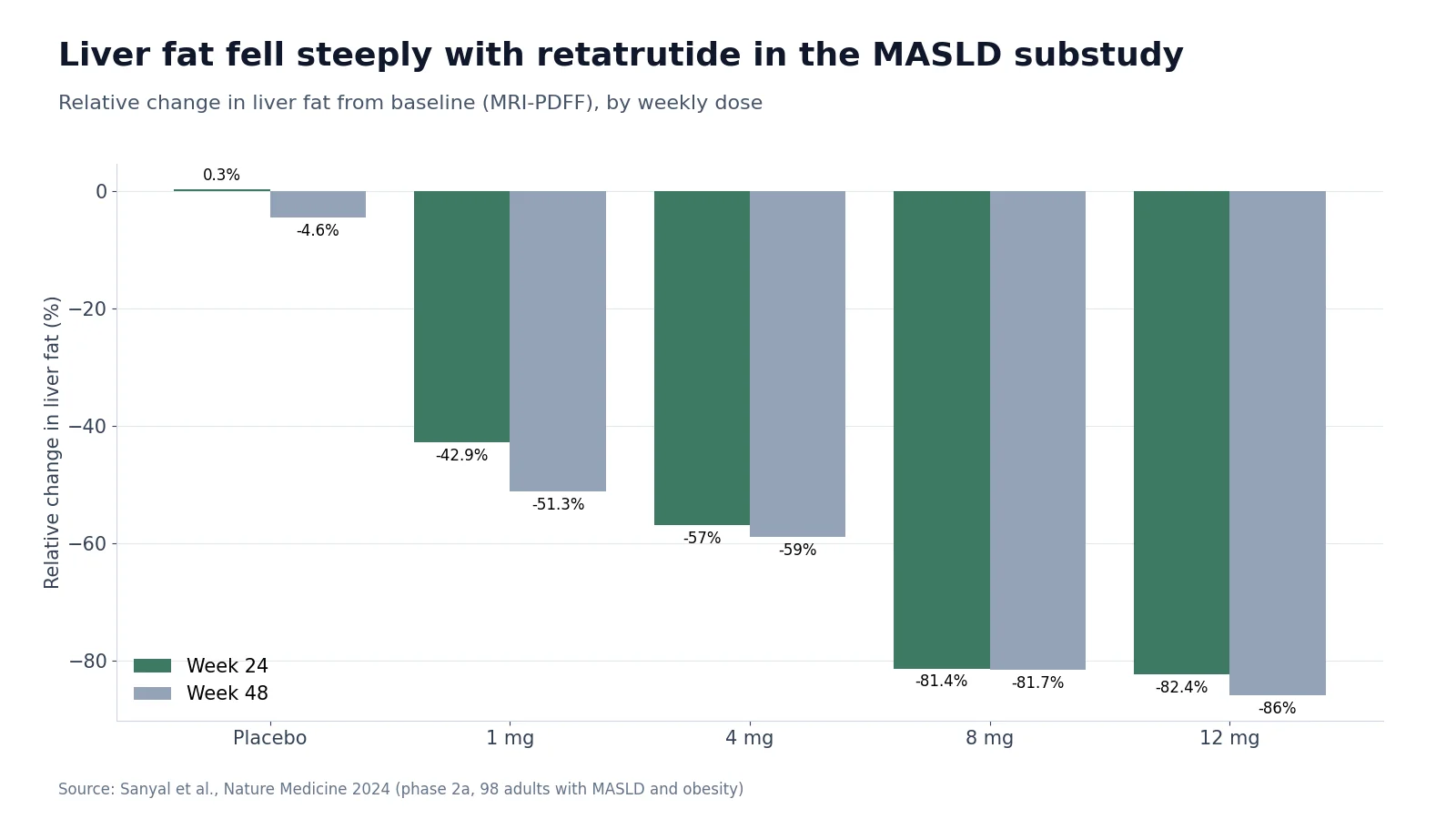
Source: Sanyal et al., Nature Medicine 2024, phase 2a MASLD substudy, 98 adults with obesity.
Two things stand out. First, the response is steep up to 8 mg and then flattens: 8 mg and 12 mg were close to identical at week 24. Second, most of the gain arrived early. By week 24 the higher doses had already cleared most of the liver fat that they would clear by week 48.
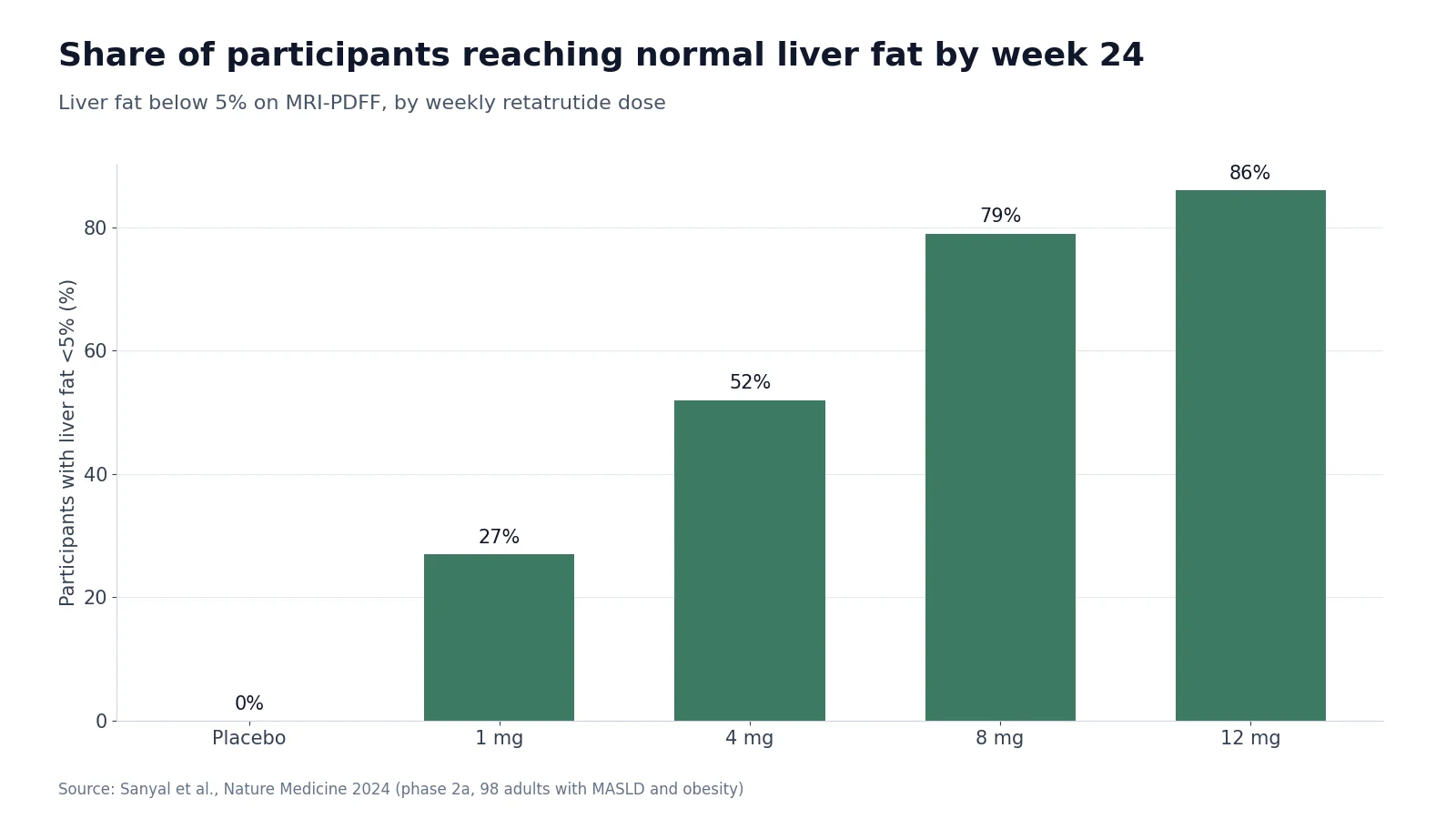
Source: Sanyal et al., Nature Medicine 2024, phase 2a MASLD substudy, 98 adults with obesity.
Several consumer sites present the 86% and 93% figures as if they were week 24 results. They are not. The 86% mean reduction and the 93% normalisation rate at 12 mg are week 48 values, and the week 24 equivalents are the lower numbers in the table above.
Why weight loss and liver fat move together
Participants on retatrutide lost a lot of weight in this substudy: a mean of 17.6% at 12 mg by week 24 and 25.9% by week 48, against about 0.1% on placebo. Liver fat tends to fall as total body fat falls, because the liver is one of the first places excess fat comes out. In humans on any effective weight-loss regimen, including diet alone, liver fat usually drops.
That raises the honest question of how much retatrutide adds beyond the weight loss itself. The paper links the liver changes to improved insulin sensitivity and lipid metabolism, and glucagon receptor activity is a plausible direct contributor, since glucagon acts on the liver. But a phase 2 trial of this size cannot separate a direct liver effect from the downstream effect of losing a quarter of body weight. Anyone claiming the liver result proves a unique mechanism is ahead of the data.
For a related look at how the drug behaves in practice, see our overview of retatrutide benefits.
The lean mass question this trial did not answer
The retatrutide fatty liver paper reports liver fat as the endpoint. It is not a body-composition study, and a lifter reading the headline should not assume the weight lost in it was mostly fat.
What the wider incretin literature shows is consistent. In trials of semaglutide and tirzepatide that scanned body composition, a substantial minority of total weight lost, commonly cited as roughly a quarter to a third, was fat-free mass. Fat-free mass includes water, glycogen and organ tissue as well as muscle, so that figure overstates pure muscle loss, but it is not zero. Retatrutide produces larger total weight loss than those drugs, so the same proportion would mean a larger absolute loss of lean tissue.
This article does not quote a retatrutide-specific lean-mass percentage, because one has not been confirmed against a primary paper by our editors. Body-composition analyses from the phase 2 programme have been discussed in the literature, and phase 3 TRIUMPH body-composition data have not been published in full. When they are, they will be the numbers to read. Until then, the working assumption for a trained person is that retatrutide is at least as lean-mass-costly as the other drugs in its class.
The site's deeper treatment is in GLP-1 muscle loss and the myostatin angle, and in the piece on bimagrumab, the activin receptor antibody studied precisely to protect lean mass during incretin weight loss.
Where phase 3 stands as of November 2026
Retatrutide is investigational and unapproved. The phase 3 TRIUMPH programme has reported topline results from several trials. TRIUMPH-1 reported in May 2026 with an average 28.3% weight loss at 80 weeks on 12 mg. On July 23, 2026, Lilly announced TRIUMPH-2 (obesity or overweight with type 2 diabetes, 1,152 participants) and TRIUMPH-3 (severe obesity with established cardiovascular disease, 1,949 participants):
| Trial | Population | Dose | Mean weight loss at 80 weeks | Placebo |
|---|---|---|---|---|
| TRIUMPH-2 | Type 2 diabetes with obesity or overweight | 12 mg | 20.8% | 4.0% |
| TRIUMPH-2 | Type 2 diabetes with obesity or overweight | 9 mg | 19.1% | 4.0% |
| TRIUMPH-3 | Severe obesity, established cardiovascular disease | 12 mg | 22.6% | 3.2% |
| TRIUMPH-3 | Severe obesity, established cardiovascular disease | 9 mg | 21.6% | 3.2% |
Lilly said it is completing the manufacturing data package and plans to submit a Biologics License Application to the FDA in Q1 2027. No approval exists, there is no announced brand name, and the July release did not report liver or lean-mass results. Retatrutide is separately being studied in phase 3 for MASLD, but those results are not public.
For the dose escalation that produced these numbers, see retatrutide dosage and, for tolerability, retatrutide side effects.
What this means for someone watching their body composition
A few points follow from the evidence, none of them medical advice.
- A fatty liver result is a reason the drug is being studied in MASLD, not a reason to infer anything about a healthy liver. Low baseline liver fat leaves little to remove.
- Fast weight loss costs lean tissue in the trials that measured it. The countermeasures with human evidence behind them are resistance training and higher protein intake during the loss, both tested in conventional dieting rather than with this drug.
- Measure rather than guess. Scale weight cannot separate liver fat, glycogen, water and muscle. DXA or similar body-composition imaging can, and so can a clinician ordering liver fat imaging if there is a real clinical concern.
- Material sold outside a trial has no regulator behind it, so the trial doses and results cannot be assumed to carry over to a vial of unknown content. Readers who still want to compare suppliers can consult a current list of retatrutide sellers, treating any certificate of analysis as a statement about a sample, not about the vial in hand.
Anything liver-related, including abnormal enzymes or a MASLD diagnosis, belongs with a doctor, not a forum.
Frequently asked questions
Does retatrutide help fatty liver?
In a phase 2 substudy of 98 adults with obesity and MASLD, retatrutide reduced liver fat by 82% to 86% at the 8 mg and 12 mg doses, and about 89% to 93% of those participants had liver fat under 5% at 48 weeks. The study measured liver fat only, not fibrosis, and retatrutide is not approved for any condition.
Is the liver fat loss just from weight loss?
Probably a large part of it. Liver fat falls with weight loss from any cause, and participants lost up to 25.9% of body weight by week 48. The trial was not designed to separate a direct liver effect from that weight loss.
Does retatrutide cause muscle loss?
Retatrutide-specific phase 3 lean-mass data are not public. Trials of related drugs report that a meaningful share of weight lost, often cited as a quarter to a third, is fat-free mass, and retatrutide causes larger total weight loss. Resistance training and adequate protein are the standard countermeasures.
Is retatrutide approved by the FDA?
No. As of November 2026 it is investigational. Lilly says it plans to submit a Biologics License Application in Q1 2027, and no brand name has been announced.
Did retatrutide harm the liver in the trial?
The substudy reported mostly mild to moderate gastrointestinal events, more frequent at 8 mg and 12 mg, and two participants had serious adverse events. Long-term liver safety beyond the trial is not established.
References
- Sanyal AJ, et al. Triple hormone receptor agonist retatrutide for metabolic dysfunction-associated steatotic liver disease: a randomized phase 2a trial. Nature Medicine. 2024;30:2037-2048. (PMC11271400)
- Jastreboff AM, et al. Triple-hormone-receptor agonist retatrutide for obesity: a phase 2 trial. New England Journal of Medicine. 2023.
- Eli Lilly and Company. Lilly's triple agonist, retatrutide, successful in two additional Phase 3 obesity trials, delivering significant improvements in weight and A1C. Press release, July 23, 2026.