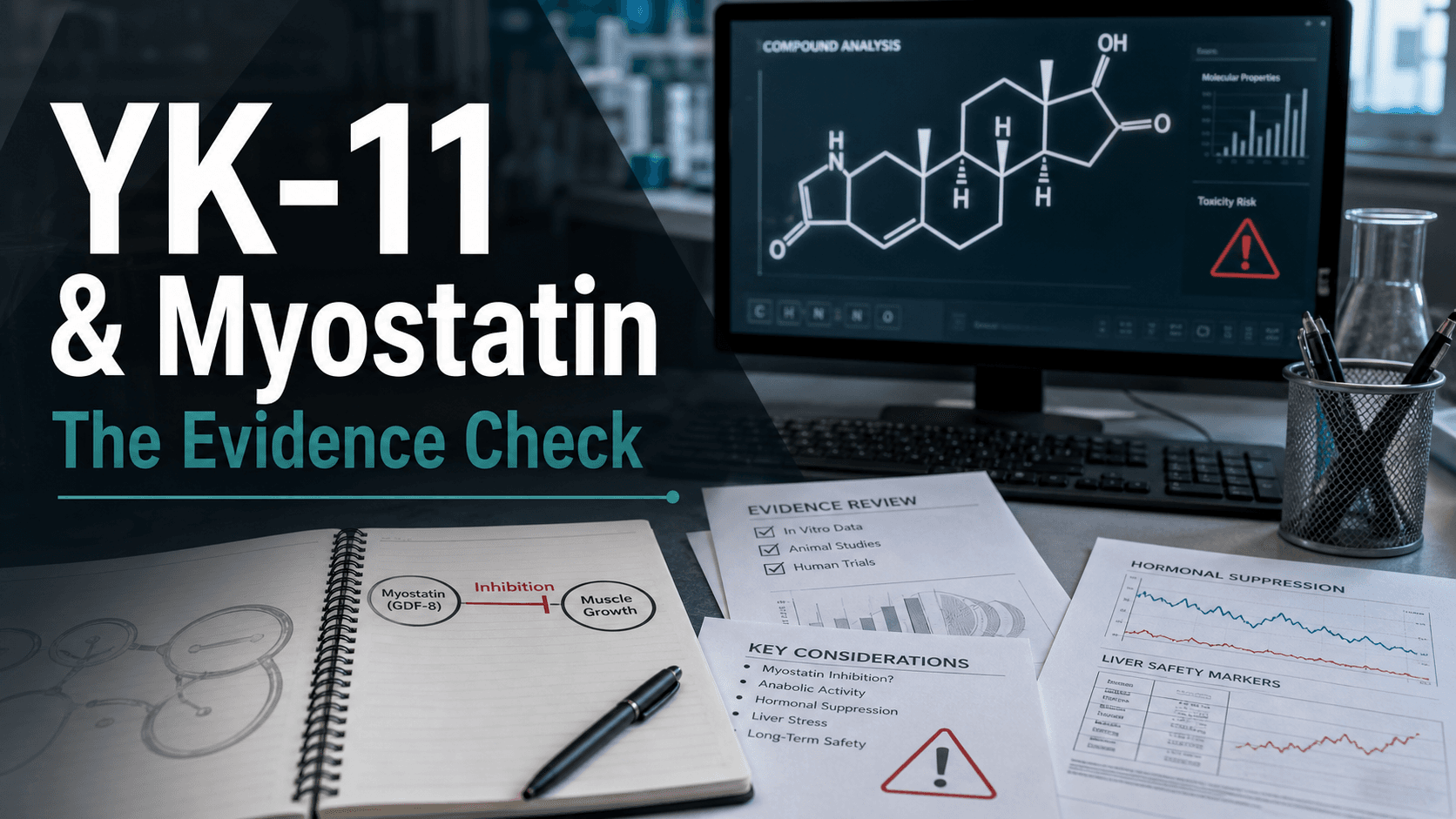
The marketing is louder than the science. YK-11 is sold as a "myostatin-inhibiting SARM" with steroid-like results and zero downside, but the chemistry, the source paper, and the side-effect log point somewhere else.
Key takeaways
- YK-11 is a synthetic steroid built on a DHT-like backbone, not a true non-steroidal SARM, despite how it is marketed.
- The "myostatin inhibitor" label comes from a single 2011 cell study showing YK-11 raised follistatin in C2C12 muscle cells — not a direct block on myostatin.
- No human clinical trial has tested YK-11 for muscle growth, safety, or dose, and the compound never advanced past early lab-stage screening.
- Common user-reported dose sits at 10–15 mg per day with cycles of 6–8 weeks, but the half-life and clearance are unknown.
- Real side-effect reports include testosterone suppression, raised liver enzymes, hair loss, joint and tendon issues, and aggression.
- Actual approved or trial-stage myostatin-pathway drugs (bimagrumab, apitegromab, taldefgrobep, garetosmab) work very differently and have real human safety data.
YK-11 myostatin claims at a glance
Start with the scale. The phrase "YK-11 myostatin inhibitor" sounds settled, but every piece of the claim is shakier than the marketing implies.
| Claim | What the evidence shows | What it does not show |
|---|---|---|
| "YK-11 is a SARM" | It binds the androgen receptor as a partial agonist | It is structurally a steroid (a 19-norpregnane derived from DHT), not a non-steroidal SARM |
| "YK-11 inhibits myostatin" | One 2011 cell paper showed it raises follistatin in C2C12 muscle cells | No direct binding to myostatin, no human data, no blood myostatin measurements in humans |
| "Stacks of clean gains" | Anecdotal forum logs | No randomised trial, no body-composition scans, no controlled human dose |
| "Mild side effects" | Some users report dry strength gains | Suppression of natural testosterone, ALT/AST elevations, hair loss, tendon weakness are widely reported |
| "Legal in supplements" | Sold openly online | Health Canada warned in 2022 that myostine (YK-11) is not authorised, and the FDA does not approve it as a dietary ingredient |
That is the honest read. YK-11 is interesting biochemistry attached to oversold marketing.
For the broader category, see the actual myostatin inhibitor drugs in trials. For why most "myostatin inhibitor" supplements miss the target, see the supplement category breakdown.
What YK-11 actually is
It is not a true SARM. YK-11 was first described by Kanno and colleagues in 2011, with a 17-alpha-methylated, 19-norpregnane steroid backbone closely related to dihydrotestosterone (DHT).
The molecular formula is C25H34O6 and the molar mass is 430.5 g/mol. The compound is taken orally and uses the 17-alpha-methyl modification that lets oral anabolic steroids survive first-pass liver metabolism.
That single structural fact matters. Non-steroidal SARMs like ostarine and ligandrol were designed specifically to avoid the liver, hair, and prostate effects of a steroid backbone. YK-11 keeps that backbone.
So when a vendor calls YK-11 "the safest SARM," the chemistry behind that sentence is wrong.
How the myostatin claim started
It started with one cell-culture paper. Kanno et al. (Biological and Pharmaceutical Bulletin, 2011, and a follow-up in 2013) treated mouse C2C12 myoblasts with YK-11 and measured several anabolic markers.
The headline finding was that YK-11-treated cells showed greater follistatin expression than cells treated with DHT alone. When researchers added an anti-follistatin antibody, the anabolic effect on those cells disappeared.
That is where "myostatin inhibitor" comes from. Follistatin can bind and neutralise myostatin. More follistatin in a dish suggests less active myostatin nearby.
Notice what the paper does not show. It does not measure blood myostatin in humans, change body composition, or run a single in-vivo experiment in a person.
The compound never advanced past early lab-stage screening. There are no published human trials, no pharmacokinetic studies in people, and no safety database.
What "partial AR agonist" means for users
YK-11 binds the androgen receptor (AR) and partially activates it. In C2C12 myoblasts it actually showed greater anabolic potency than DHT in some markers.
But partial agonism cuts both ways. It can still flip the AR-driven feedback loop that tells the hypothalamus to slow down LH and FSH, which then drives down endogenous testosterone.
Forum logs consistently describe libido drops, mood shifts, and post-cycle suppression that look more like a mild anabolic steroid than a "selective" compound. Independent reviewers, including More Plates More Dates, classify it as essentially a methylated DHT derivative with follistatin-inducing side effects.
That framing fits the chemistry better than the "SARM" label does.
YK-11 vs real myostatin inhibitors
This is where the marketing falls apart. Real myostatin-pathway drugs in human trials look nothing like YK-11.
| Compound | Mechanism | Stage | Notes |
|---|---|---|---|
| YK-11 | Partial AR agonist, raises follistatin in cells | No human trials | Sold as "SARM," structurally a steroid |
| Bimagrumab | Antibody blocking ActRII receptors | Phase 2/3 in obesity and sarcopenic obesity | Built ~2–3 kg lean mass and reduced fat in some trials |
| Apitegromab | Antibody binding pro/latent myostatin | Phase 3 for spinal muscular atrophy | Approved in some regions for SMA |
| Taldefgrobep alfa | Anti-myostatin adnectin | Phase 3 in SMA | Mixed efficacy data |
| Garetosmab | Antibody to activin A | Phase 3 in FOP | Activin A is in the same pathway |
| Sotatercept | ActRIIA-Fc fusion | Approved for PAH | Acts on the same receptor family |
YK-11 is the only one in that list with zero human evidence. The others come with structured trials, dose finding, safety reports, and adverse-event databases.
A serious comparison should put YK-11 in the "interesting cell biology" bucket, not the "drug" bucket. For broader context on what works in humans, read our review of the best evidence-based myostatin inhibitors.
What forum users actually report
The user picture is messier than the marketing. The most consistent themes from large bodybuilding forums and review sites map to a steroid-like compound, not a benign SARM.
- Dry, somewhat slow lean-mass gains over 8 weeks, typically in the 2–4 kg range
- Strength increase that lags behind classic anabolic steroids at similar weeks
- Heavy joint discomfort and reports of tendon pain
- Notable testosterone suppression that often requires a post-cycle therapy with SERMs
- Liver enzyme elevations on basic blood panels, sometimes substantial
- Hair shedding in users with male-pattern baldness risk
- Mood and aggression changes more than non-steroidal SARMs
These are not signs of a "follistatin-only" mechanism. They are the signs of a methylated oral anabolic with extra myostatin-pathway activity.
Common user doses and how it is taken
There is no validated dose. Across forums and grey-market guides, the most common daily dose is 10–15 mg, split twice daily, for 6–8 weeks.
First-time users often start at 5 mg. Some bodybuilders push to 30 mg per day, which lines up with the worst reported liver and suppression effects.
The half-life is not formally established but is estimated at roughly 6–10 hours, which is why splitting the dose is the default. Cycles are usually followed by a 4-week post-cycle therapy with clomifene or tamoxifen to restart endogenous testosterone.
None of this comes from clinical trials. It comes from anecdote, and the variability between sources is large.
This article does not endorse self-administration. It describes what is being done in the wild so the chemistry can be read against real user behaviour.
Side effects that show up most often
The risk list is not gentle. Putting together the cell-paper data, the structural class, and forum reports, the realistic side-effect profile looks like this.
- Testosterone suppression. Dose-dependent, similar pattern to oral anabolic steroids and most SARMs, mediated by LH and FSH suppression.
- Liver toxicity. The 17-alpha-methyl modification predicts hepatic stress, and users report ALT and AST elevations on routine bloodwork.
- Hair loss. AR activation in the scalp drives shedding in genetically predisposed users.
- Tendon and joint problems. Myostatin-deficient mice have brittle tendons and joint capsules; reducing the brake on muscle growth without matching tendon adaptation is a real concern.
- Aggression and mood changes. Reported less than oral anabolic steroids but more than non-steroidal SARMs.
- Cardiovascular markers. Most users do not run lipid panels, but oral 17-alpha-methylated compounds typically push HDL down and apoB up.
- Unknown long-term risk. No multi-year human safety data exists.
Health Canada flagged SARMs sold as myostine (YK-11) in 2022, naming heart attack, stroke, and liver damage as documented risks for the category.
For the regulatory side of this question, see whether myostatin inhibitors are legal.
Who is actually the wrong fit
The wrong-fit list is long. YK-11 is a poor choice for healthy adults who already train, eat enough protein, and recover well.
It is a worse choice for anyone with elevated cardiovascular risk, family history of liver disease, hair-loss sensitivity, hormone-sensitive conditions, or any plan to compete in a tested federation. WADA bans SARMs, and YK-11 in particular shows up on routine screens.
It is also a bad fit for adults seeking sarcopenia support. The actual sarcopenia-direction myostatin antibodies (apitegromab, taldefgrobep) have controlled dose, monitoring, and real outcome data. YK-11 does not.
What competitor pages overstate
The pattern is repetitive. Most vendor-affiliated pages and SARM guides repeat four claims that the evidence does not support.
- "YK-11 directly inhibits myostatin." It does not. The mechanism in the source paper is follistatin upregulation in a cell line, which is several steps removed from blocking circulating myostatin in a human.
- "YK-11 is a SARM." It is structurally a steroid. The original "selective androgen receptor modulator" label is loose enough to include it, but the chemistry is closer to a 19-norandrogen.
- "Side effects are minimal." Suppression, hair loss, lipid shifts, and liver enzyme elevations are all routinely reported.
- "Just run a 4-week PCT and you are fine." With no human pharmacokinetic data, no half-life confirmation, and oral methylation, a SERM-only PCT is a guess, not a protocol.
Watching for those four sentences makes most YK-11 sales pages easy to spot.
A realistic read on the science
The honest version is short. YK-11 is a real anabolic compound with interesting follistatin biology in cell culture and a steroid-like profile in users.
It is not a clean myostatin inhibitor. It is not a "safer SARM." It is not approved as a drug, supplement, or food ingredient anywhere with a serious regulator.
For adults focused on muscle quality after 40, the higher-evidence levers are still the same: progressive resistance training, enough protein (around 1.6 to 2.2 g per kg per day), creatine, sleep, and management of underlying disease. Pathway drugs with real human trials are the place to look next, not unapproved orals.
For background on the protein itself, see the myostatin protein primer. For the natural-options side, see reduce myostatin naturally.
Sources and notes
- YK-11 — Wikipedia (chemical class, Kanno references, Health Canada warning)
- Myostatin inhibitor YK11 as a preventative health supplement for muscle atrophy (ScienceDirect, 2021)
- YK11 Overview — More Plates More Dates
- YK-11, the SARM Exception? — Type-IIx Substack
- YK-11 Overview, Dosing and Safety — Peptide Database
- YK-11 Myostine SARM — Muscle and Brawn
- Health Canada — Risks of SARMs including myostine (2022)
Frequently Asked Questions
Does YK-11 actually inhibit myostatin in humans?
There is no human evidence that YK-11 lowers circulating myostatin. The "myostatin inhibitor" tag comes from a 2011 cell-culture study showing it raises follistatin in mouse muscle cells, which is several steps short of blocking myostatin in a person.
Is YK-11 a SARM or a steroid?
Functionally a partial AR agonist, structurally a 17-alpha-methylated steroid built on a DHT-like backbone. Most chemists treat it as a designer anabolic steroid rather than a non-steroidal SARM.
What dose do users typically take?
Forum reports cluster around 10–15 mg per day, split twice daily, for 6–8 weeks, followed by a 4-week post-cycle therapy. That dose has never been validated in a human trial.
What are the most common side effects?
Testosterone suppression, raised liver enzymes, hair loss, tendon and joint problems, mood changes, and likely negative effects on cholesterol panels.
How does YK-11 compare to bimagrumab or apitegromab?
Bimagrumab, apitegromab, and taldefgrobep are antibodies tested in real human trials with structured doses and adverse-event data. YK-11 has none of that. They are not in the same category.
Is YK-11 legal?
It is not approved as a drug, dietary supplement, or food additive in the United States, Canada, EU, UK, or Australia. WADA bans it for tested athletes. Sale online does not equal regulatory approval.
This article is for educational purposes only and is not medical advice. YK-11 is an unapproved compound with no human safety data. Talk with a qualified healthcare professional before considering any unapproved compound, especially if you have liver, kidney, cardiovascular, or hormone-sensitive conditions.