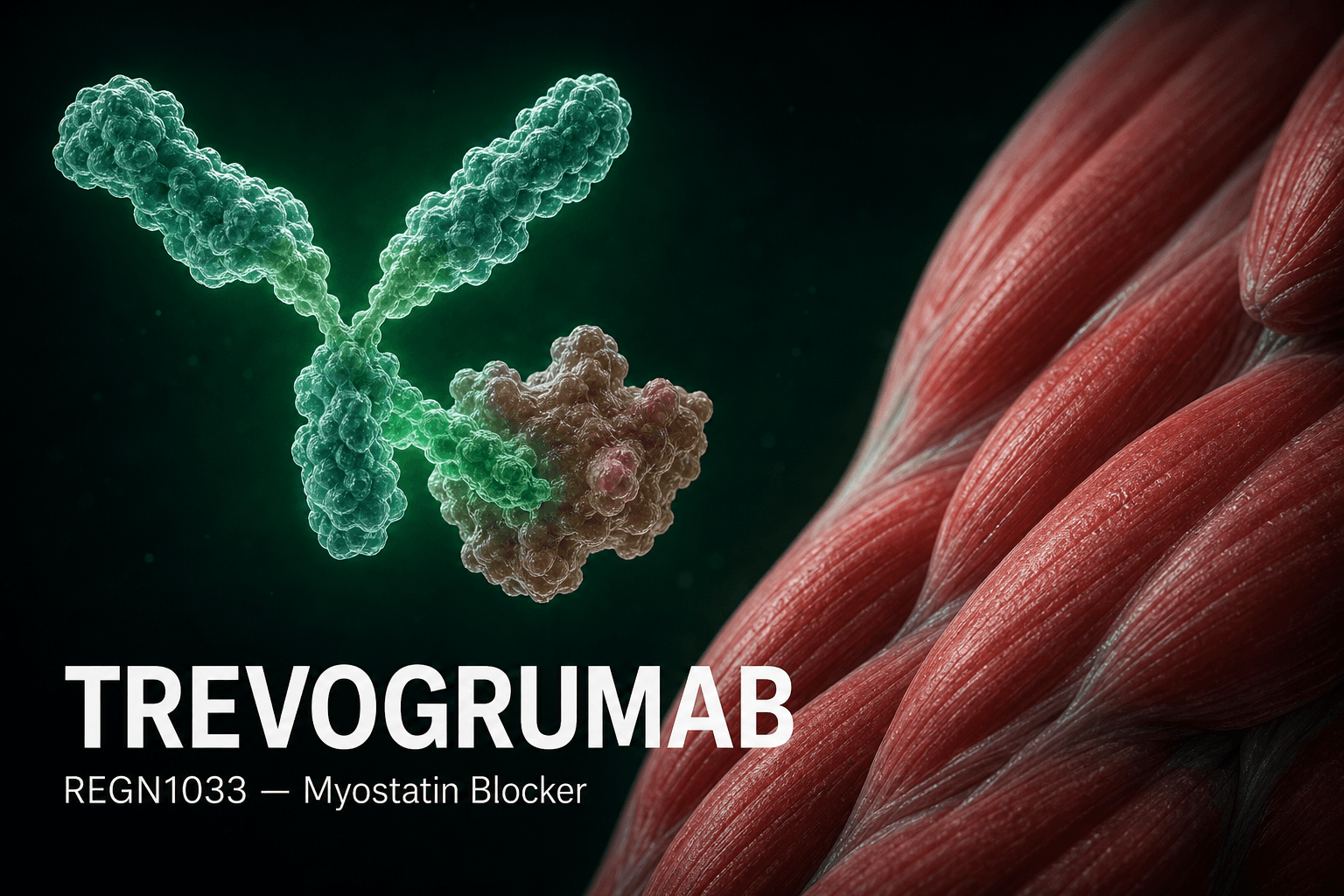
Semaglutide takes muscle along with the fat. Trevogrumab is Regeneron's attempt to stop that, and its first big trial readout in 2025 made the whole obesity field pay attention.
Key takeaways
- Trevogrumab (REGN1033) is a fully human antibody from Regeneron that blocks myostatin (GDF8), the body's main brake on muscle.
- It started life as a sarcopenia and disuse-muscle drug years ago, underdelivered, and was reborn for a sharper job: protecting muscle during GLP-1 weight loss.
- In the Phase 2 COURAGE trial, adding trevogrumab to semaglutide preserved roughly half of the lean mass that semaglutide alone would have stripped away.
- A three-drug version that adds garetosmab (an activin A blocker) preserved about 81 percent of lean mass, but discontinuations jumped to 28 percent.
- You cannot buy it. Trevogrumab is investigational, available only inside the COURAGE clinical trial, and not approved or sold as a medicine.
Quick facts on trevogrumab
| Field | Value |
|---|---|
| Drug name | Trevogrumab (formerly REGN1033 / REGN-1033) |
| Class | Fully human IgG monoclonal antibody |
| Target | Myostatin (GDF8) |
| Sponsor | Regeneron Pharmaceuticals |
| Route | Subcutaneous injection (garetosmab is given IV) |
| Original use | Muscle atrophy from orthopedic disuse and sarcopenia |
| Current use | Muscle preservation during GLP-1 (semaglutide) weight loss |
| Key trial | COURAGE (NCT06299098), Phase 2 |
| Status (June 2026) | Investigational; not approved; trial-only |
For the broader cross-drug picture, see myostatin inhibitors and GLP-1 muscle loss and the myostatin inhibitor obesity class hub.
What trevogrumab is and how it works
Trevogrumab is a single, focused tool. It is a fully human antibody that grabs myostatin, also called GDF8, and holds it so it cannot do its job.
Myostatin's job is to limit muscle. It is the brake. Your body uses it to stop muscle from growing without limit, and you can read the full story of that brake in our myostatin protein explainer.
By mopping up myostatin, trevogrumab stops it from reaching the activin type II receptors on muscle. The brake comes off. Muscle is protected, and under the right conditions it can even grow.
That is a narrower action than the receptor antibodies. Drugs like bimagrumab block the whole receptor and catch several signals at once. Trevogrumab catches one: myostatin. Narrow usually means cleaner, and that turns out to matter for the safety story below.
The pivot that saved the drug
Trevogrumab is not new. Regeneron first tested it years ago for sarcopenia and for muscle wasting after orthopedic disuse, the kind of muscle you lose lying in a hospital bed. Those early programs did not deliver enough benefit to move forward, and the drug went quiet.
Then the GLP-1 era arrived and changed the question.
Semaglutide and tirzepatide produce huge weight loss, but a large slice of that loss is muscle, not fat. Suddenly a drug whose entire purpose is to protect muscle had an obvious partner. Regeneron pulled trevogrumab back out and pointed it at the muscle-loss problem inside the obesity boom. That is why a years-old antibody is one of 2026's most-watched names.
The COURAGE trial: the data that matters
This is the readout the field was waiting for.
COURAGE (NCT06299098) is a Phase 2, randomized, double-blind study testing trevogrumab, with or without garetosmab, on top of semaglutide in adults with obesity. It enrolled about 1,005 patients across multiple arms, ran in 26-week periods, and is designed to measure the percent change in fat mass, lean mass, and body weight. Regeneron reported the first major results on June 3, 2025.
The trial had three ideas in it: semaglutide alone, semaglutide plus trevogrumab, and semaglutide plus trevogrumab plus garetosmab.
Headline results
| Arm | Fat loss vs semaglutide alone | Share of lost weight that was fat (lean preserved) | Serious adverse events | Discontinuations |
|---|---|---|---|---|
| Semaglutide alone | Reference | 65.5 percent (34.5 percent of loss was lean) | 2.0 percent | ~4 percent |
| Semaglutide + trevogrumab | 15 to 18 percent more fat loss | 50.8 to 51.3 percent of weight lost preserved as lean | 1.4 to 3.3 percent | 4 to 10 percent |
| Semaglutide + trevogrumab + garetosmab | 27 percent more fat loss | 80.9 percent lean preserved | 10.1 percent | 28.3 percent |
Read the lean-mass column slowly, because that is the whole point.
On semaglutide alone, more than a third of the weight people lost came out of lean mass. Adding trevogrumab roughly halved that muscle loss while actually increasing fat loss. The drug did its one job.
The garetosmab triplet: more muscle, more cost
Adding garetosmab, an antibody against activin A, pushed lean preservation up to about 81 percent and increased fat loss further. On the numbers alone it is the strongest body-composition result in the trial.
But honesty matters here. The triplet also drove overall adverse events to 77 percent, serious adverse events to about 10 percent, and discontinuations to roughly 28 percent. Two deaths were reported in the study, with no causal link to treatment established. The triplet buys more muscle at a real tolerability price, and that trade-off is now the central question for the program.
Regeneron's chief scientist George Yancopoulos summarized the takeaway plainly: blocking GDF8 with or without activin A can preserve muscle while people lose fat on a GLP-1.
Side effects and the safety trade-off
The pattern across COURAGE is clear. Trevogrumab on its own was easy to tolerate.
The two-drug combination of semaglutide plus trevogrumab kept serious adverse events low, in the 1.4 to 3.3 percent range, near the semaglutide-alone level. Most of the trouble that did appear tracked the known GLP-1 side effects, mainly gastrointestinal.
The three-drug combination is where caution belongs. Adding garetosmab roughly tripled serious adverse events and pushed more than a quarter of patients to stop. If trevogrumab reaches the clinic, the clean two-drug version is the more likely path, with the triplet reserved for cases where maximum muscle preservation is worth the risk.
How trevogrumab compares to the other muscle-savers
Three antibodies are chasing the same goal from different angles.
| Drug | Target | Specificity | Best COURAGE-style result | Main downside |
|---|---|---|---|---|
| Trevogrumab | Myostatin (GDF8) | Narrow | ~51 percent lean preserved with semaglutide (~81 percent with garetosmab) | Triplet tolerability |
| Apitegromab | Pro- and latent myostatin | Narrow | Strong lean-mass preservation vs tirzepatide alone | Slower, milder effect |
| Bimagrumab | Activin type II receptor | Broad | Largest body-composition swing | Muscle spasms in most patients |
The short version: bimagrumab moves the needle hardest but with the roughest side-effect profile, apitegromab is the gentlest, and trevogrumab sits in between, with garetosmab available as a high-power, high-risk add-on. For the full landscape, see our myostatin inhibitor drug overview and the anti-myostatin antibody class history.
Can you buy trevogrumab?
No, and this is worth being blunt about.
Trevogrumab is investigational. It is available only to people enrolled in the COURAGE clinical trial. It is not approved by the FDA or any regulator, it is not sold in pharmacies, and it is not a legal personal-use product.
You may see chemical-supply companies listing trevogrumab. Those are laboratory reagents sold to labs, not medicines, and they are not made or tested for human injection. Buying an antibody from a catalog and injecting it is dangerous and pointless: dose, purity, and sterility are all unknown. If muscle preservation during weight loss is your goal today, the realistic tools are adequate protein and resistance training, covered in how resistance training affects myostatin, not a trial-only antibody.
FDA status and realistic timeline
Trevogrumab is in Phase 2. There is no approved indication anywhere as of June 2026.
The COURAGE primary completion lands in 2026, and a positive package would still need a Phase 3 program before any filing. A realistic earliest approval for a trevogrumab plus GLP-1 combination is 2028 or later, in line with the timelines for bimagrumab and other muscle-sparing add-ons. The likeliest commercial form is the two-drug combination, because the safety math on the triplet is hard.
Where to read next
- Myostatin inhibitors and GLP-1 muscle loss for the cross-drug comparison.
- Bimagrumab for the receptor-antibody approach Lilly bought.
- Apitegromab for the gentlest myostatin antibody.
- Garetosmab for the activin A blocker used in the triplet.
- Best myostatin inhibitor for ranking the class by use case.
Sources and notes
- Trevogrumab - Wikipedia
- Results from Phase 2 COURAGE trial - Regeneron investor news
- Regeneron's semaglutide plus trevogrumab combo demonstrates superior fat loss, reduced muscle wasting - Pharmaceutical Executive
- A study of trevogrumab with or without garetosmab plus semaglutide in obesity - NCT06299098
- Myostatin blocker preserves muscle with GLP-1 treatment - Medscape
- Regeneron, Lilly grapple with clinical endpoints in obesity - Fierce Biotech
- The effect of combined activin A and myostatin blockade on body composition - Diabetes (34-OR)
Frequently Asked Questions
What is trevogrumab?
Trevogrumab (REGN1033) is a fully human monoclonal antibody made by Regeneron that blocks myostatin (GDF8), the protein that limits muscle growth. It is being developed to protect muscle in people losing weight on GLP-1 drugs like semaglutide.
What did the COURAGE trial show?
In the Phase 2 COURAGE trial, adding trevogrumab to semaglutide preserved roughly half of the lean mass that semaglutide alone would have removed, while increasing fat loss by about 15 to 18 percent. A three-drug version adding garetosmab preserved about 81 percent of lean mass but caused far more side effects and discontinuations.
Can you buy trevogrumab?
No. Trevogrumab is investigational and available only inside the COURAGE clinical trial. It is not approved, not sold in pharmacies, and not a legal personal-use product. Chemical-supply listings are laboratory reagents, not medicines, and are unsafe to inject.
What is the difference between trevogrumab and garetosmab?
Trevogrumab blocks myostatin. Garetosmab blocks a related protein called activin A. In COURAGE they were combined on top of semaglutide. Adding garetosmab preserved more muscle but sharply increased adverse events and discontinuations, so the two-drug version is the gentler option.
How does trevogrumab compare to bimagrumab?
Bimagrumab blocks the whole activin type II receptor, producing the biggest body-composition changes but causing muscle spasms in most patients. Trevogrumab blocks only myostatin, a narrower and generally cleaner action, with garetosmab available as a stronger but riskier add-on.
When could trevogrumab be approved?
Not before about 2028 at the earliest. It is in Phase 2, with COURAGE finishing in 2026, and it would still need a Phase 3 program before any regulatory filing.
This article is for educational purposes only and is not medical advice. Trevogrumab is an investigational antibody that is not approved for any indication and is only available within a registered clinical trial. Talk with a qualified clinician before changing any medication, supplement, or weight-loss strategy.