FLGR-242 is sold to lifters as a follistatin that lasts, and follistatin is the reason a myostatin site covers it at all. What ships in the vial is not a short peptide. It is a recombinant glycoprotein of roughly 40 kDa, a fragment of follistatin fused to an albumin binding construct, and that one fact changes how the rest of the marketing should be read.
This page covers what the product is, what a pair of vials costs, and the three claims on the vendor's own listing that a buyer cannot resolve before paying. All three are checkable, and none of them are hidden. They are sitting on the page that sells it.
Key takeaways
- FLGR-242 is a follistatin albumin fusion construct of roughly 40 kDa, not a short synthetic peptide, and not the same molecule as follistatin-344 despite deriving from it.
- The vendor's own product page says three incompatible things about activin binding, and the difference is not cosmetic for anyone buying it on the myostatin argument.
- A certificate of analysis is advertised in the product title, but the public COA library holds nothing for this product.
- PubMed and ClinicalTrials.gov both return zero for the name. The papers cited on the listing are genuine follistatin studies, largely in mice, and none of them tested this construct.
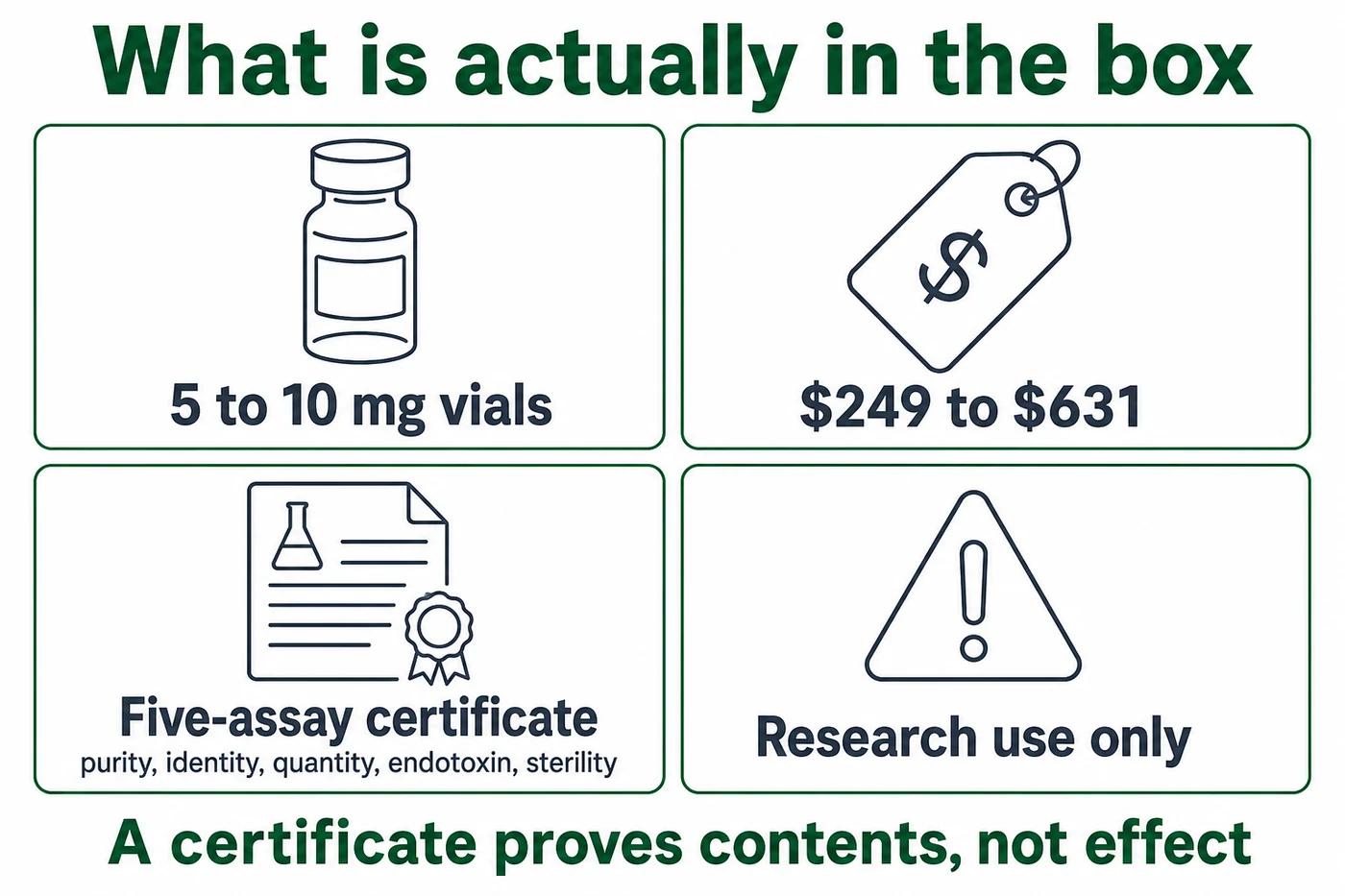
- List price is $499.00 for one pair, two 5 mg vials, and the code Peptidedeck is entered at checkout.
What FLGR-242 actually is
The vendor describes it as "a novel fragmented, modified version of Follistatin-344 (FST-344) that does not bind to the protein activin," carrying "a patented albumin binder." More precisely, in its words, it is "Follistatin protein (FST) fused with an albumin-binding construct that uses a hydrophilic glycine-serine linker to achieve high-affinity binding to serum albumin."
| Vendor-stated property | Value |
|---|---|
| Type | Follistatin albumin binding construct |
| Linker sequence | GGSGGSGGSGGRLIEDICLPRWGCLWEDD |
| Molecular weight | Roughly 40 kDa |
| Albumin binding affinity | Under 20 nM Kd |
| Synonyms given | FST-Albumin Construct, Extended Half-Life Follistatin |
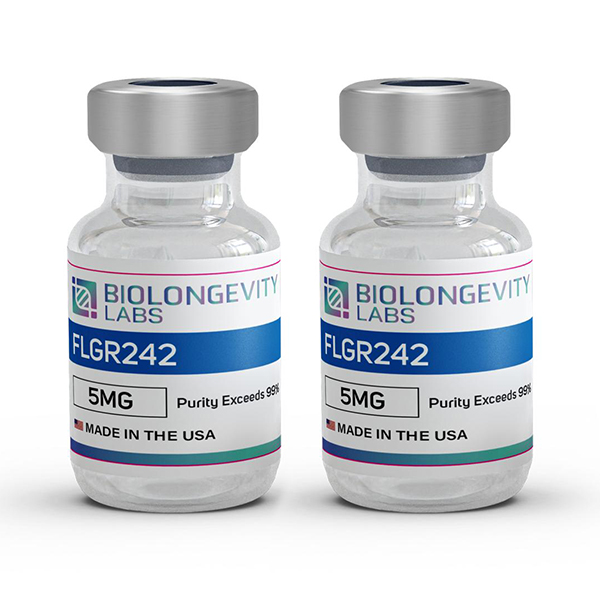
| Vial format | 5 mg, sold as pairs of two vials, 10 mg |
| Manufacturing claim | US GMP, third-party verified |
The 40 kDa figure is the one to hold on to, because it sorts this product into a different category from almost everything else on the same shelf. A short synthetic peptide runs to a few thousand daltons. Forty thousand is protein territory, which is why the accurate description is a recombinant follistatin construct rather than a peptide. Anyone comparing it in their head to the small peptides they have used before is comparing across a category boundary, and the handling, stability and immunogenicity questions that apply to a biologic are not the ones that apply to a short chain.
That distinction is missing from most pages selling it, which is the first sign of how carefully those pages were written.
FLGR-242 vs follistatin-344
Buyers reach for this comparison constantly, and the vendor answers it in its own description: FLGR-242 is a fragmented, modified version of FST-344, with something else attached. Both halves of that sentence matter. Fragmented and modified means material has been removed and changed. The albumin binder means material has been added that native follistatin does not carry.
The consequence for a reader is simple and unwelcome. Everything established about follistatin-344 describes a different molecule. It can motivate a hypothesis about this construct. It cannot stand as evidence for it. The engineering goal is legible enough, since native follistatin protein clears quickly and an albumin binder is a recognised way to slow that down, but a legible goal is not a demonstrated result.
The activin contradiction on the vendor's own page
One product listing says three incompatible things.
The product description states FLGR-242 "does not bind to the protein activin." The meta description and social card for the same page say it is "Studied for myostatin inhibition and activin binding." The research applications section, further down that same page, lists "activin neutralisation assays."
This is not a copywriting slip to shrug at. Follistatin's entire established mechanism is high-affinity binding and neutralisation of activins and related TGF-beta ligands. A follistatin construct that genuinely did not bind activin would be a substantially different molecule from the one the name implies, and the same page then sells it as a reagent for neutralising activin.
For this audience the problem is sharper still. The reason a lifter looks at follistatin at all runs through that ligand family, and the vendor's own social card sells the product on "myostatin inhibition." The listing therefore advertises the lean mass argument and, in its main description, disclaims the binding behaviour that argument depends on. A reader cannot resolve which statement is correct from the page, and should not have to.
The COA is advertised but not published
The product title says "COA Included." The description promises "comprehensive COAs." That is exactly the right thing for a research supplier to offer, and it is worth checking rather than assuming.
The vendor's public COA library holds eight PDFs. Not one covers follistatin or FLGR-242. They are a Cortagen report, plus endotoxin reports for BPC-157 and TB-500, CJC-1295 and ipamorelin, DSIP, retatrutide, SS-31 and tesamorelin. Useful documents, all for other products.
A certificate that materialises only after purchase cannot inform the purchase, and before purchase is the moment it has value. The same reservation applies to the "US GMP, third-party verified" line: it is a claim about manufacturing that no publicly available document currently supports for this product. None of this proves the material is poor. It means the buyer is relying on the seller's word during the only window in which independent evidence would change a decision, which is the general problem with this market covered in our follistatin sourcing guide.
No independent literature exists under this name
Searches for FLGR-242 and for the vendor's unhyphenated spelling return zero results on PubMed and zero records on ClinicalTrials.gov.
The listing does cite twelve papers, and a sample of them checks out as genuine research.
| Paper cited on the listing | What it studied | Organism |
|---|---|---|
| PMID 23942549 (2013) | Systemic follistatin288 administration and muscle mass | Mouse |
| PMID 30555546 (2018) | Nanoparticle-mediated hepatic delivery of follistatin mRNA | Mouse |
| PMID 36325432 (2022) | Follistatin in NAFLD via mTOR signalling | Preclinical |
| FLGR-242 itself | Nothing published, no registered trial | None |
Real papers, real findings, and every one of them is about follistatin rather than about this construct. That gap is the mechanism by which a proprietary molecule borrows the evidence base of the protein family it derives from. The citations are accurate and the implication drawn from them is not, because a modified fragment carrying an added albumin binder is precisely the thing whose behaviour those studies did not measure.
For the deeper technical reading on the construct itself, our longer analysis of FLGR242 claims against evidence goes further into what the engineering does and does not establish.
What the lean mass case actually rests on
Stated plainly, so nobody has to infer it. There is no human data on FLGR-242. No trial has been run, none is registered, and no published result exists for lean mass, strength, recovery capacity or any other endpoint in any species for this specific construct.
That leaves the case resting on a chain of inferences: follistatin neutralises ligands in the TGF-beta family, this molecule is derived from follistatin, an albumin binder should extend how long it persists, therefore it should do something useful for muscle. Each link is plausible. None has been tested end to end, and the vendor's own description breaks the first link by stating the construct does not bind activin.
A reader may still decide the hypothesis is worth their money. That is a defensible choice, made with the evidence in view. It is different from believing a result exists.
FLGR-242 for sale: what a pair costs
| Purchase | Price |
|---|---|
| One pair, 10 mg total, two 5 mg vials | $499.00 list |
| 6 pairs | 5% off |
| 12 pairs | 10% off |
| 24 pairs | 15% off |
| 48 pairs, 96 vials | up to $19,161.60 list, 20% off |
The list price is the number worth planning against. A sitewide sale was running when this was checked on September 8, 2026, and sale banners are temporary while this page is not, so the discounted figure on any given day may bear no relation to what a later reader sees. The code Peptidedeck is entered at checkout. We have not independently verified what it takes off, so this page will not put a percentage on it.
What this page will not tell you
FLGR-242 dosage is a common search, and it does not get answered here. No published protocol exists for this construct, no human study has established anything about exposure, and the follistatin literature describes a different molecule administered differently. Any number circulating for it has been extrapolated or invented, and repeating one would lend it authority it has not earned. That includes reconstitution and administration guidance, which this site does not publish for compounds with no human data.
The honest summary is that FLGR-242 is a well-described piece of protein engineering with a coherent rationale, sold with a certificate nobody outside the company has seen, a page that contradicts itself on mechanism, and no study of its own. All three of those are fixable by the seller. Until they are, the buyer is the one carrying the uncertainty.
Frequently asked questions
Is FLGR-242 a peptide?
Not accurately. It is a recombinant glycoprotein construct of roughly 40 kDa, a fragment of follistatin fused to an albumin binder. Short synthetic peptides are an order of magnitude smaller, so calling it a peptide places it in the wrong category for handling, stability and comparison.
What is the FLGR-242 discount code?
Peptidedeck, entered at checkout. We have not verified what percentage it returns and will not state one. List price is $499.00 for one pair of two 5 mg vials, checked September 8, 2026, and volume tiers take 5% to 20% off between 6 and 48 pairs.
Does FLGR-242 bind activin or not?
The vendor's page says both. Its product description states the construct does not bind activin, while its meta description advertises activin binding and its research applications section lists activin neutralisation assays. The contradiction sits on a single page and cannot be resolved from it.
Is there a certificate of analysis for FLGR-242?
The product title advertises one and the public COA library does not contain it. That library holds eight PDFs covering Cortagen, BPC-157 and TB-500, CJC-1295 and ipamorelin, DSIP, retatrutide, SS-31 and tesamorelin. A certificate supplied only after purchase cannot inform the purchase.
Is FLGR-242 the same as follistatin-344?
No. The vendor describes it as a fragmented, modified version of follistatin-344 with an albumin binding construct attached. Material has been removed, changed and added, so findings about follistatin-344 describe a different molecule and cannot transfer as evidence.
Are there any human studies on FLGR-242?
None. PubMed returns zero results for the name in either spelling and ClinicalTrials.gov returns zero records. The papers cited on the product listing are genuine follistatin studies, largely in mice, and none of them tested this construct.