Search FLGR242 and the first page is five shops, two newsletters and a photograph on X. Not one of those pages tells you the thing that matters most: as of 28 August 2026 there is no published study on FLGR242, and no registered clinical trial. Not a small one, not a preprint. Zero.
That is not, by itself, a verdict. Plenty of real molecules spend years in that state. But it means every number you have read about this compound was borrowed from something else, and it is worth knowing what from.
Key takeaways
- FLGR242 is a shortened follistatin joined to an albumin-binding peptide. The engineering is real and the sequence vendors publish matches a granted US patent.
- That patent, US 12,377,158 B1, claims the albumin binder. The word follistatin does not appear in a single one of its claims.
- The 19-day half-life figure circulating in marketing is albumin's own half-life in humans, offered in the patent as a projection. The one in-vivo number in that document is 7 days, in dogs.
- Vendors contradict each other on whether FLGR242 binds activin, and mouse genetics say activin binding is part of why follistatin grows muscle at all.
- Every dramatic muscle figure attached to FLGR242 comes from gene therapy or transgenic mice, neither of which is an injected protein.
What FLGR242 actually is
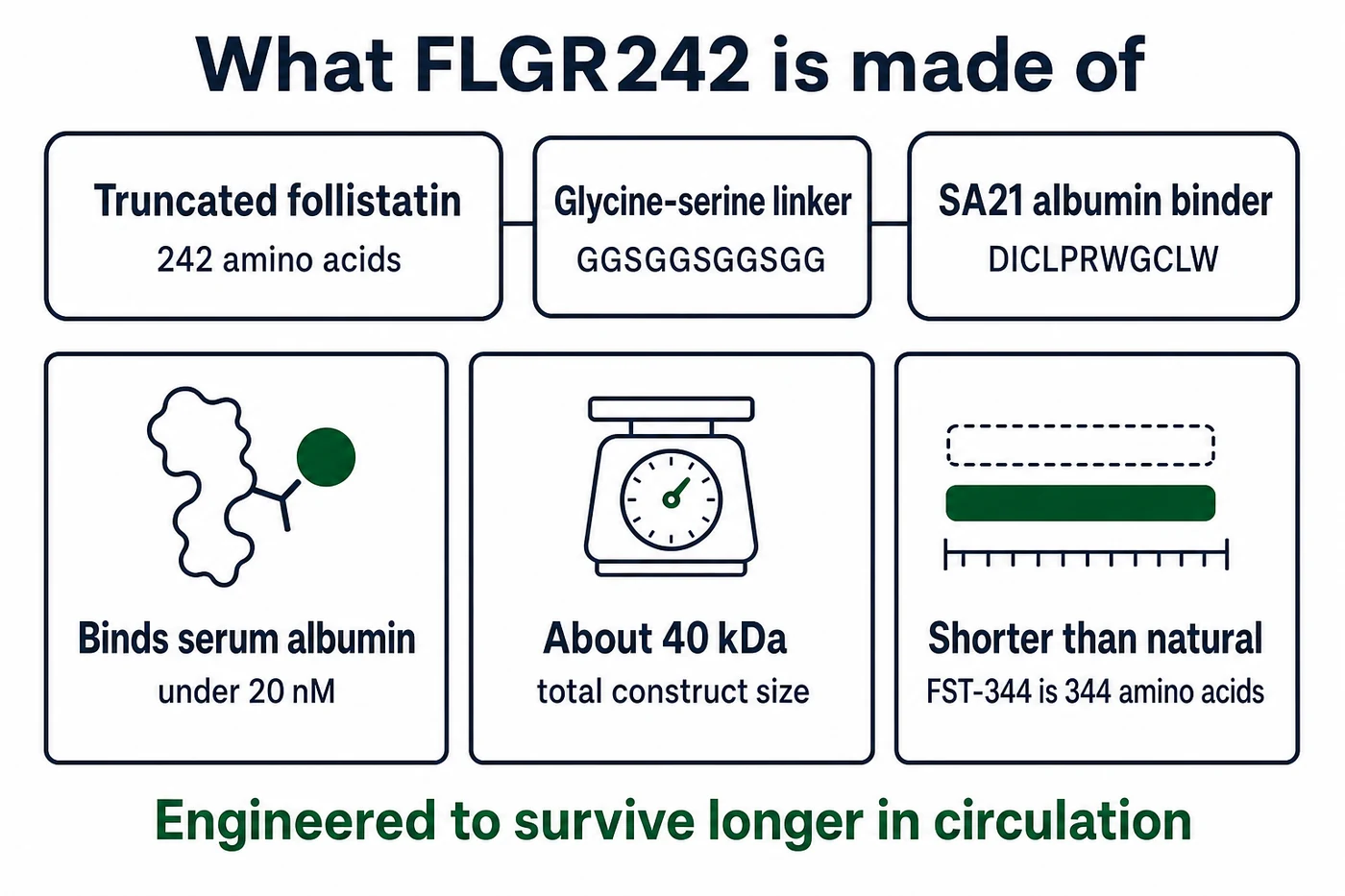
The name is a specification. Follistatin's common forms are named for their length in amino acids: FST-344 is the precursor, which the body processes into circulating FS-315 and tissue-bound FS-288. FLGR242 is a 242-amino-acid construct, so it is a follistatin that has had a substantial piece removed, then had something else added.
The something else is the interesting half. BioLongevity Labs, which sells it and which appears first in most searches for the name, describes it as follistatin "fused with an albumin-binding construct that uses a hydrophilic glycine-serine linker to achieve high-affinity binding to serum albumin (<20 nM Kd)", and publishes the sequence of that construct: GGSGGSGGSGGRLIEDICLPRWGCLWEDD. They give the whole molecule as roughly 40 kDa.
Albumin binding is a legitimate and widely used trick, not a fringe one. Albumin is the most abundant protein in plasma and it circulates for weeks, because the FcRn receptor rescues it from degradation and puts it back. Hitch a small drug to albumin and the drug inherits some of that protection. Approved medicines already use the idea. So the concept behind FLGR242 is sound engineering, and it is worth saying that plainly before saying anything else.
The reason anyone wants this is that follistatin protein does not last. This is not a rumour from a forum; it is the documented obstacle that has kept follistatin out of the clinic. A 2013 pharmacokinetic study from Eli Lilly's laboratories concluded that the intrinsic properties of native follistatin-315 "are poorly suited for acting as a parentally administered biotherapeutic with broad systemic effects." Injected follistatin clears too fast to do much, which is why community protocols for follistatin 344 call for daily or split injections. A version that survived for days rather than minutes would be a genuine improvement. That is the pitch, and the pitch is coherent.
What follows is the checking.
The patent is real, and it does not say what it is being used to say
FLGR242 is routinely described as patented, and it is. The patent is US 12,377,158 B1, "Enhanced peptide constructs for albumin binding", filed 6 January 2025, granted 5 August 2025, with a priority date of 5 July 2024. The named inventor is Michael Farber; the assignee is listed as an individual rather than a company.
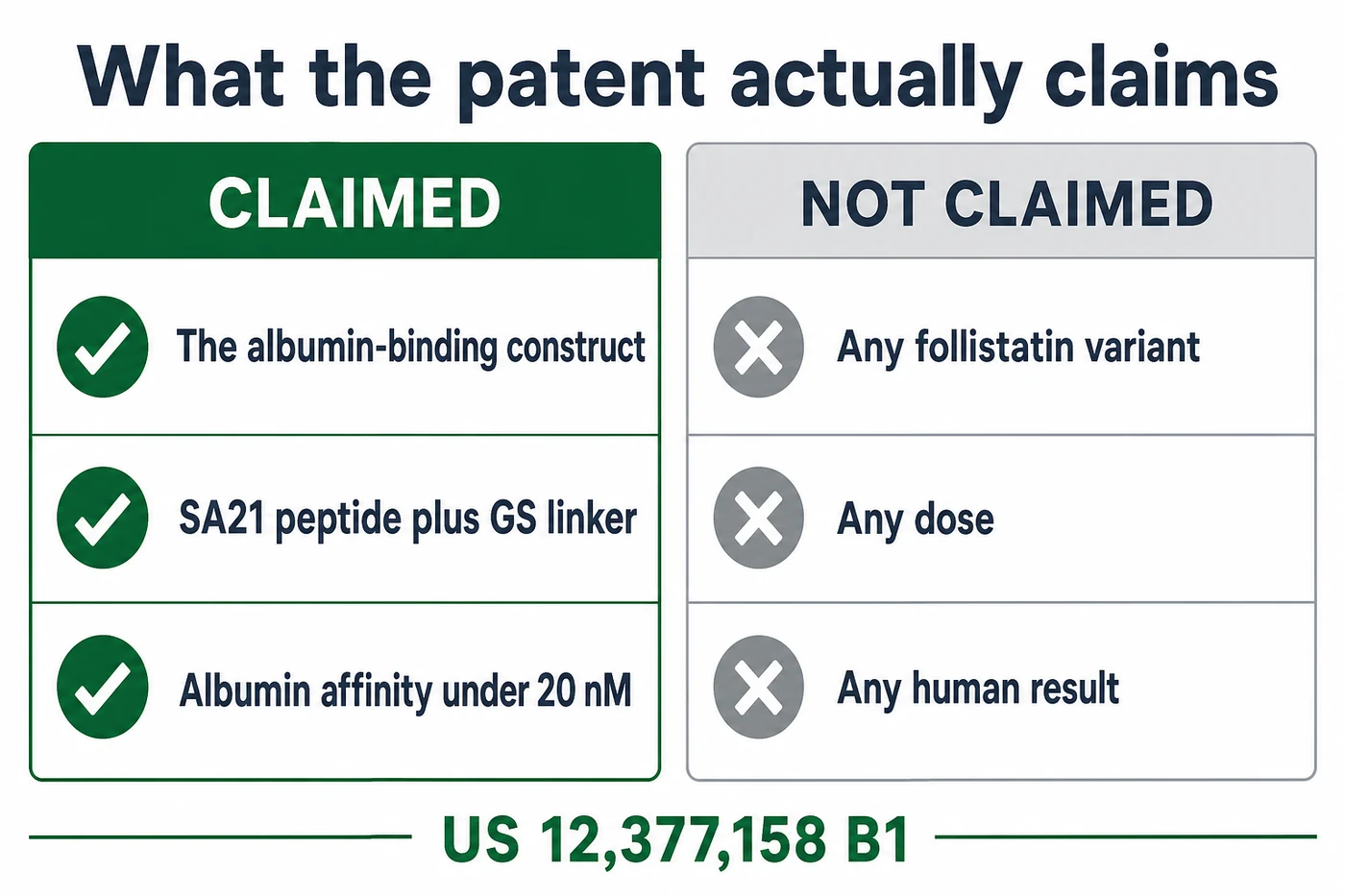
Read the claims and the picture sharpens considerably. There is exactly one independent claim, and it covers an albumin binding construct: an SA21 peptide with the core sequence DICLPRWGCLW attached to a glycine-serine linker GGSGGSGGSGG, binding human albumin below 20 nanomolar. Claims 2 through 5 depend on it.
The word follistatin does not appear in any claim in the patent. It appears twice in the entire document, both times in the description rather than the claims: once noting the technology can be used "with other proteins, such as follistatin used in anti-obesity treatments or treatments for sarcopenia", and once in a single sentence of result.
This distinction is not pedantry. A patent's claims are the part that was examined and granted. What this patent establishes is that a particular albumin-binding construct is novel and non-obvious. It does not establish that a follistatin carrying that construct is safe, effective, or well-characterised, because that was never what was being claimed. "Patented" here means the linker is patented.
It is also worth noting what a patent is not. A granted patent requires novelty, non-obviousness and utility. It does not require a clinical trial, a human volunteer, or evidence that the molecule does anything useful in a person. Patent offices do not run experiments.
Where the 19-day half-life number comes from
This is the claim most worth tracing, because it is the one doing the most persuasive work.
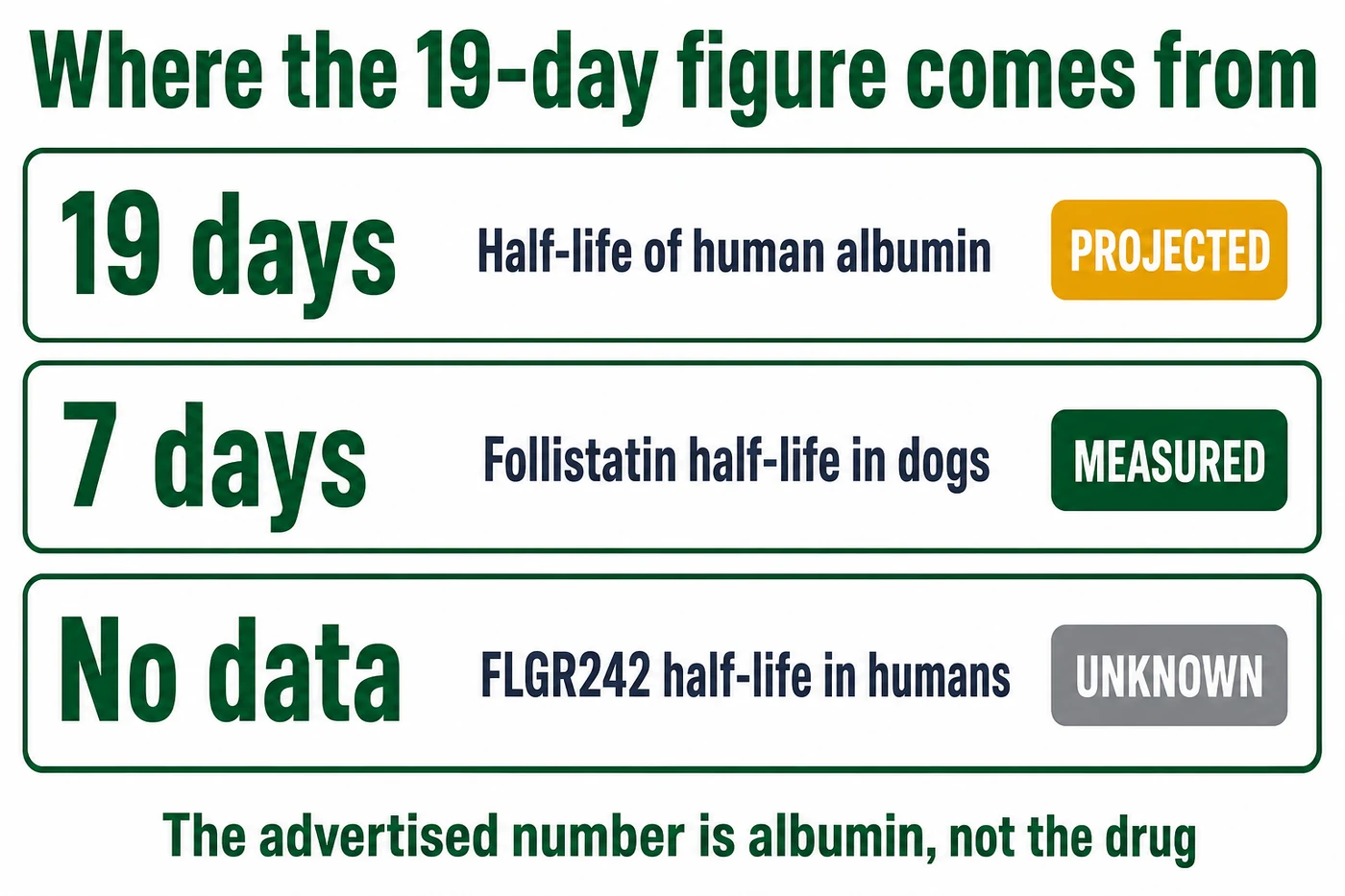
The patent contains this sentence: "Albumin, a key protein in plasma with a molecular mass of about 67 kDa and a half-life of 19 days in humans, plays a critical role in drug delivery." Nineteen days is albumin's half-life. It is a well-established number and it has nothing to do with follistatin.
Two sentences later the document asserts that active proteins bound to the construct "have a half life in the human body of approximately 19 days, as opposed to current pharmaceuticals where constructs using fatty acid binders typically have half lives of from 4 to 7 days."
So the 19 days being advertised for FLGR242 is albumin's own persistence, assumed to transfer intact to whatever is attached to it. That is a ceiling, not a measurement. No human pharmacokinetic study is reported anywhere in the document.
There is one in-vivo number, and it is more modest and more honest: "This results in a follistatin with a 7 day half life in canine." Seven days, in dogs. That number is genuinely encouraging, because it is a real measurement in a living animal and it is in the range you would hope for from an albumin-bound protein. It is evidence the approach works in principle. It is not a human figure, and it is not 19.
If you want a single sentence for how to read this compound: the engineering has one real animal result behind it, and the marketing quotes a number that is roughly three times larger and belongs to a different protein.
This problem has been solved before, and published
The most useful context for FLGR242 is that a pharmaceutical company already tried the same idea, wrote it up, and put the numbers in the open literature.
In 2013, researchers at Eli Lilly published a study in the Journal of Pharmacology and Experimental Therapeutics doing exactly what FLGR242 claims to do: fixing follistatin's pharmacokinetics so it could work as an injected drug. They made two changes. They fused follistatin-315 to an antibody Fc fragment, and they removed the protein's intrinsic heparan-sulfate-binding activity, which is what makes follistatin stick to tissue instead of circulating.
The result was roughly a hundredfold improvement in terminal half-life and about a sixteen-hundredfold improvement in exposure. Where native follistatin had done nothing useful when injected, the engineered version produced a dose-dependent effect given subcutaneously once a week in mouse models of muscle atrophy and degeneration.
Two things follow from this, and they cut in opposite directions.
The first is that FLGR242's design is not fanciful. Reducing heparin binding is precisely one of the two modifications Lilly made, and at least one vendor describes FLGR242 as having exactly that property. Extending half-life through a carrier rather than through an Fc is a different route to the same destination, and a reasonable one. Somebody thinking about this molecule was thinking about the right problem.
The second is that the Lilly work shows what the evidence looks like when this is done properly. Measured half-life. Measured exposure. Dose-response. Named disease models. Published where anyone can check it. That is the comparison FLGR242 has to be held against, and against it there is a patent about a linker and a sentence about a dog.
The activin problem, where vendors contradict each other
Here the sellers stop agreeing with one another, on a property that decides whether the molecule can work.
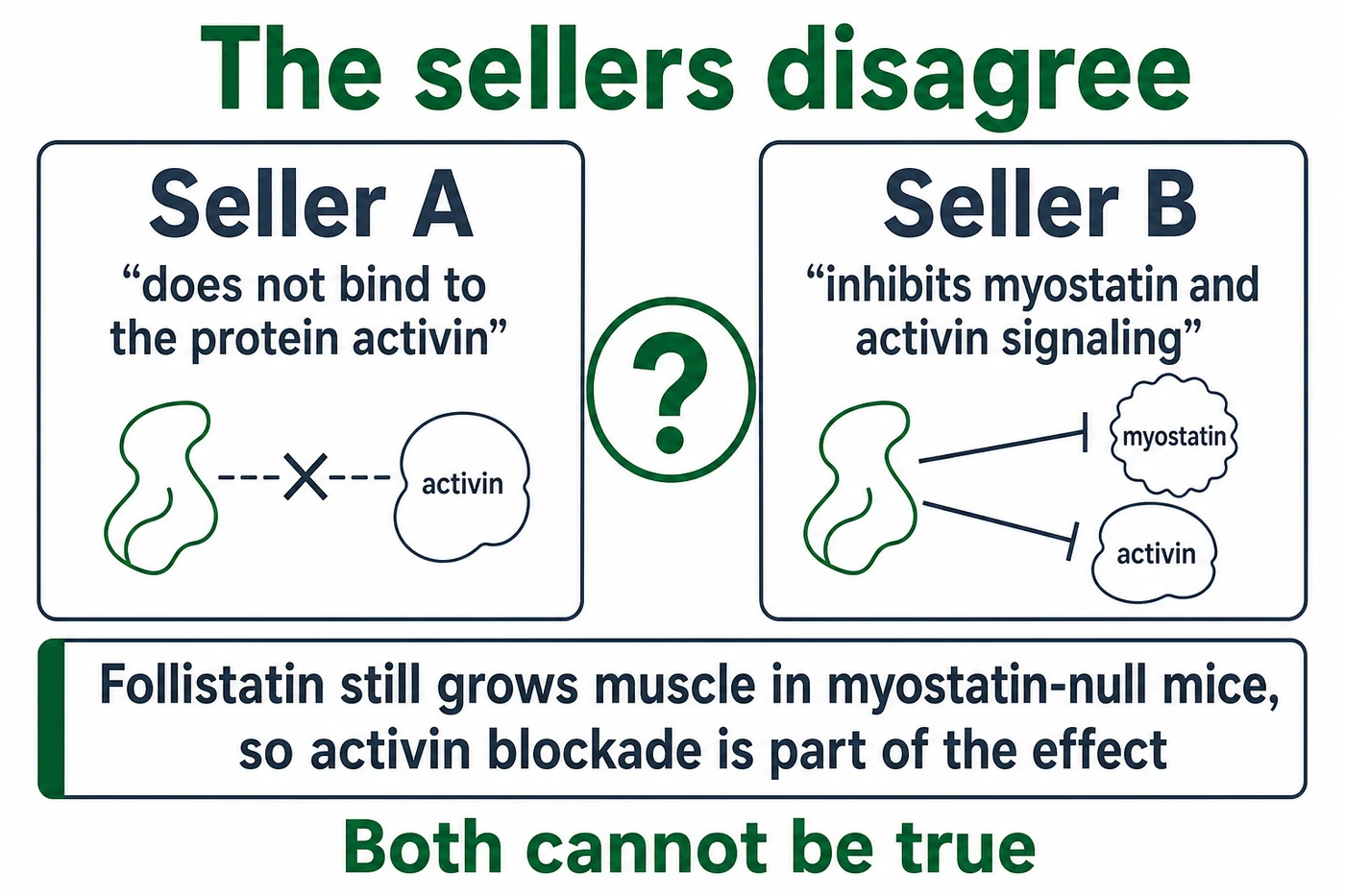
BioLongevity Labs states that FLGR242 "is a novel fragmented, modified version of Follistatin-344 (FST-344) that does not bind to the protein activin." WikiPeptidia, which ranks on the first page for the same term, says the opposite: that it "inhibits myostatin and activin signaling" and acts as "a potent endogenous inhibitor of TGF-β superfamily members."
Both cannot be true. And this is not a detail that only a biochemist would care about, because of what the mouse genetics show.
Follistatin's reputation rests on it being a spectacularly effective muscle builder in animals, and the reason it beats pure myostatin blockade is precisely that it is not selective. In 2007 Se-Jin Lee crossed a follistatin transgene into myostatin-null mice and got animals with about four times the muscle mass of wild type. If follistatin worked only by blocking myostatin, adding it to a mouse that already had no myostatin should have changed nothing. It quadrupled them, which means follistatin was blocking something else as well.
The 2010 follow-up identified a likely candidate. Mice with only one working copy of the follistatin gene had smaller muscles, more oxidative fibres, impaired repair after injury and reduced force, and that deficit was partially retained even in a myostatin-null background. The authors' conclusion was that follistatin normally inhibits other TGF-β family members in addition to myostatin, and they presented genetic evidence pointing at activin A as one of them.
Read those two papers together and the marketing claim inverts. A follistatin variant engineered specifically not to bind activin has, by the very literature used to sell it, given away part of the mechanism that made follistatin more impressive than the myostatin antibodies in the first place. Selectivity may buy a cleaner safety profile, which is a defensible design goal. It should not be sold as more potent.
The impressive numbers belong to a different intervention
This is the substitution at the centre of nearly every FLGR242 page, and once you see it you cannot unsee it.
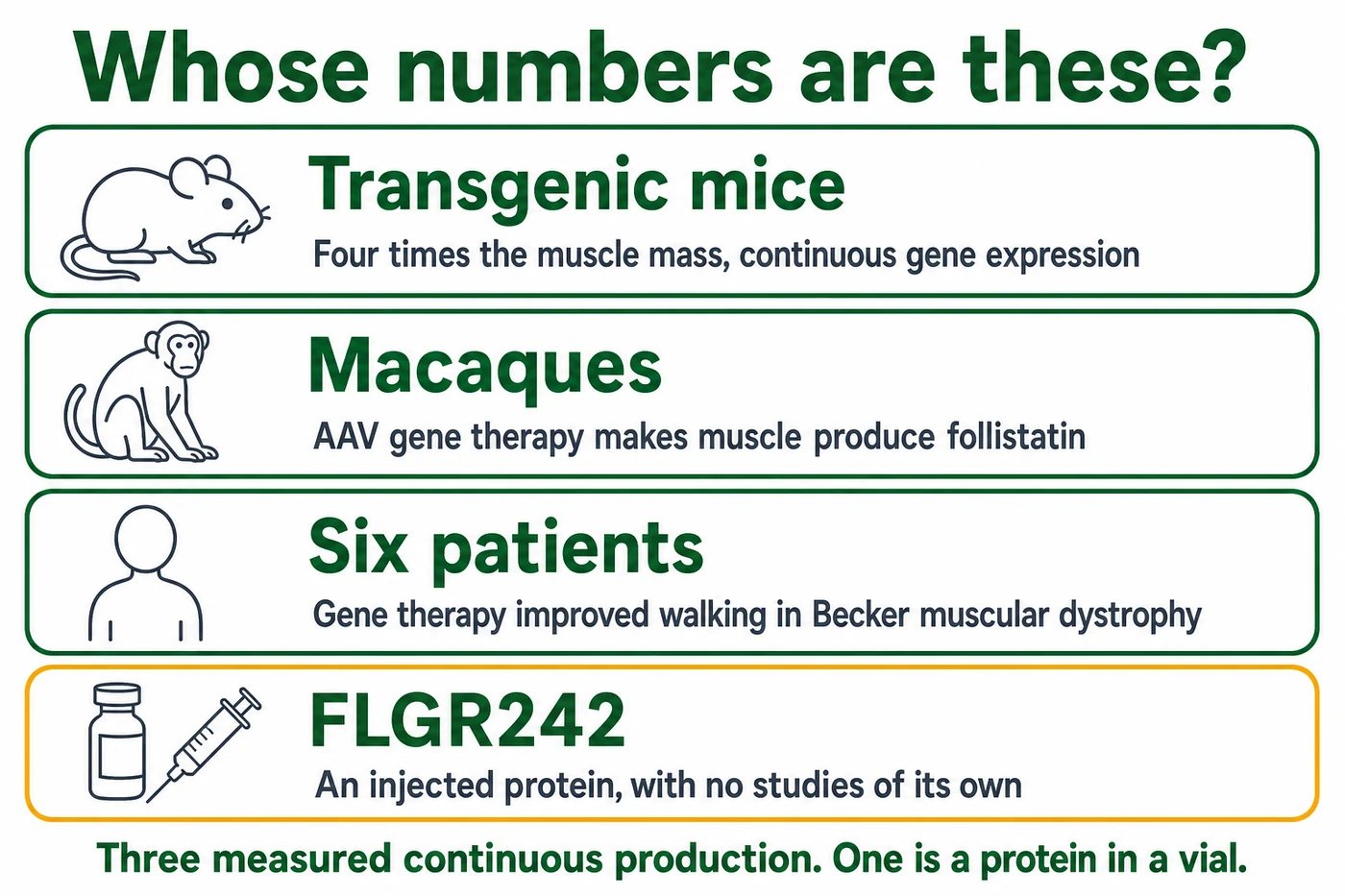
The figures that get quoted are real, from good laboratories, published in serious journals. They are also all measurements of something that is not an injected protein.
Transgenic mice. Lee and McPherron's 2001 work put a follistatin transgene under a muscle-specific promoter, so the muscle manufactured follistatin continuously from development onward. The 2007 quadrupling study did the same thing on a myostatin-null background. These animals were built to overexpress follistatin for life.
Primates. The 2009 study in Science Translational Medicine injected AAV1-FS344, an adeno-associated viral vector, into the quadriceps of cynomolgus macaques. The virus turns muscle cells into follistatin factories that keep producing for months or years after a single administration.
Humans. The one human efficacy result worth citing is the Becker muscular dystrophy work published in 2015, where follistatin gene therapy improved ambulation. It was gene therapy again, in six patients, in a specific disease.
Every one of those is continuous local production of follistatin. FLGR242 is a protein in a vial, injected. Even with albumin binding working perfectly and a 7-day half-life, that is a fundamentally different exposure profile from a gene that never switches off, and the muscle mass numbers do not carry across. Our page on follistatin gene therapy covers what that route actually achieved and where it stalled.
Two smaller things are worth flagging for anyone checking sources themselves. WikiPeptidia attributes the Becker muscular dystrophy result to "Mendell et al. (2015) in Science Translational Medicine"; the 2015 ambulation paper was in the Journal of Neuromuscular Diseases, while Science Translational Medicine published the 2009 primate study, whose first author was Kota. Citations that have drifted from their sources are a reasonable signal about how carefully the rest of a page was assembled.
What is actually being sold
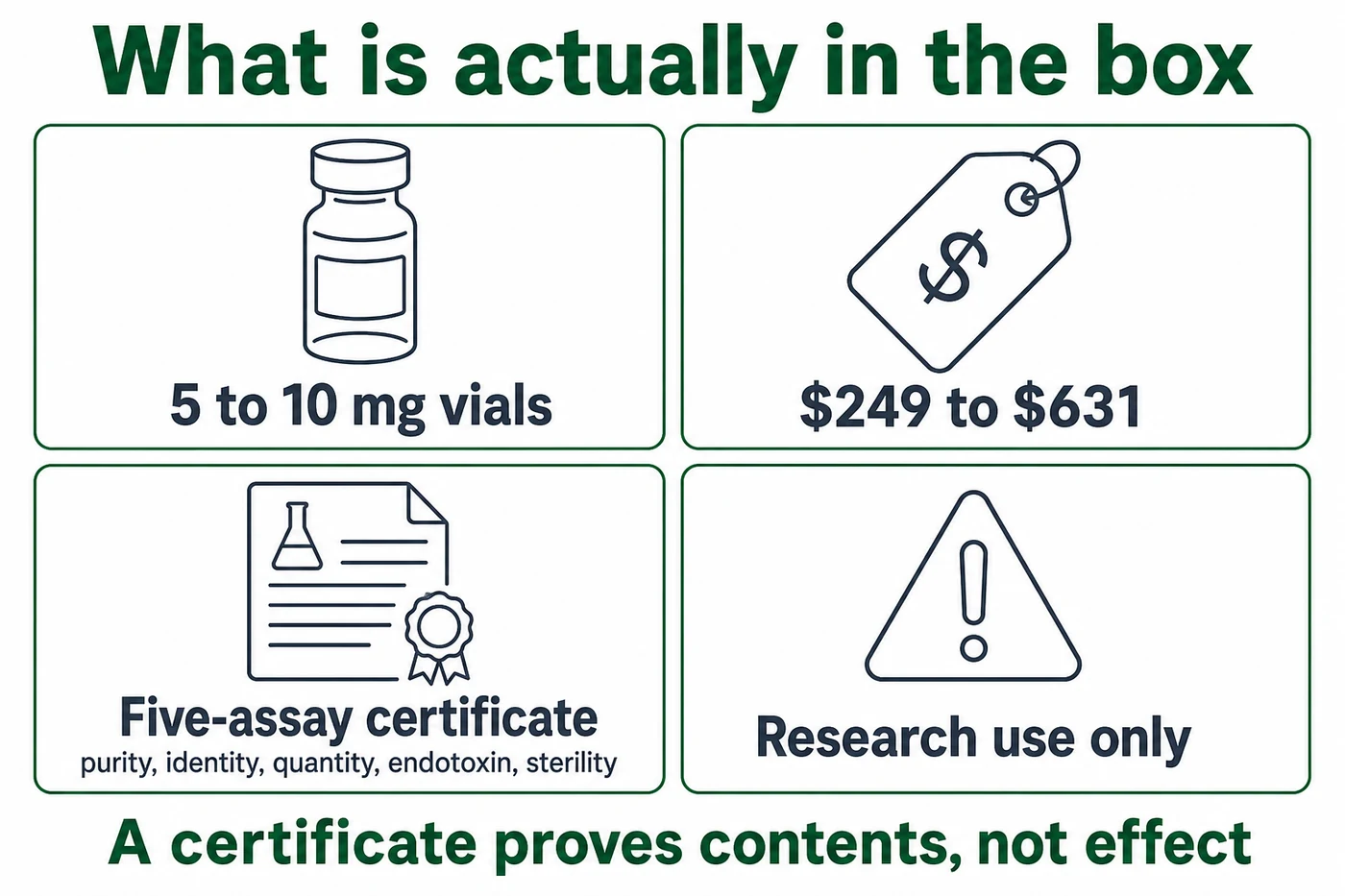
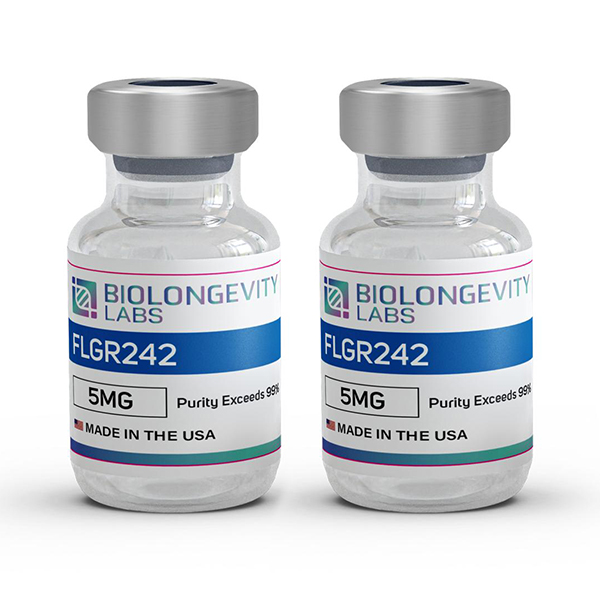
The products are consistent enough to describe. Vials run 5 mg or 10 mg. Peptagon lists two 10 mg vials at $631, with volume discounts, purity stated at 98% or better by HPLC and lots verified between 99.0% and 99.98%, tested by an outside laboratory for purity, identity, quantity, endotoxin and sterility. BioLongevity Labs lists 10 mg with prices from $499 down to $249.50 on sale, and much larger figures for bulk quantities.
Testing at that level is genuinely better than this market's average, and a five-assay certificate that includes endotoxin and sterility is worth more than a bare HPLC trace. What a certificate establishes is that the vial contains what the label says, at the stated purity, without contamination. That is a real and useful thing to know.
What it cannot tell you is whether the molecule does anything, at what dose, or with what consequences over months. No certificate carries that information for any compound, and for this one there is no other source to consult.
The vial sizes deserve one comment. Milligram quantities are large for a follistatin product when community dosing for recombinant FST-344 has historically been discussed in micrograms. A longer-acting molecule would reasonably be dosed differently, but there is no published protocol establishing what "differently" means, so the gap between vial and dose is being filled by guesswork.
Every one of these products is labelled for research use only and not for human or veterinary use. That label is what makes the sale lawful.
Safety, and the part nobody can fill in
There is no safety data on FLGR242. That sentence is the whole section, but it is worth unpacking what is missing rather than leaving it abstract.
From follistatin more broadly there are known concerns worth carrying over, and the side effects page covers them in more detail. Follistatin is not a muscle-specific protein. It has established roles in reproductive signalling, in the pituitary, and in inflammation, which is why blocking the whole activin arm has consequences beyond skeletal muscle. Activin and myostatin blockade as a drug class has repeatedly produced effects that trial programmes had to reckon with, which is a large part of why so few of these agents have reached approval.
Then there is the specific unknown that albumin binding introduces. The entire value proposition is that the molecule persists. If something goes wrong with a compound that clears fast, it clears. If something goes wrong with a compound engineered to circulate for days, it circulates. Longer exposure is the feature and the risk in the same sentence, and no dose-ranging study exists to tell anyone where the line falls.
Reproductive signalling deserves a specific note, because follistatin was originally characterised as a follicle-stimulating-hormone-suppressing protein. That is what it was named for.
How to think about it
Set the marketing aside and the honest summary is short.
FLGR242 is a plausible piece of engineering aimed at a real problem. Follistatin protein clears too fast to be practical, albumin binding is a legitimate way to fix that, the construct is patented, the published sequence matches the patent, and there is one animal result showing the approach extended a follistatin's half-life to about a week in dogs. That is a more substantial foundation than most compounds sold in this market ever have.
It is also true that no study of FLGR242 exists, that the half-life figure being advertised is albumin's rather than the drug's, that the patent's claims cover the linker and not the follistatin, that the sellers disagree about a defining property of the molecule, and that every muscle-growth number attached to it was measured in gene therapy or transgenic animals.
Both paragraphs are accurate at the same time. Anyone deciding what to do with that should at least be deciding with both in view, which is more than the rest of the first page of results offers. If you are working through the broader category, the pages on follistatin 315 vs 344 and on where follistatin is sold cover the ground around this one.
Sources
- Regulation of myostatin activity and muscle growth, Lee SJ and McPherron AC, PNAS, 2001. PMID 11459935.
- Quadrupling muscle mass in mice by targeting TGF-beta signaling pathways, Lee SJ, PLoS One, 2007. PMID 17726519.
- Follistatin gene delivery enhances muscle growth and strength in nonhuman primates, Kota J et al., Science Translational Medicine, 2009. PMID 20368179.
- Regulation of muscle mass by follistatin and activins, Lee SJ et al., Molecular Endocrinology, 2010. PMID 20810712.
- An engineered human follistatin variant: insights into the pharmacokinetic and pharmacodynamic relationships of a novel molecule with broad therapeutic potential, Datta-Mannan A et al., Journal of Pharmacology and Experimental Therapeutics, 2013. PMID 23249626.
- Follistatin Gene Therapy Improves Ambulation in Becker Muscular Dystrophy, Mendell JR et al., Journal of Neuromuscular Diseases, 2015. PMID 27858738.
- Enhanced peptide constructs for albumin binding, US Patent 12,377,158 B1, granted 5 August 2025.
Database checks were run on 28 August 2026: PubMed returns no records for FLGR242 or FLGR-242, and ClinicalTrials.gov returns no registered studies for either spelling. One housekeeping note on the 2009 primate paper: an erratum was published on 5 August 2026 (Science Translational Medicine 18:861, eaek4223). The correction notice sits behind a paywall and we have not read it, so we make no claim about what it changes.
Frequently asked questions
Is FLGR242 FDA approved? No. It is not approved for any indication, it is not in any registered clinical trial, and it is sold labelled for research use only, not for human use.
Is FLGR242 the same as follistatin 344? No. FST-344 is a natural follistatin isoform. FLGR242 is a 242-amino-acid construct derived from it and carrying an appended albumin-binding peptide, so it is shorter than natural follistatin and includes a synthetic segment that follistatin does not have.
What is the half-life of FLGR242? Nobody has published one. The 19-day figure in circulation is the half-life of human albumin, quoted in the patent as a projection for proteins bound to its construct. The only in-vivo measurement mentioned in that document is a 7-day half-life for a follistatin in dogs.
Is FLGR242 really patented? The albumin-binding construct is, under US 12,377,158 B1. Follistatin does not appear in any claim of that patent, so what is patented is the linker technology rather than FLGR242 as a follistatin drug. A patent also certifies novelty, not efficacy or safety.
Does FLGR242 build muscle? There is no study of FLGR242 in any species that answers this. The muscle-growth figures quoted in its marketing come from transgenic mice and from AAV follistatin gene therapy, both of which produce follistatin continuously rather than delivering an injected protein.
Does FLGR242 block activin? Its main seller says it does not. Another first-page source says it does. Because mouse genetics indicate activin contributes to follistatin's effect on muscle, this unresolved contradiction matters more than it might appear.
How much does FLGR242 cost? Listings run from about $249.50 for a 10 mg vial on sale up to $631 for two 10 mg vials, with bulk pricing above that.