Best peptides for muscle growth is a question with an uncomfortable answer. The compounds that reliably raise growth hormone are easy to name. The human evidence that this becomes meaningful lean mass in a trained adult is weak.
Key takeaways
- The GH secretagogues, CJC-1295 and ipamorelin, are the only category here with published human pharmacology. They raise growth hormone and IGF-1, which is a measurement rather than an outcome.
- The best human data on this axis is unflattering. In a 12-month randomised trial of the oral ghrelin mimetic MK-677, fat-free mass rose 1.1 kg against a 0.5 kg loss on placebo, and the authors reported that the gain did not translate into changes in strength or function.
- No controlled trial has measured hypertrophy or one-rep max in trained adults on any of these peptides. Every ranking, this one included, ranks pharmacology rather than results.
- BPC-157, TB-500 and IGF-1 LR3 have no published randomised human evidence for muscle growth. Follistatin products are a separate discussion, and the vendor linked below does not stock follistatin.
- All of it is sold as research material, not as a supplement, and growth hormone, its secretagogues and GHRH analogues are banned at all times in tested sport.
The vendor we point lifters to
CJC-1295 and ipamorelin from Ascension Peptides
Independently assayed material, dispatched from the US. Both drop by half with the code below.
Buying 3, 5 or 10 of either takes 3%, 5% or 10% off the list price. Free shipping starts at $250.
- Two independent lab reports per batch
- Free delivery above $250
- Same-day dispatch on orders before 2pm CST
Research material, laboratory use only, not for human consumption. Affiliate links: we may earn a commission at no extra cost to you. Pricing verified August 19, 2026.
Best peptides for muscle growth, ranked by evidence
The ranking below is ordered by strength of published human evidence, which is not the same as ordering by popularity.
| Compound | What it does | Best human evidence | Honest verdict |
|---|---|---|---|
| CJC-1295 | GHRH analogue, raises GH pulse amplitude | Phase 1 pharmacology in healthy adults | Best-characterised of the group. No hypertrophy trial |
| Ipamorelin | Selective ghrelin receptor agonist, raises GH | Phase 2 in postoperative ileus, not muscle | Sound mechanism, no muscle outcome data |
| MK-677 | Oral ghrelin mimetic, not a peptide | 12-month randomised trial in older adults | Lean mass up, strength and function unchanged |
| BPC-157 and TB-500 | Claimed tissue repair | No randomised human trials | Not muscle-growth agents |
| IGF-1 LR3 | Direct IGF-1 receptor agonism | No hypertrophy trials in healthy adults | Highest theoretical risk, least data |
| Follistatin peptides | Myostatin sequestration | Gene therapy work, not injectable peptide | Mechanism strong, product evidence weak |
What CJC-1295 and ipamorelin actually do
They work on two different receptors, which is why they are sold together.
CJC-1295 is an analogue of growth hormone releasing hormone, acting on the pituitary through the GHRH receptor to increase the size of natural GH pulses. Teichman and colleagues in the Journal of Clinical Endocrinology and Metabolism found that a single injection produced dose-dependent increases in mean plasma GH of 2 to 10 fold lasting six days or more, and increases in IGF-1 of 1.5 to 3 fold lasting nine to eleven days, with an estimated half-life of 5.8 to 8.1 days.
One detail gets skipped constantly. That study tested CJC-1295 with DAC, the version carrying a drug affinity complex that binds albumin and gives it that long half-life. The product sold as CJC-1295 no DAC is modified GRF(1-29), the same GHRH fragment without the anchor, and it is short-acting by design. The multi-day figures above do not describe it. That is not a reason to avoid it, but it is a reason not to cite that paper as if it did.
Ipamorelin reaches GH release through the ghrelin receptor instead. Raun and colleagues described it in 1998 as the first selective growth hormone secretagogue, releasing GH without the cortisol and prolactin rise that limited earlier compounds such as GHRP-6. Its furthest human development was not in muscle at all: a phase 2 proof-of-concept study in postoperative ileus.
Combining a GHRH analogue with a ghrelin receptor agonist is expected to produce a larger GH pulse than either alone, because the receptors are separate. That is the rationale for the pairing, and it is a rationale about hormone concentrations rather than a demonstrated effect on muscle.
Why more growth hormone is not the same as more muscle
This is the section most rankings leave out, and it is the one that decides the question.
The largest relevant synthesis is Liu and colleagues in Annals of Internal Medicine, pooling randomised trials of growth hormone itself in healthy older adults. Lean body mass rose by 2.1 kg and fat mass fell by 2.1 kg, with body weight essentially unchanged. Participants on GH were significantly more likely to experience soft tissue swelling, joint pain, carpal tunnel syndrome and gynaecomastia. The conclusion was that GH could not be recommended as an anti-aging therapy.
Note what that lean mass figure includes. Much of the early change on GH is water, because GH causes fluid retention, and a scan reporting lean mass does not separate contractile tissue from extracellular fluid.
The cleanest test of the secretagogue route is Nass and colleagues, a two-year double-blind randomised trial of MK-677 in adults aged 60 to 81. GH and IGF-1 rose into the young-adult range and fat-free mass increased by 1.1 kg against a 0.5 kg decline on placebo. Then the sentence that matters: increased fat-free mass did not result in changes in strength or function. Fasting glucose rose, insulin sensitivity fell, and body weight climbed 2.7 kg against 0.8 kg on placebo.
That is the ceiling of what is documented for this mechanism in humans, in a population with far more room to gain than a trained lifter has.
The peptides with no muscle evidence at all
BPC-157 and TB-500 dominate peptide forums on tendon and connective tissue repair claims. Neither has a published randomised controlled human trial behind those claims, and neither is a hypertrophy agent even in theory. IGF-1 LR3 acts further downstream and carries the most obvious theoretical risk profile here, with no hypertrophy trials to weigh against it.
Follistatin products deserve a note because they are the ones that would matter most if they worked. Follistatin binds and neutralises myostatin, the protein that restrains muscle growth. The dramatic results in that field come from gene therapy in animals, not from injecting a peptide, and we set out the gap in follistatin peptide. The vendor linked in this article does not sell follistatin, which is worth stating plainly.
The legal and testing position
None of these are supplements. They are sold as research chemicals for laboratory use, not for human consumption, and no regulator has approved any of them for muscle growth. That labelling describes their status accurately.
If you compete in a tested sport, this is settled: growth hormone, GH secretagogues and GHRH analogues sit in class S2 of the WADA prohibited list, banned at all times. The FDA has also published a consumer warning on bodybuilding products.
What actually moves lean mass
Everything above competes with interventions that have real trial evidence, and loses.
Resistance training is the stimulus and nothing here replaces it. Protein is the second lever, and the effect size is known: the Morton meta-analysis of 49 studies found protein supplementation added 0.30 kg of fat-free mass and 2.49 kg of one-rep max during prolonged resistance training, with no further benefit above roughly 1.6 g per kg of bodyweight per day. Modest, real, cheap, with a defined plateau, which is more than any peptide here can claim. Detail in protein intake and myostatin, resistance training and myostatin and best supplements for muscle growth.
Sleep belongs in the same list, partly because the largest natural GH pulses occur during slow-wave sleep, which makes chronic short sleep an odd thing to fix with an injection. See sleep and myostatin.
Where myostatin sits in all this
Myostatin is the brake, and releasing it is the mechanism that would genuinely change what a trained adult can build. That is why the industry spent two decades on it, and the results have been sobering: bimagrumab shifted toward body composition and obesity, and the dystrophy programmes produced biology without function, covered in myostatin inhibitors in Duchenne. The supplement market that borrows the word is reviewed in myostatin inhibitor supplements and natural myostatin inhibitors.
If you want the single-compound version of this question rather than the survey, we answer it in best peptide for muscle growth.
What the material costs
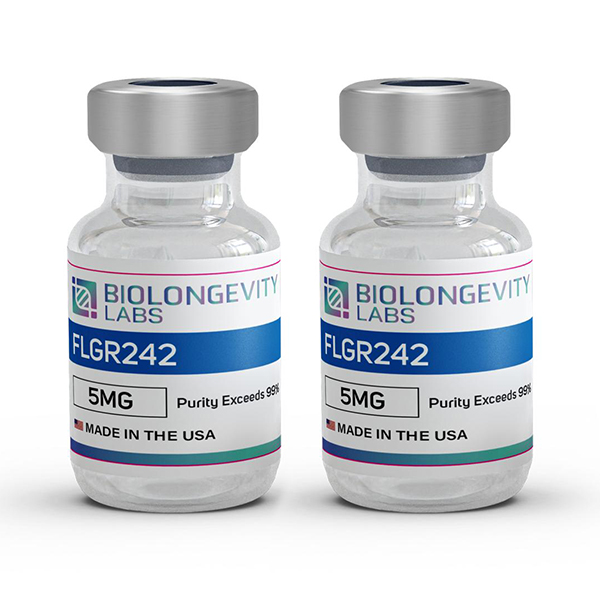
For readers who have weighed the above and still want to source it, the arithmetic without the marketing: CJC-1295 no DAC, 10 mg, lists at $80.00 and falls to $40.00 with the code PEPTIDEDECK, which is $4.00 per milligram. Ipamorelin, 5 mg, lists at $50.00 and falls to $25.00, which is $5.00 per milligram. Buying 3, 5 or 10 vials takes 3%, 5% or 10% off list, and nothing documented says the code stacks with those tiers.
Frequently asked questions
Which peptide has the strongest human evidence for building muscle?
None of them, because that trial has not been run in trained adults. CJC-1295 has the best-characterised human pharmacology, showing it raises GH and IGF-1. The closest thing to an outcome study on this mechanism is the MK-677 trial, where fat-free mass rose but strength and function did not.
Why are CJC-1295 and ipamorelin usually sold together?
They act on different receptors: CJC-1295 through the GHRH receptor, ipamorelin at the ghrelin receptor. Using both is expected to produce a larger growth hormone pulse than either alone. That is a mechanistic rationale about hormone levels, and it has not been tested as a hypertrophy intervention.
Is the study showing CJC-1295 raises IGF-1 for over a week relevant to the no-DAC version?
Not directly. That study used CJC-1295 with DAC, the albumin-binding version with an estimated half-life of 5.8 to 8.1 days. The product sold as CJC-1295 no DAC is modified GRF(1-29), the same fragment without that anchor, and short-acting. The published duration figures belong to a different molecule.
What about BPC-157 and TB-500?
Both are marketed for tissue repair rather than hypertrophy, and neither has a published randomised controlled human trial behind those claims. They do not belong on a muscle-growth list at all.
Will these show up on a drug test?
Growth hormone, GH secretagogues and GHRH analogues sit in class S2 of the WADA prohibited list and are banned at all times, in and out of competition. Anyone in a tested sport should treat the category as off limits.
This article is for educational purposes only and is not medical advice. The compounds discussed are unapproved for muscle growth in any market, and material sold by research suppliers is labelled for laboratory use only and not for human consumption. Speak with a qualified healthcare professional before making any decision involving peptides, injections or off-label compounds.