Peptides for dogs is a search a lot of lifters run for the first time on a weeknight, after watching an eleven year old shepherd think about the stairs before taking them. You already keep a shelf of research vials for your own rehab, and the dog has a shoulder that never came back right from last winter, or a working dog is starting to pay for the miles. The distance between those two facts feels short. It is not, and this page is written by people who understand the impulse rather than people who think it is stupid.
Key takeaways
- Peptide medicines for dogs exist and are approved. Merck Animal Health describes Vetsulin, a porcine insulin zinc suspension, as the first FDA-approved insulin for use in dogs and cats with diabetes, and insulin is a peptide.
- What is not approved is anything on a research-peptide website. Those vials are labelled for laboratory research only, not for human or animal consumption.
- Even the tolerated compounding route runs through a veterinarian and a State-licensed pharmacy, so an owner buying a vial online is not on that pathway at all.
- The canine evidence base for research peptides is close to empty. Hundreds of BPC 157 records sit on PubMed and almost none involve dogs.
- This page gives no dose, schedule or injection technique for any peptide in a dog, on purpose. A dog cannot tell you the first one was a mistake.
Peptides for dogs: three routes a vial can travel, and only one is approved
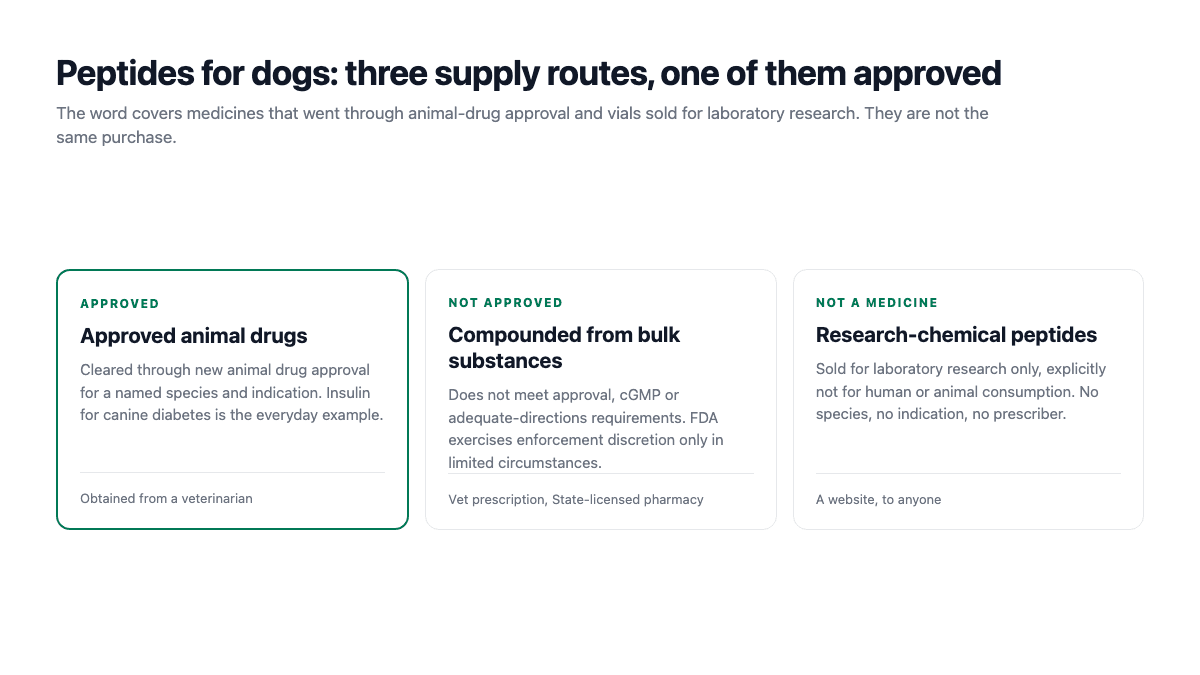
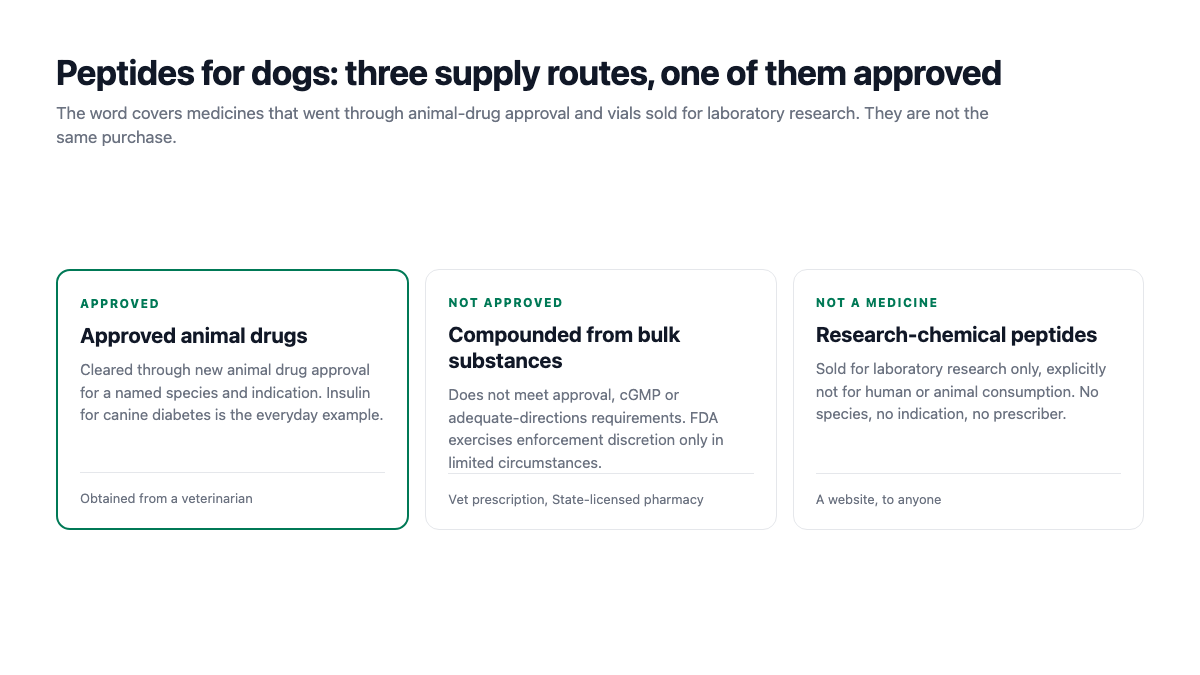
Most arguments here fall apart because they treat one word as one thing. There are three separate routes by which something called a peptide reaches an animal, and they carry completely different obligations.
| Route | What it actually is | Where it comes from |
|---|---|---|
| Approved animal drugs | Went through new animal drug approval, with a reviewed label, manufacturing requirements and adverse event reporting behind it | A veterinarian, or a pharmacy filling a prescription |
| Compounded from bulk drug substances | Not approved. FDA exercises enforcement discretion in limited circumstances | A veterinarian's prescription, filled by a State-licensed pharmacy |
| Research-chemical peptides | Sold under a label saying laboratory research only, not for human or animal consumption | A website, to anyone with a card |
The lazy version of this page says peptides are not approved for dogs and sends you to a vet. Half of that is wrong, and the correction shows where the risk sits, which is in the third row rather than in the word.
Some peptide medicines for dogs are approved, and the list is not short
Insulin is a peptide hormone. Diabetic dogs have been treated with it for decades, and none of that is experimental or grey market. Merck Animal Health describes Vetsulin, a porcine insulin zinc suspension, as "the first FDA-approved insulin for use in dogs and cats with diabetes". Anyone telling you peptides in dogs are inherently unapproved territory has not looked in the fridge of a veterinary practice.
The more recent example is not a peptide, and it belongs here anyway, because it shows what a real approval looks like for exactly the dog this article is about. On May 5, 2023, FDA approved Librela (bedinvetmab injection) "for the control of pain associated with osteoarthritis (OA) in dogs", and noted it "is the first monoclonal antibody (mAb) the FDA has approved for use in dogs". Osteoarthritis, in FDA's words, "is the most common form of arthritis in dogs". It is given by a veterinarian.
That approval is not a fairy tale ending, and pretending otherwise would be the same failure pointing the other way. FDA's Center for Veterinary Medicine later issued a Dear Veterinarian Letter about adverse events reported in dogs treated with Librela, including ataxia, seizures and other neurologic signs, with death reported as an outcome in some cases.
Sit with how you came to know that. An approved product has a sponsor, a label, a lot number, a vet who noticed, and a channel that report travelled down until a federal agency wrote to every practice in the country. A research vial has none of those, so nothing that happens to your dog gets counted anywhere. That is the difference between a problem that gets found and one that stays in your house.
The compounding route exists, and an owner buying online is not on it
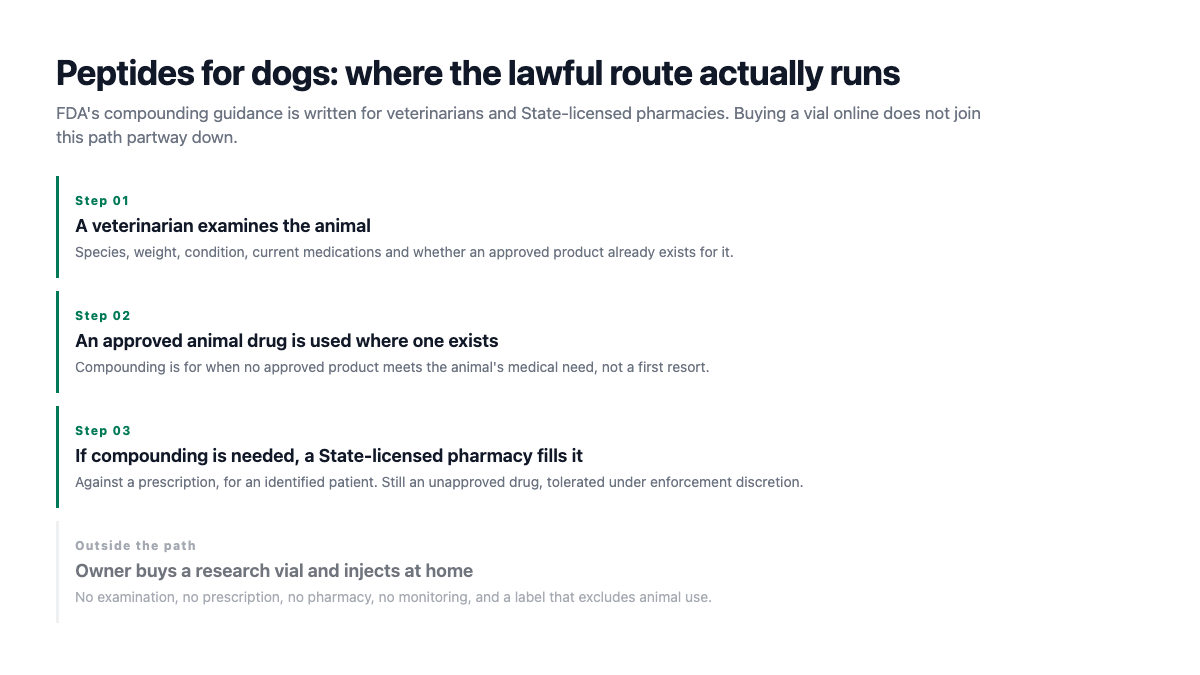
Veterinary compounding is real, sometimes necessary, and not the same thing as approval. FDA's position is set out in CVM Guidance for Industry #256, Compounding Animal Drugs from Bulk Drug Substances, docket FDA-2018-D-4533, from the Center for Veterinary Medicine:
"Animal drugs that are compounded from bulk drug substances do not meet the FD&C Act's new animal drug approval, cGMP, or adequate directions for use requirements. However, FDA has generally exercised enforcement discretion with regard to animal drug compounding from bulk drug substances under certain circumstances."
Two things follow, and both land on the owner rather than the pharmacist.
The first is who the document is talking to. It states that it "is intended for veterinarians, State-licensed pharmacies, and Federal facilities" compounding from bulk substances under limited circumstances. The tolerated route runs through a professional who examined your dog and a pharmacy that holds a licence. An owner buying from a research-peptide storefront has not entered that lane and bent the rules inside it. They are standing outside the building.
The second is what enforcement discretion is. FDA has generally chosen not to act in certain circumstances, based on its current understanding of the risks. That is not approval, it confers no safety, and it can change. Reading it as permission is reading a decision not to prosecute as a certificate of quality.
What the canine evidence base actually contains
BPC-157 is the compound raised most often here, usually for the reason you would expect. A lifter used it for a joint, felt better, and looked at the dog.
Here is the shape of the literature. A PubMed search for BPC 157, run for this article on August 25, 2026, returns 227 records. Narrowing it to records mentioning dogs returns two, and one of those is a rat study on serotonin syndrome that matched incidentally. The other is a 2022 paper in Frontiers in Pharmacology on the pharmacokinetics, distribution, metabolism and excretion of the compound in rats and dogs.
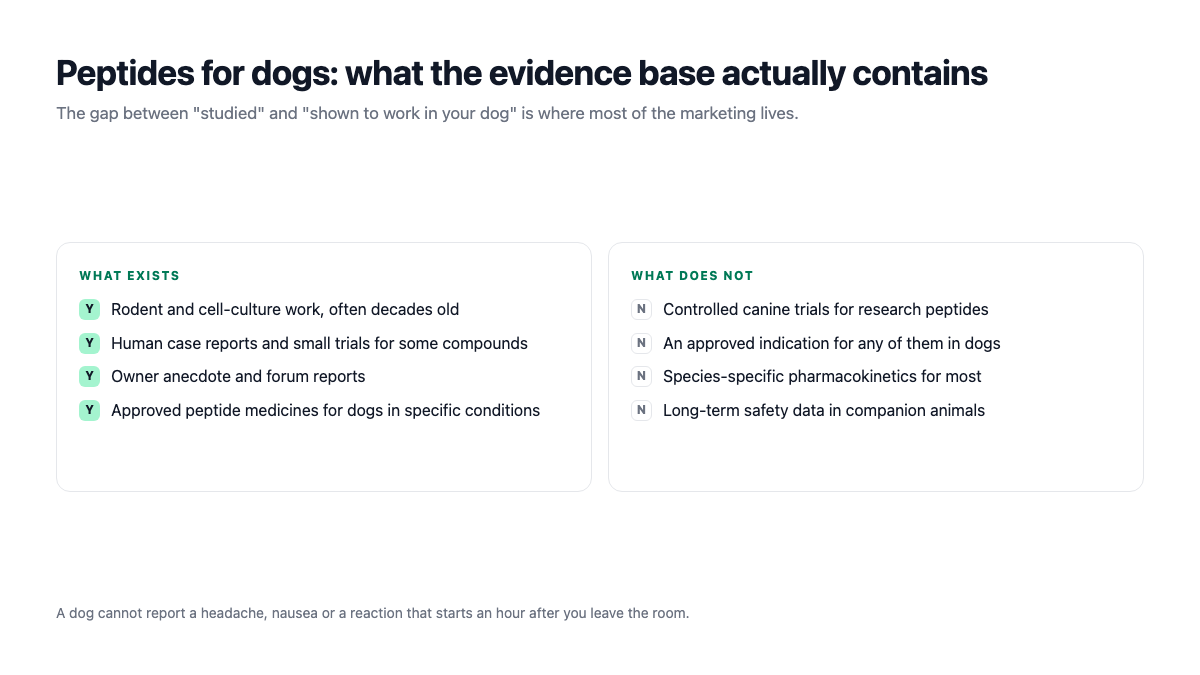
That paper is real work, and it is worth being precise about what kind. Characterising how a molecule is absorbed and cleared in a laboratory species is what you do before finding out whether it helps anybody. It is not a trial of whether a dog with a torn shoulder or an arthritic hip does better, and no such trial exists to point at. There is no approved indication and no controlled canine outcome data.
The bridge people build across that gap is their own experience, and it is the weakest part of the structure. A dog is a different species with different pharmacokinetics, a very different body size, and no vocabulary. Rodent work plus your own subjective response is not canine evidence, however sincerely it is reported.
If you want the compound by compound version, PeptideDeck's breakdown of the peptides discussed for dogs covers more of the individual claims and who makes them. It carries dosing material this page deliberately does not reproduce, and the next two sections are part of why.
Myostatin in dogs is real, and nobody injected anything
This site is about myostatin, so it is worth saying where canine muscle biology genuinely touches this subject. It is genetic, not pharmaceutical.
A 2007 paper in PLoS Genetics reported a mutation in the myostatin gene that increases muscle mass and enhances racing performance in heterozygote dogs, working in whippets. Dogs carrying one copy of the variant raced faster than the population around them. Dogs carrying two copies are the heavily muscled animals breeders call bully whippets.
Read what it is, though. It describes an inherited variant present from conception, in an animal whose skeleton, tendons and heart developed around it. It is not evidence that lowering myostatin in an adult dog with an injection produces a faster or more durable dog, and no myostatin inhibitor is approved for dogs. That gap between a lifelong genetic state and a drug given to an adult body has swallowed most of the human work too, which is the subject of myostatin and aging.
Sterility and endotoxin matter more here, not less
Readers of this site judge a vendor by the lot certificate rather than the marketing on the page. Good habit, and it does not transfer the way people want it to.
Where a certificate covers bacterial endotoxin and sterility, it establishes something specific and real about the lot that was tested. What it does not do is make a compound appropriate for a dog. It does not establish a safe exposure in a species nobody studied, it says nothing about an indication that does not exist, and it does not survive whatever happened to the vial after reconstitution on a kitchen counter. A certificate answers a manufacturing question, never a clinical one, and the way we grade a BPC-157 supplier's paperwork is written around that boundary.
Three things about a dog make that question weigh more rather than less. The animal is smaller, so the margin for a contaminated or mislabelled vial is narrower. It cannot report an early reaction, so the first sign is often behavioural and late. And nobody is monitoring, because the person injecting is the owner. Owners sometimes assume a doctor could prescribe the human version and reason from there. No such prescription exists, for reasons covered in the piece on BPC-157 without a prescription.
What is actually worth doing for a working dog or an old dog
The honest ending is not a shrug. Osteoarthritis pain in dogs has approved treatment, and a dog slowing down at ten has a list of causes worth separating before anything is injected into it. Stiffness, weight change and a drop in work capacity are signs rather than a diagnosis.
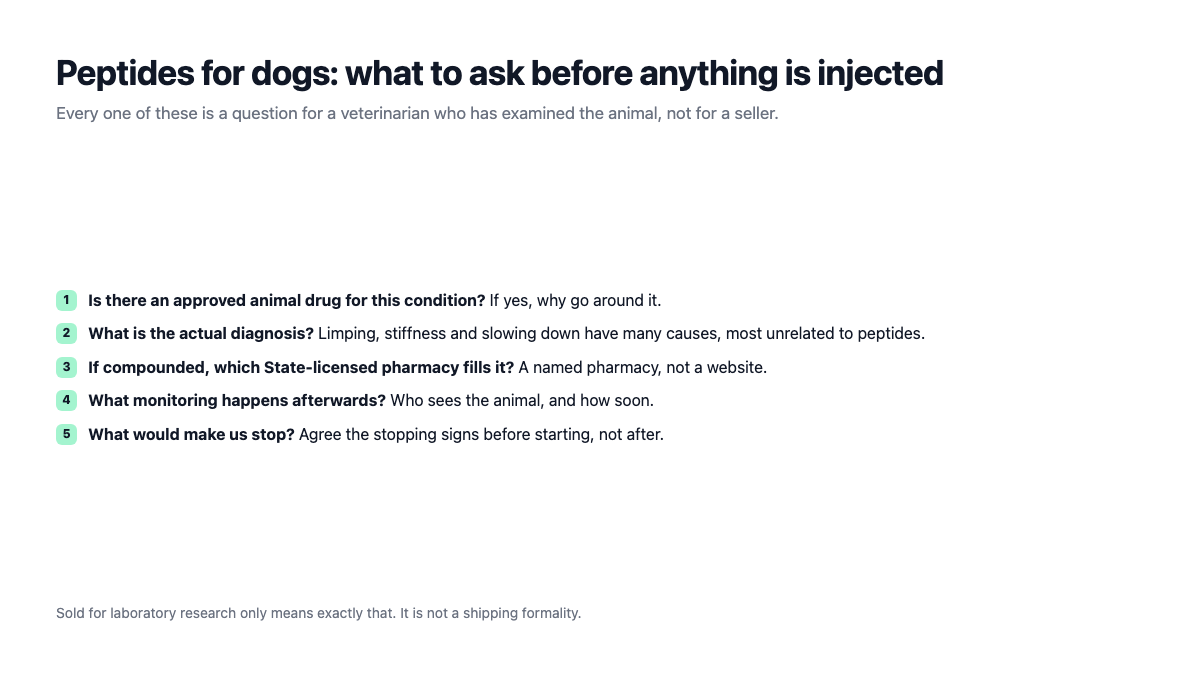
Take the impulse that brought you here into the consulting room instead of leaving it at the door. These are the questions worth asking:
- What is actually causing this, and what would it take to tell the likely causes apart?
- Is there an approved veterinary product for this diagnosis, and what does its label say about dogs like mine?
- If you are suggesting something compounded, which pharmacy is it, and why will an approved product not do?
- What are we monitoring after we start, and what would make us stop?
- If something goes wrong, how does it get reported?
The last one is not a formality. It is the whole difference between the first row of that table and the third.
Frequently asked questions
Are peptides safe for dogs?
The question needs splitting, because the word covers unrelated things. Approved peptide medicines such as insulin have an established safety profile in dogs, monitored after approval. Research peptides sold online have no approved use in animals, no canine safety data worth the name, and no route by which a problem in your dog would ever be recorded.
Can I give my dog the BPC-157 I use myself?
No, and this article will not tell you how much even as an illustration. There is no approved use in dogs, no controlled canine outcome evidence, and no way to reason backwards from human use to another species. A dog cannot tell you the first injection felt wrong, which is exactly why no numbers appear here.
Is there any peptide a vet can legally prescribe for my dog?
Yes. Approved peptide medicines exist in veterinary practice, insulin for canine diabetes being the everyday example. Beyond that list, a veterinarian can in some circumstances prescribe a compounded preparation filled by a State-licensed pharmacy, which FDA treats as unapproved but has generally exercised enforcement discretion over. That decision belongs to a vet who has examined your dog.
Does a certificate of analysis make a research peptide safe for a dog?
It does not. A certificate reporting identity, purity, endotoxin and sterility describes the lot that was tested and says nothing about whether the compound belongs in an animal. There is no approved indication for it to support, no canine exposure data behind it, and no coverage of what happens to the vial at home.
My dog is old and stiff. What actually helps?
Start with a diagnosis rather than a compound. Osteoarthritis is common in ageing dogs and has approved treatment, and weight, dental disease, endocrine problems and orthopaedic injury all produce a dog that slows down. Body condition, controlled exercise and monitored pain control will do more for a working or ageing dog than anything in a research vial.
Sources
- CVM GFI #256, Compounding Animal Drugs from Bulk Drug Substances, FDA
- Animal Drug Compounding, FDA
- Vetsulin, Merck Animal Health
- FDA Approves First Monoclonal Antibody for Dogs with Osteoarthritis Pain
- Dear Veterinarian Letter on adverse events with Librela, FDA
- BPC 157 pharmacokinetics in rats and dogs, Frontiers in Pharmacology 2022
- Myostatin mutation and racing performance in whippets, PLoS Genetics 2007
- Animal Drugs @ FDA, approved animal drug products
- Reporting animal drug side effects, FDA
This article is for educational purposes only and is not veterinary or medical advice. No dose, schedule or administration method is given here for any peptide in an animal, and none should be inferred. Research peptides are sold for laboratory use only and are not approved for use in dogs or any other animal. Decisions about treating a dog belong to a licensed veterinarian who has examined that animal. If your dog is unwell, contact a veterinary practice rather than a supplier.