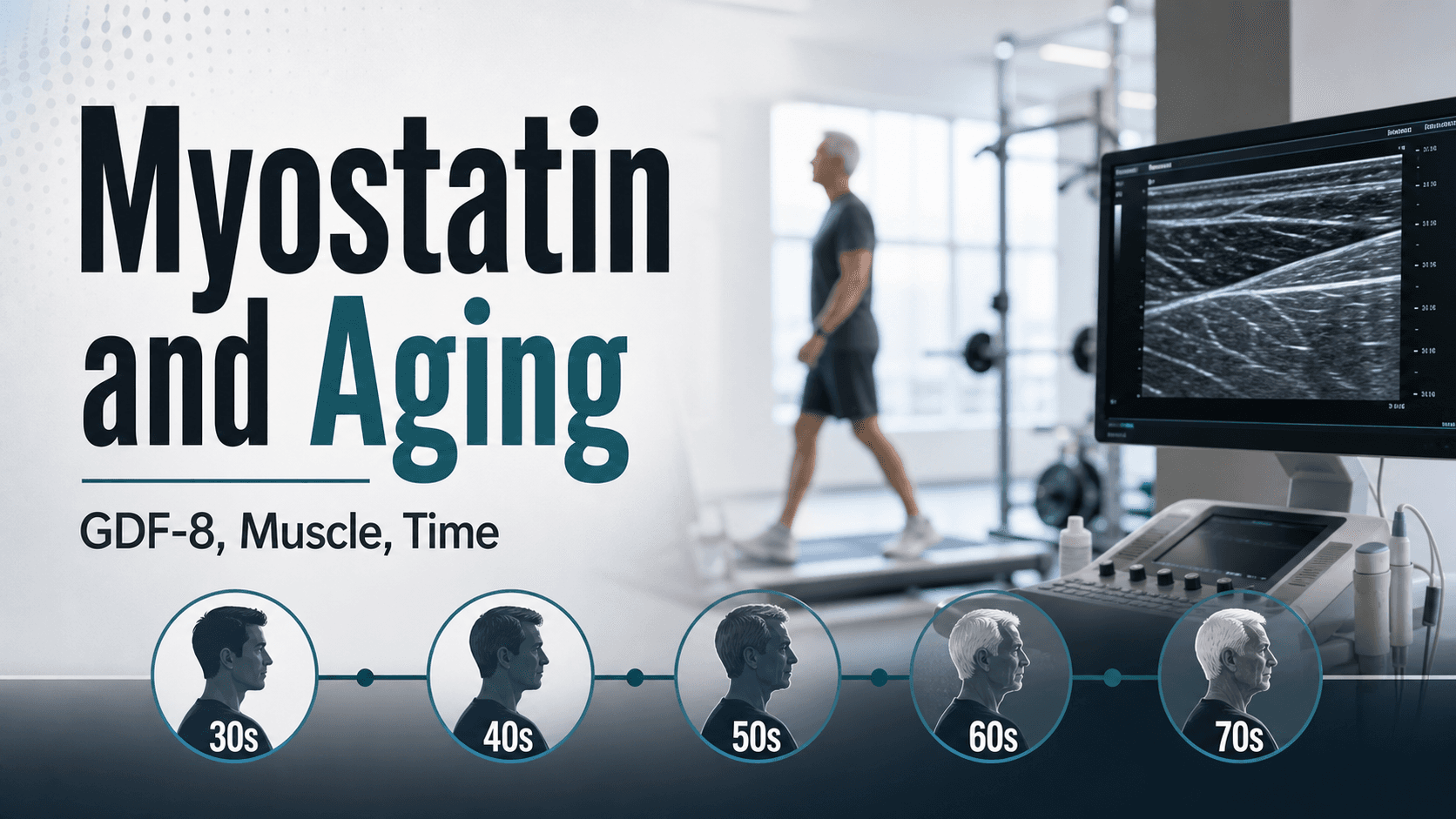
The chart is not a straight line. Myostatin and aging share a noisy relationship: some studies show it rising, others show it falling as muscle mass drops, and the bigger driver of strength loss is anabolic resistance, not myostatin alone.
Key takeaways
- Circulating myostatin with age is mixed: it rises in some cohorts, falls in others as muscle shrinks, and follows a U-shaped pattern in longitudinal cell models.
- The 2014 Health ABC study of 399 adults aged about 78 years found myostatin was largely unrelated to lean mass, grip strength, or walking speed — a sobering result.
- Anabolic resistance, protein quality, sleep, and inactivity drive more of the sarcopenia story than myostatin does alone.
- Resistance training and 1.2–1.6 g protein per kg per day still beat almost everything on the market.
- Drug candidates (bimagrumab, apitegromab, taldefgrobep alfa) target the pathway in older adults, with modest lean-mass gains but variable functional results.
Myostatin and aging at a glance
The picture is not what most blogs suggest. Headlines say "myostatin rises with age," but the real data is more mixed.
| Decade | Typical lean-mass change | What myostatin data suggests | What actually matters most |
|---|---|---|---|
| 30s | Lean mass usually peaks | Levels mostly stable | Training consistency, sleep |
| 40s | Slow 0.3–0.5% yearly drop without training | Mild upward drift in some cohorts | Protein intake, recovery |
| 50s | Acceleration starts, especially after menopause for women | Activin A rises alongside myostatin | Resistance training, hormonal status |
| 60s | 1–2% lean mass per year if sedentary | Mixed: some studies show rise, others find low myostatin with low muscle mass | Anabolic resistance, mobility |
| 70s+ | Sarcopenia risk climbs sharply | Health ABC study: no clear link between myostatin and function | Falls prevention, protein, training |
That table is not pessimism. It is the honest read.
For pathway basics, see the myostatin overview and the myostatin protein primer. For sex-specific notes, read myostatin in women.
What myostatin actually does as you age
Same molecule, changing context. Myostatin (also called GDF-8) is a TGF-β family protein that slows muscle-fiber growth and satellite-cell activation.
In youth, training drops it temporarily, food and protein blunt it, and the muscle response is brisk. With age, two things shift:
- Muscle becomes less responsive to the same anabolic signals (anabolic resistance).
- Inflammation, oxidative stress, and inactivity all push the system toward atrophy.
Myostatin sits inside that loop, but it is not the loop itself. That is one reason a "block myostatin" supplement rarely produces dramatic results in older adults outside of clinical trials.
The GDF-11 confusion
A clean origin story would help, except history is messy. Around 2013–2015, a series of high-profile papers suggested GDF-11, a close cousin of myostatin, was a "rejuvenation factor" that fell with age.
Within two years, other labs showed the original assays were cross-reactive: they were partly measuring myostatin too. The rejuvenation claim partially collapsed, and the field is still arguing over what GDF-11 actually does with age.
The practical takeaway is narrower than the headlines. Many older "myostatin rises with age" claims may have been GDF-11 measurements in disguise. Read the assay methods before believing the trend line.
Anabolic resistance: the bigger story
This is the part that does not fit on a supplement label. Anabolic resistance means an older muscle needs more protein, more leucine, and a stronger training stimulus to switch on the same amount of muscle-protein synthesis.
A young adult might max out muscle-protein synthesis with 20 g of high-quality protein. An older adult often needs 30–40 g, with more leucine and a training stimulus close in time.
Pile that on top of:
- Reduced postprandial blood flow to muscle.
- Higher chronic inflammation (so-called inflammaging).
- Smaller satellite-cell pool.
- Vitamin D shortfalls.
- Mitochondrial decline.
Suddenly myostatin is one switch among many. Lowering it without addressing the rest is like opening a single window in a building with five other leaks.
What the Health ABC study found
The big surprise was that the link broke. The Health, Aging, and Body Composition study followed older adults with detailed body composition and function metrics. A 2014 substudy measured myostatin in 399 adults around age 78.
The findings were uncomfortable for the "block myostatin and you will rebuild" story:
- Myostatin was not associated with lean mass.
- Myostatin was not associated with grip strength.
- Myostatin was not associated with walking speed.
- Myostatin was not associated with thigh cross-sectional area.
Higher myostatin quartiles were actually linked to slightly higher muscle density (about a 3 percent gap), the opposite of what most models predicted. So circulating myostatin is a poor single marker for sarcopenia risk in real-world older adults.
That is consistent with newer reviews where Activin A, IL-6, and exercise responsiveness all carry more weight than any single TGF-β family ligand.
The U-shape: a more honest model
A 2024 longitudinal cell study from the Basque Country group offered a useful reframing. Using a C2C12 myogenic cell aging model, they tracked myostatin, follistatin, mTOR, and RPS6KB1 over time.
The pattern looked like a U-shape:
- Myostatin: basal — up — down.
- Follistatin: basal — down — up.
- mTOR and downstream regulators: similar non-linear curves.
That fits the clinical picture better than a straight line. In early sarcopenia, myostatin can rise. In advanced sarcopenia, muscle is so atrophic it produces less of everything, including myostatin. A "low myostatin" reading in an 80-year-old is not a win, it can be a sign of severe muscle loss.
What actually works at every age
The boring stuff still wins. The same levers move myostatin, follistatin, and the rest of the pathway in the right direction, even in your 70s:
| Lever | Why it works | What it costs |
|---|---|---|
| Resistance training, 2–3x weekly | Drops myostatin, raises follistatin, fights anabolic resistance | A gym membership or a small home setup |
| Protein 1.2–1.6 g per kg per day | Supports muscle protein synthesis around the lower-response curve | Mostly food; whey or casein if needed |
| Creatine 3–5 g daily | Improves strength, hydration, and possibly satellite-cell activity | Cheap |
| Vitamin D to a normal level | Many older adults are low; deficiency worsens muscle quality | Bloodwork plus supplementation |
| Omega-3, 2 g daily | Slightly reduces anabolic resistance in older adults | Modest |
| Sleep 7–9 hours | Underrated; recovery and IGF-1 depend on it | Free |
| Stop smoking, limit alcohol | Both raise inflammation and inflate muscle loss | Hard but real |
Anyone selling a single pill for sarcopenia in your 70s is overselling what we know.
Lifestyle vs supplements: realistic ranking
Order matters. The first six items above outperform almost any supplement chasing the myostatin angle:
- Natural myostatin inhibitors such as cocoa or green tea can fit a healthy diet, but they should not replace lifting and protein.
- Epicatechin has a small human pilot signal in middle-aged adults but no large outcome trial.
- Reducing myostatin naturally usually comes back to the same training, protein, sleep stack.
The supplement market often inverts that order because the basics do not pay clicks.
What is coming from the drug pipeline
The pipeline is moving, slowly. After years of underwhelming sarcopenia trials, the field is back to running larger studies, this time often paired with weight-loss drugs to protect lean mass:
- Bimagrumab — an activin receptor antibody. Older obesity trials showed roughly 20 percent fat mass loss and 4 percent lean mass gain over 48 weeks; new trials test it alongside GLP-1 drugs to limit muscle loss.
- Apitegromab — a selective anti-latent myostatin antibody for spinal muscular atrophy with positive 12 and 36 month data in the TOPAZ studies.
- Taldefgrobep alfa — in development for several muscle-wasting indications.
- LY2495655 — an earlier myostatin antibody tested in weak older fallers, with modest gait-speed effects.
None of these are reaching pharmacy counters as anti-aging tools any time soon. For an older adult today, the lifestyle stack is still the highest-yield play.
Sarcopenia, falls, and what to measure
If you are tracking aging muscle, do not chase myostatin labs. More useful markers in your 60s and 70s:
- Grip strength (a cheap and validated proxy).
- Five-times sit-to-stand time.
- Gait speed over 4 meters.
- DEXA-measured appendicular lean mass index.
- Bone mineral density if osteoporosis risk is present.
For pathway-curious readers, the myostatin blood test is available but rarely changes a treatment plan in non-research settings.
What the field still does not know
Open questions, honestly listed:
- Whether early intervention with anti-myostatin drugs in healthy 60-year-olds extends independence later.
- Whether myostatin-targeting therapy combined with GLP-1 drugs preserves lean mass without raising tendon or bone risks.
- Whether the U-shaped pattern shown in cell models will hold in a large human longitudinal study.
- Whether genetic low-myostatin variants confer real protection from sarcopenia in old age.
Watch how the next three years of trial data settle, not the next three years of supplement marketing.
Sources and notes
- Myostatin in Older Adults: the Health, Aging, and Body Composition (Health ABC) Study
- The Non-Linear Profile of Aging: U-Shaped Expression of Myostatin and Follistatin
- Frontiers: The role and mechanisms of myokines in sarcopenia (2025)
- Slowing or reversing muscle loss - Mayo Clinic
- Myokines and osteokines in aging-related degenerative diseases (ScienceDirect, 2025)
- Myostatin-driven muscle hypertrophy: a double-edged sword in muscle aging (Springer, 2025)
- Geriatric Syndrome — Bone Up, Muscle Up, and More with Myostatin Inhibition (NDNR)
Frequently Asked Questions
Does myostatin always increase with age?
No. Human data is mixed. Some cohorts show a rise, others find no change, and very atrophic older adults can have low myostatin alongside low muscle mass. A non-linear, U-shaped pattern fits the data better than a steady upward line.
Is sarcopenia caused by high myostatin?
No, not on its own. Anabolic resistance, inflammation, inactivity, hormone changes, and nutritional gaps all contribute. Myostatin is one of several signals, not the master switch.
Should older adults take myostatin-blocking supplements?
The evidence for visible muscle gain from over-the-counter "myostatin inhibitors" in older adults is thin. Resistance training, protein, creatine, and sleep deliver more reliably and cost less.
Will myostatin drugs reach pharmacies for aging?
Probably for specific conditions before broad anti-aging use. Apitegromab is closest for spinal muscular atrophy, and bimagrumab is being tested alongside GLP-1 drugs for obesity-related muscle loss. General anti-aging approval is not imminent.
What is the single best move for muscle aging?
Resistance training 2–3 times a week paired with adequate protein. If you only do one thing, do that.
This article is for educational purposes only and is not medical advice. Talk with a qualified healthcare professional before changing your training, supplements, or medications, especially if you have a chronic condition, take prescription drugs, or are managing sarcopenia, osteoporosis, or frailty.