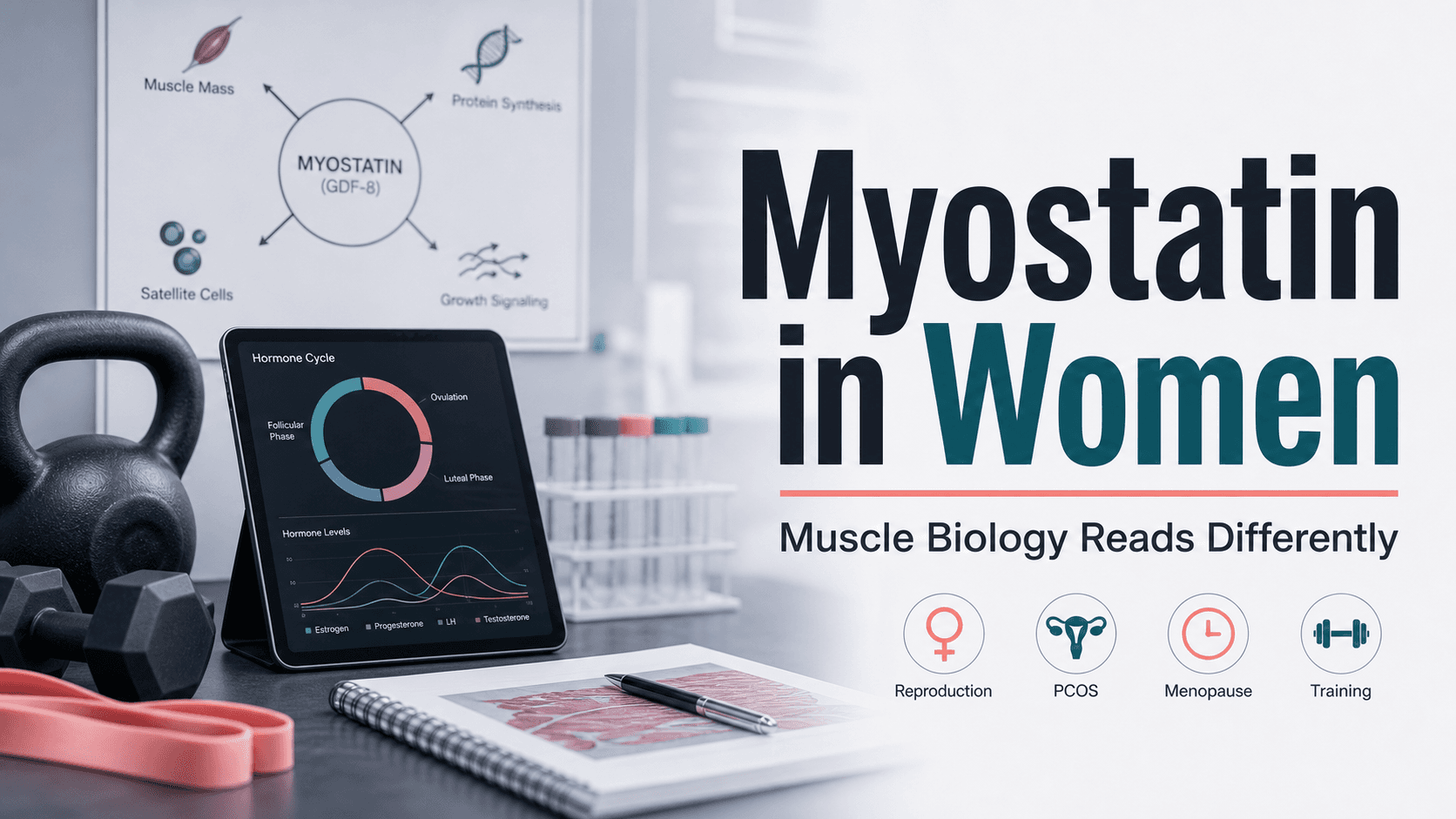
Female muscle biology reads differently. Myostatin in women is not just a smaller version of the male story. It also helps run the ovary, the pituitary, and the placenta.
Key takeaways
- Circulating myostatin in healthy women is usually similar to or slightly lower than in men, with sex hormones doing more of the heavy lifting for muscle differences.
- Myostatin is expressed in the ovary, granulosa cells, uterus, and placenta and helps regulate FSH, follicle growth, and oocyte maturation.
- PCOS, perimenopause, and pelvic floor weakness all shift myostatin levels in human data.
- Resistance training drops myostatin in women about as effectively as in men, but the visible muscle change is paced by estrogen, sleep, and protein intake.
- Anti-myostatin drug trials (bimagrumab, apitegromab) include women but rarely break out fertility outcomes — that gap matters for anyone planning a pregnancy.
Myostatin in women at a glance
Start with the baseline. Female circulating myostatin tracks closely with male levels in young, healthy adults, but the downstream story is different.
| Topic | What the data says | What it does not say |
|---|---|---|
| Resting blood levels | Similar to men in young adults; small sex differences in some assays | A "lower female level" alone does not explain smaller average muscle mass |
| Ovary and FSH | Myostatin in granulosa cells modulates FSH receptor and oocyte maturation | A blood myostatin value does not predict fertility on its own |
| PCOS | One Taiwan study of 239 women linked higher myostatin to waist circumference, BMI, and fasting glucose | Causation is not proven |
| Menopause | Myostatin and Activin A trend upward versus pre-menopausal women | Estrogen loss, not myostatin alone, drives most of the lean-mass drop |
| Training response | 8–12 weeks of resistance work lowers myostatin in mixed-sex trials | Drops do not always translate to large strength gains in untrained beginners |
| Anti-myostatin drugs | Bimagrumab and apitegromab trials enrol women, with weight and lean-mass gains reported | Long-term fertility data in young women is still thin |
The female story is not "less" myostatin biology. It is "more" places where the pathway matters.
For the broader pathway, read the myostatin overview and the myostatin protein primer. For age-specific notes, see myostatin and aging.
What myostatin actually does in women
It is the same molecule, with extra jobs. Myostatin (GDF-8) is a TGF-β family protein made mainly in skeletal muscle, but female tissue expresses it in places men do not have.
In the ovary it sits inside granulosa cells, the cells that wrap each developing follicle. There, it nudges follicle-stimulating hormone receptor levels and influences estradiol and progesterone output.
In the placenta it shows up in trophoblasts and helps regulate growth signals across the maternal-fetal interface.
In the uterus it has been detected in smooth muscle and may take part in myoma (fibroid) biology. None of that maps cleanly onto the lifter-focused "myostatin = brake on muscle" framing.
Resting blood myostatin: are women lower than men?
Not by much. In healthy young adults, serum myostatin overlaps heavily between sexes. Some assays show women a few percent lower, others show no difference at all.
The bigger drivers of female muscle mass are estrogen, testosterone, growth hormone, and IGF-1, not a structural myostatin gap. That is one reason a "low myostatin" supplement is rarely the right first lever for a woman who wants more muscle.
A more useful marker is the follistatin-to-myostatin ratio, which behaves a bit more dynamically with training and food.
The menstrual cycle and myostatin
This is small data, but worth flagging. A few studies have measured serum myostatin across the cycle and found mild fluctuations near the late follicular and early luteal phases, when estradiol and progesterone are shifting fastest.
Effect sizes are small (usually under 10 percent), and assay noise can swallow them. So if a tracker says your myostatin "spiked mid-cycle," do not treat that as a training disaster.
A more important practical question is whether the cycle changes how you respond to training. Strength data suggests the follicular phase tolerates volume slightly better for some women, but training adherence beats fine-tuned cycle programming for most goals.
Myostatin and PCOS
The PCOS link is the most studied female myostatin angle. Polycystic ovary syndrome affects up to one in ten women of reproductive age and combines insulin resistance, hyperandrogenism, and irregular cycles.
The Chen team in Taipei studied 239 women with PCOS against 38 controls. Average serum myostatin was not dramatically different across groups, but inside the PCOS group:
- Higher myostatin tracked with higher BMI and waist circumference.
- Higher myostatin tracked with higher fasting glucose.
- Myostatin was inversely related to follistatin and DHEAS levels.
A separate strand of work found elevated myostatin in granulosa cells from large antral follicles in obese PCOS women, but not lean PCOS women. So myostatin in PCOS looks more like a metabolic marker than a primary cause.
For women already managing PCOS, that means resistance training, protein intake, and insulin sensitization (diet, sleep, sometimes metformin under a clinician) still belong at the top of the list.
Pregnancy, fertility, and the FSH axis
This is where the story gets unfamiliar. A 2025 Science paper showed that muscle-derived myostatin acts as an endocrine driver of pituitary FSH synthesis. In other words, muscle is talking to the ovary through this molecule.
The early data shows that knocking out myostatin in mice reduces FSH and impairs ovarian function. That is one reason the lifter slogan "more is always better" does not translate cleanly: completely silencing myostatin in a young woman could plausibly nudge fertility.
So far human anti-myostatin drug trials have not flagged a clear fertility signal, but most enroled older adults or patients with neuromuscular disease, not women trying to conceive. If you are on or considering an anti-myostatin peptide and you want children, talk to a reproductive endocrinologist before continuing.
A separate finding worth knowing: MSTN levels in follicular fluid have been linked to IVF/ICSI pregnancy rates in small samples, but the result is preliminary.
Perimenopause and menopause
Levels drift upward, not by much. Comparing post-menopausal to pre-menopausal women, several studies show modestly higher circulating myostatin and Activin A.
That fits the bigger picture: lean mass drops about 3–8 percent per decade after menopause without resistance training, grip strength falls, and oxidative stress climbs. Myostatin is one of several signals nudging in the wrong direction.
What changes the slope is well-documented:
- Two to three resistance sessions a week protect lean mass and strength.
- Protein at 1.2–1.6 g per kg per day, spread across meals, supports the response.
- Hormone therapy, where appropriate, slows several of the same processes.
- Vitamin D, sleep, and creatine each add small but real margins.
A flat 49 percent rise in the follistatin-to-myostatin ratio (as seen with epicatechin in a tiny human pilot) is interesting but not a substitute for those basics.
Pelvic floor: a smaller, surprising signal
This one rarely makes the gym blogs. A 2024 Italian study of 19 women with urinary incontinence used flat magnetic stimulation for eight sessions and saw serum myostatin drop along with shorter genital hiatus length and lower bother-questionnaire scores.
It is a quasi-experimental, single-arm study, so the effect is not pinned to magnetic stimulation alone. But it points to a real pattern: when pelvic floor muscle activity rises, local myostatin signaling falls, just like in a quadriceps that starts training again.
If you are dealing with stress incontinence after birth or in perimenopause, this is one more reason pelvic floor strength training (Kegel work, physio-led programs) is worth the effort.
How training changes myostatin in women
The training response is broadly similar to men. Across mixed-sex trials, 8–12 weeks of resistance training drops resting myostatin around 20–37 percent, with follistatin rising in parallel.
Endurance training also lowers myostatin, but with smaller effects on muscle size. Combined training tends to win.
Practical numbers for a woman starting fresh:
| Variable | Useful starting point |
|---|---|
| Resistance sessions per week | 2–3 |
| Sets per major muscle group per week | 8–12, working up to 15–20 |
| Reps per set | 6–15 depending on goal |
| Protein per day | 1.2–1.6 g per kg body weight |
| Creatine monohydrate | 3–5 g daily, year-round |
| Sleep | 7–9 hours, with consistent timing |
Those levers move myostatin and muscle in the same direction without any peptide or supplement marketed around the pathway.
Anti-myostatin drugs and what they show in women
Female sub-analyses are sparse but informative. Three families of agents are worth knowing:
- Bimagrumab — an ActRII antibody now being tested for obesity. Mixed-sex phase 2 trials reported around 20 percent fat mass loss and 4 percent lean mass gain over 48 weeks, with women showing similar effects.
- Apitegromab — a selective anti-pro/latent myostatin antibody for spinal muscular atrophy. The TOPAZ studies enroled both sexes, with motor-function gains over 12 to 36 months.
- Taldefgrobep alfa and garetosmab — earlier-stage programs with smaller female-specific datasets.
None of these are approved for cosmetic muscle gain, and they are not first-line tools for healthy women.
Peptide myostatin inhibitors and fertility considerations
This is the part most internet conversations skip. Myostatin inhibitor peptides marketed online (often labeled "MYO-029-like" or "MSTN inhibitor") are unregulated, frequently mislabeled, and not third-party tested for purity.
For a woman of reproductive age, three concerns stack up:
- Suppressing myostatin chronically may reduce FSH signaling, which could affect cycle regularity.
- There is no long-term safety data in women in any structured program.
- Stacking these with follistatin peptides compounds the unknowns.
If you are post-menopausal and dealing with sarcopenia, the risk math is different — but it is still not a casual decision. A clinician-monitored plan beats a Reddit thread.
What we still do not know
Several questions stay open. The honest list:
- Whether mid-cycle myostatin shifts meaningfully change training adaptation.
- Whether pregnancy alters circulating myostatin in a way that matters for postpartum recovery.
- Whether long-term anti-myostatin therapy affects bone mineral density differently in women.
- Whether HRT changes the myostatin response to training at menopause.
Anyone who tells you these are settled is overselling the evidence.
Sources and notes
- Myostatin: a multifunctional role in human female reproduction and fertility (Springer review, 2022)
- The relationship between myostatin, abdominal obesity, androgen and follistatin in women with PCOS
- Muscle-derived myostatin is a major endocrine driver of follicle-stimulating hormone (Science, 2025)
- The role of myostatin in female fertility - News-Medical.net
- Myostatin Changes in Females with UI after Magnetic Stimulation
- Myostatin: a multifunctional role in human female reproduction (PMC version)
Frequently Asked Questions
Do women have lower myostatin than men?
In young healthy adults, circulating myostatin is similar across sexes. Small assay-level differences exist, but the female-male gap in muscle mass is driven mostly by sex hormones, not by baseline myostatin.
Does myostatin affect fertility in women?
Probably yes, through the FSH axis and direct ovarian effects. Animal data and small human studies link myostatin to follicle development and IVF outcomes, though no woman should rely on a blood myostatin test as a fertility marker on its own.
Should women in menopause use myostatin-blocking peptides?
Not as a first move. Resistance training, protein intake, creatine, sleep, and (where appropriate) hormone therapy do most of the work. Unregulated peptide use carries safety and labeling risks that outweigh the small theoretical gain.
Does myostatin go up in PCOS?
Higher myostatin in PCOS tracks with higher BMI, waist circumference, and fasting glucose, especially in obese PCOS. Lean PCOS may not show the same shift, and myostatin looks more like a metabolic readout than a primary cause.
Can women take creatine if they are worried about myostatin?
Yes. Creatine monohydrate is one of the best-studied supplements in women, supports training adaptation, and does not raise myostatin levels.
This article is for educational purposes only and is not medical advice. Talk with a qualified healthcare professional before changing training, supplements, or any prescription regimen, especially during pregnancy, fertility planning, perimenopause, or while managing PCOS or any chronic condition.