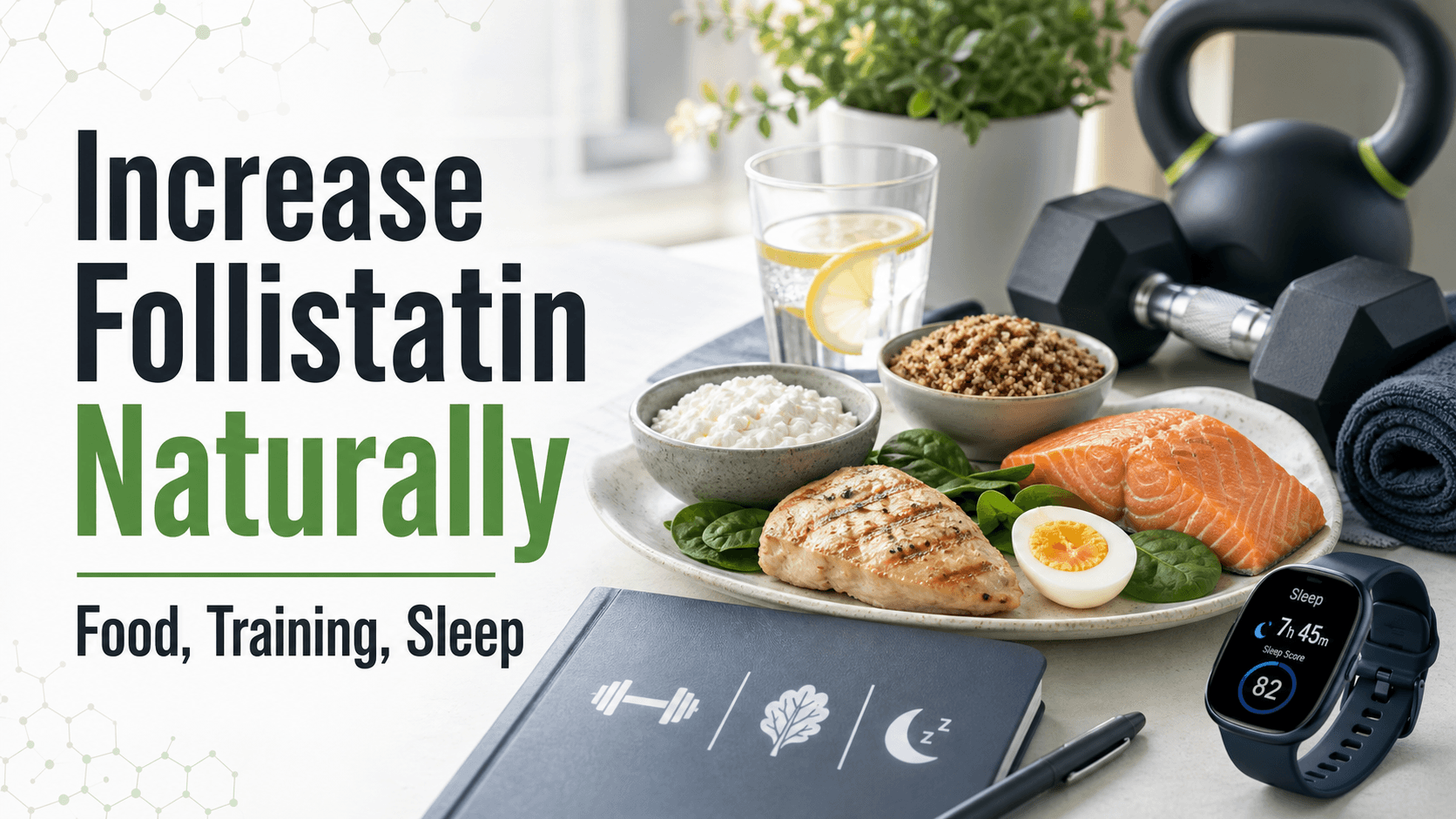
The honest answer is small. You can move follistatin naturally with heavy training, decent sleep, and a couple of supplements, but the ceiling on those moves is modest compared to a peptide or gene-therapy effect.
Key takeaways
- Heavy resistance training is the strongest natural lever. A 2025 trial showed roughly a 28% rise in circulating follistatin after combined aerobic and resistance training in older adults.
- Acute hard exercise can spike plasma follistatin up to about seven-fold during recovery, but the elevation fades within 24 hours, so consistency beats one heroic session.
- Sleep and the day-night circadian rhythm of follistatin matter more than most articles admit. Short or fragmented sleep blunts the post-exercise rise.
- Epicatechin from cocoa or green tea has the only direct human signal — a 49% rise in the follistatin-to-myostatin ratio in a six-person pilot — but the trial is tiny.
- Even stacked perfectly, "natural" methods produce a small fraction of the muscle change seen with [follistatin gene therapy](/blog/follistatin-gene-therapy) or peptide protocols. Anyone selling you "natural follistatin gains" of 20–30 lbs is selling fiction.
Natural follistatin levers at a glance
Start with the scale. The methods are real. The size of the effect is what most articles get wrong.
| Lever | Best evidence | Realistic effect size | Time to show up |
|---|---|---|---|
| Heavy resistance training | RCT in 62 older adults, follistatin rose from 50.5 to 64.8 ng/mL (~28%) over the training block | Moderate, consistent rise with progressive training | Weeks to months |
| Acute hard cardio (long cycling) | ~7-fold plasma follistatin peak during recovery | Large but transient, gone within 24 hours | Same-day spike only |
| Sleep, 7–9 hours, regular schedule | Cortisol suppression and circadian alignment | Permissive, not causal — blunts post-exercise rise if poor | Cumulative |
| Epicatechin (cocoa, green tea) | 25 mg twice daily for 7 days raised follistatin-to-myostatin ratio ~49% in 6 adults | Small, signal-only | 5–7 days |
| Protein and leucine | Permissive for muscle protein synthesis | Supports the training effect, not a direct follistatin driver | Days |
| Vitamin D sufficiency | Observational links to muscle quality and TGF-β family signaling | Modest, mainly for the deficient | Weeks |
| Sulforaphane (broccoli sprouts) | Indirect Nrf2 and TGF-β modulation | Speculative for follistatin specifically | Unclear |
| Short fasts plus training | One study, fasted exercise raised follistatin more than fed | Small additional lift on top of training | Same-session |
For background on the protein itself, read the follistatin overview and the follistatin peptide explainer.
Resistance training is the strongest natural lever
Train hard or do not bother. The clearest natural driver of circulating follistatin is heavy, progressive resistance training.
A 2025 randomized trial across two assisted-living facilities put 62 older adults through about three sessions per week of mixed aerobic walking at 50–70% of max heart rate plus resistance training at 50% of one-rep max. Serum follistatin in the exercise group rose from 50.52 ± 24.35 ng/mL at baseline to 64.79 ± 32.35 ng/mL — roughly a 28% increase with a strong effect size (η² = 0.368). The control group did not move.
A separate meta-analysis on resistance training across age groups found the same direction of effect more reliably than any nutritional intervention. The pattern is consistent: train, recover, train, recover, and the follistatin-to-myostatin ratio drifts in the muscle-building direction.
Practical implications:
- Compound lifts — squats, deadlifts, presses, rows — recruit the most muscle mass and produce the largest acute signal.
- Eccentric overload (slow lowers, heavy negatives) produces measurable follistatin elevation for hours after the session.
- Progressive overload matters more than novelty. The training adaptation is what shifts the chronic ratio.
If progressive overload is the engine, see the reduce myostatin naturally page for the matching myostatin side of the equation.
The post-exercise follistatin spike
The acute response is dramatic. One cycling study reported about a seven-fold rise in plasma follistatin during recovery from extended intense exercise. That sounds like a miracle until you read the half-life.
The spike fades within 24 hours. By the next morning, follistatin is back near baseline. The chronic adaptation — the part that matters for muscle building — comes from doing this often enough that the trough between sessions never falls all the way back.
That is why training frequency beats training heroics. Three to four hard sessions a week produce a higher chronic average than one massacre per week followed by five days of nothing.
Sleep and the circadian rhythm of follistatin
This is the part most articles skip. Circulating follistatin has a measurable day-night rhythm, with overnight changes tied to cortisol, growth hormone, and the timing of fasting.
Two practical points fall out of that:
- Short or fragmented sleep raises cortisol. Cortisol suppresses anabolic signaling and blunts the post-exercise follistatin rise the next day.
- Regular sleep timing matters as much as total hours. A consistent 7–9 hour window keeps the rhythm aligned. Bouncing between five-hour and ten-hour nights does not.
The sleep lever is permissive, not causal. It does not directly raise follistatin. It removes the ceiling that bad sleep puts on every other lever.
For lifters who chase numbers, the cheapest "supplement" in this list is going to bed thirty minutes earlier.
Epicatechin: the only direct human signal in food
This is the one supplement with a real human signal. The widely cited pilot study gave six middle-aged adults 25 mg of pure (-)-epicatechin twice daily for seven days and reported a roughly 49% increase in the plasma follistatin-to-myostatin ratio along with about a 7% bilateral rise in hand-grip strength.
That is a small study. Six people, no placebo arm, one week. It is a signal, not proof.
Food sources of epicatechin include:
- Cocoa powder (the densest source).
- Dark chocolate at 70%+ cocoa.
- Green tea, especially Japanese green teas brewed strong.
- Apples, including the peel.
- Blackberries, raspberries, and pomegranates.
The honest read: a daily cup of strong green tea and a square of dark chocolate is a low-friction add-on that fits a normal diet. A supplement-grade pure epicatechin capsule mimics the trial dose but does not yet have a larger blinded study to back it up. The detailed picture lives in the epicatechin and myostatin review.
Fasting, cortisol, and the training window
This one is small but consistent. A study in healthy males found that exercise performed during a fasting window raised follistatin more than the same exercise performed fed.
The mechanism is plausible: lower insulin, slightly higher cortisol, and a metabolic state that biases toward fat oxidation and growth-hormone pulses. Combine that with a hard training session and the acute follistatin response shifts up.
The size of the effect is modest, and it is not a license to train fasted forever. Strength tends to suffer in long fasted blocks, and chronic high cortisol works against everything else in this list. A reasonable application is one or two morning sessions per week done before breakfast, not every session.
Protein, leucine, and why food alone will not move the needle much
Food is permissive, not driving. There is no direct evidence that eating more protein, more leucine, or more of any single food chronically raises follistatin in healthy adults.
What protein does is feed the muscle-protein-synthesis side of the equation that the training-driven follistatin rise unlocks. Hitting roughly 0.7 to 1.0 grams of protein per pound of body weight per day, spread across three to four meals with 30 to 50 grams of high-leucine protein each, supports the training adaptation that actually shifts the ratio.
Egg yolks deserve a separate mention because they show up on every natural-follistatin list. A specific supplement called MYO-X used a fertilized egg-yolk extract at 10 grams daily for eight weeks alongside resistance training in college-age men and reported greater lean-mass gains than placebo. That is interesting, but it is a single product study, and a daily egg or two on top of a normal diet does not replicate it.
Vitamin D, sulforaphane, and the supplements with weaker signals
Two compounds show up often in natural-follistatin lists with thinner evidence:
- Vitamin D. Deficiency is associated with worse muscle quality and altered TGF-β family signaling. Correcting a deficiency probably helps. Stacking on top of an already-sufficient 25(OH)D level probably does not move follistatin further.
- Sulforaphane (from broccoli sprouts or supplements). Activates Nrf2 and modulates TGF-β signaling in cell systems. Direct evidence for follistatin elevation in humans is essentially absent.
A practical read: get vitamin D into the 30–50 ng/mL range if a blood test says you are low, eat broccoli sprouts because they are useful for other reasons, and do not expect either to outwork training.
What the natural ceiling actually looks like
This is the part that needs to be said clearly. Stack every natural lever in this article perfectly — heavy training four times a week, 8 hours of sleep, 25 mg of epicatechin twice daily, occasional fasted morning sessions, sufficient protein, vitamin D in range — and the muscle-mass effect over six to twelve months is a few pounds of lean mass beyond what training alone would have produced.
That is a real result. It is also a small one compared to what muscle-pathway intervention can do.
Published reports on follistatin gene therapy in human and non-human primate work show muscle-mass changes that are an entire order of magnitude larger than anything diet and training have produced. Peptide protocols sit somewhere between the two, with smaller effect sizes than gene therapy and larger ones than food.
The point is not to discourage the natural path. The point is to set the right expectation before someone spends $400 on cocoa extract hoping for a 20-pound transformation. The natural ceiling is real, and the marketing ceiling is not.
For the comparison the other way, the best myostatin inhibitor page lines up the pharmacological options.
A weekly stack that actually fits a normal life
Skip the heroics. The version that works for most lifters looks like this:
| Day part | What to do | Why |
|---|---|---|
| Morning, 4x/week | 45–75 min resistance training, compound lifts, progressive overload | The main follistatin driver |
| 1–2 of those sessions | Done fasted before breakfast | Small additive lift on the acute response |
| Daily | 7–9 hours of sleep on a consistent schedule | Removes the cortisol ceiling on every other lever |
| Daily | One cup of strong green tea and 20–30 g of 70%+ dark chocolate, or 25 mg pure epicatechin twice daily | The one supplement with a real human signal |
| Daily | 0.7–1.0 g/lb of protein in 3–4 meals, vitamin D corrected if low | Permissive, not driving |
| Optional, 1x/week | Long-duration moderate-intensity cardio (60+ min cycling or hiking) | Drives the large acute follistatin spike on top of resistance work |
That is the stack. There is nothing exotic in it. The boring version is the one that works.
Sources and notes
- Effects of (-)-epicatechin on molecular modulators of skeletal muscle growth and differentiation
- The Effect of Exercise on Spexin and Follistatin in Older Adults (RCT, 2024)
- The effects of resistance training on myostatin and follistatin — meta-analysis
- The Effects of Dietary Supplements, Nutraceutical Agents, and Physical Exercise on Myostatin Levels
- 4 Benefits of Follistatin + Side Effects — SelfHacked
- How Can Follistatin Be Increased? — Factually.co
- How to Increase Follistatin Naturally for Muscle Growth — Biology Insights
- Follistatin: Grow Muscle, Fight Fat — Dave Asprey
Frequently Asked Questions
How much can I actually raise follistatin naturally?
A consistent resistance-training program plus decent sleep can raise circulating follistatin in the range of 20–30% over a training block, based on the older-adult RCT data. Acute post-exercise spikes are much larger but transient.
What is the single most effective natural method?
Heavy progressive resistance training. No food, supplement, or sleep change has produced the same chronic shift in the follistatin-to-myostatin ratio in published human studies.
Does dark chocolate really increase follistatin?
The 49% follistatin-to-myostatin ratio rise was reported in a six-person pilot using 25 mg of pure (-)-epicatechin twice daily for seven days. Dark chocolate contains epicatechin, but the dose-per-gram varies and the human evidence remains small.
Will fasted training raise my follistatin more than fed training?
One study in healthy males suggested fasted exercise produced a slightly larger acute follistatin response than fed exercise. The effect is small and not worth training fasted every session if it costs you strength.
Can natural follistatin methods replace a peptide or gene therapy?
No. The muscle-mass effect from training plus food sits at a fraction of what published peptide protocols and gene-therapy reports produce. The natural ceiling is real and modest.
How long until I see results from this stack?
Acute follistatin spikes happen within hours of a hard session. Measurable changes in chronic circulating follistatin appear over 8 to 12 weeks of consistent training. Visible muscle-mass changes track the underlying training adaptation, not the follistatin number itself.
This article is for educational purposes only and is not medical advice. Talk with a qualified healthcare professional before starting a new training program, fasting protocol, or supplement, especially if you take medications or have a diagnosed condition affecting blood pressure, glucose, liver, kidney, or heart health.